

Most software projects are treated as finished the day they go live, yet that is when the real work starts. Documentation is incomplete, access sits in the developer's personal accounts, and only one person knows the secrets. Closing a software project and handing it over is how you close that gap in a controlled way: from acceptance and post-launch support to the handover of documents, code and access, the move to a maintenance agreement, and the lessons learned.
This guide covers the closure stages, closure criteria, the handover checklist, the order of access and secret handover, managing the support window, cost analysis, and the cost gap between a good and a poor handover. All figures are representative, not industry averages or real project data. For legal matters, consult your legal counsel.
What Is Software Project Closure?
Project closure is the formal end point where the work is accepted, the system is handed to the business, open issues are written down and lessons are recorded. Acceptance says "the product does what we asked"; closure says "our team can run the product on its own."
If the team disbands after acceptance, knowledge disbands with it. We explain how to structure the acceptance test in our user acceptance testing guide; this article picks up after that test.
We recommend reading: What is the software development life cycle? Stages, models and how to choose
What Stages Does Closure Include?
Five stages are enough: acceptance, hypercare, handover, a closure meeting and a lessons-learned session. Durations are representative and vary with project size.
| Stage | Output | Typical duration |
|---|---|---|
| 1. Acceptance | Signed acceptance record | 1–2 weeks |
| 2. Hypercare (live support) | Request curve and exit decision | 2–4 weeks |
| 3. Handover | Completed handover checklist | In parallel with hypercare |
| 4. Closure meeting | Closure minutes | 1 session |
| 5. Lessons learned | Action list and project archive | 1 session plus follow-up |
When Is a Project Considered Closed? Closure Criteria
Closure criteria are written in advance and measured in numbers. The table shows the state of a representative dealer portal project at its closure meeting.
| Criterion | Threshold | Example status | Decision |
|---|---|---|---|
| Open items that block closure | 0 | 2 items closed, 0 left | Met |
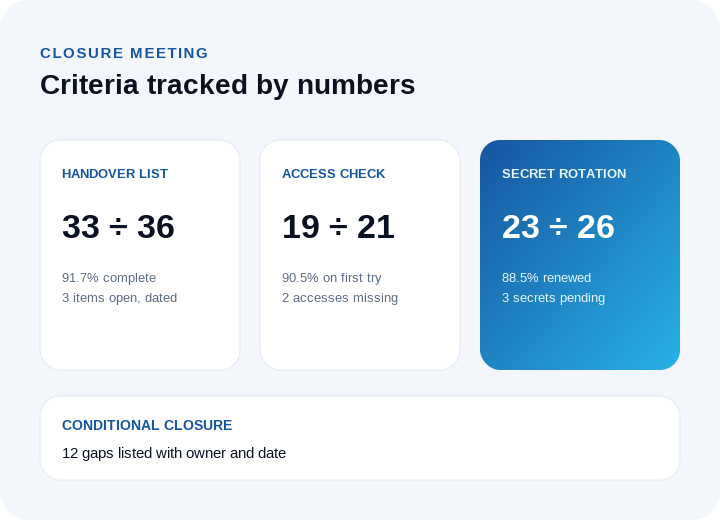
| Handover checklist | 36 ÷ 36 | 33 ÷ 36 = 91.7% | 3 items open, dated |
| Access handover (new owner verified) | 21 ÷ 21 | 21 ÷ 21; old access closed 17 ÷ 21 | 4 closures pending |
| Secret rotation | 26 ÷ 26 | 23 ÷ 26 = 88.5% | 3 secrets pending |
| Training completion | 90% or more | 14 ÷ 16 = 87.5% | Make-up session |
| Maintenance agreement | Signed | Signed | Met |
Four criteria were not fully met, so you either postpone closure or do a conditional closure. In a conditional closure every gap is written down with an owner and a date; here 3 + 4 + 3 + 2 = 12 items (handover, access closure, secrets, training gaps) go on the list. How the criteria relate to payment is set in the contract; consult your legal counsel.
What Belongs on a Handover Checklist?
The list has nine areas, and each needs concrete evidence. In the example each area has four items: 9 × 4 = 36. We cover document content in our software documentation guide; here we only check the delivery.
| Area | Check question | Evidence |
|---|---|---|
| Code repository | Is the repository in the company's own account, and who owns it? | Screenshot of repository settings |
| Environments and access | Does every environment have a known owner and administrator? | Access list |
| Secrets | Is there an inventory of passwords, keys and tokens? | Inventory and rotation date |
| Domain, certificates, subscriptions | In whose name are they registered, and when do they expire? | Account owner and expiry calendar |
| Third-party licences | Were component and service licences transferred to the business? | Licence list and contract |
| Backup and restore | Did the business itself try a restore? | Test record |
| Monitoring and alerts | Have dashboards and alert recipients moved to the business? | Recipient list |
| Operations manual | Can a newcomer bring the system up with the manual? | Trial run with the manual |
| Known issues | Are the impact and workaround of each known issue written down? | Current list |
Domain and subscription accounts are the most often forgotten; a domain registered under a developer's personal account can take a site down when a renewal email is missed. Write backup expectations using the RPO and RTO concepts in our data backup guide.
In What Order Are Access and Secrets Handed Over?
The order is: give the new owner access, verify that it works, and only then close the old access. Swapping everything at once leaves nobody able to open the system if the receiving side hits a problem.
- Inventory: List all access and secrets. The example has 21 accesses and 26 secrets.
- Grant to the new owner: Corporate accounts and authorised people are defined.
- Verify: The new owner uses every access without developer help. On the first try 19 ÷ 21 = 90.5% worked; 2 had a missing sharing setting. Closing everything at once would have locked those two (9.5%).
- Close the old access: The development team's accounts and keys are closed.
- Rotate secrets: Every secret the development team knew is renewed.
- Record it: Date, who did it and who verified it are written down.
In the rotation, a new value is created first, the consuming component is updated next, and the old value is revoked last. Secrets shared with a third party depend on the other side's approval; the 3 pending secrets in the example are of this kind. For access design, see our role-based access control guide.
How Is the Post-Launch Support Window Managed?
Request volume should fall quickly; if it does not, the problem is in the delivery. The window typically lasts 2–4 weeks, and the exit decision is tied to a threshold.
| Week | Requests | Share of total |
|---|---|---|
| 1 | 40 | 45.5% |
| 2 | 25 | 28.4% |
| 3 | 12 | 13.6% |
| 4 | 6 | 6.8% |
| 5 | 5 | 5.7% |
| Total | 88 | 100% |
The exit rule in the example: weekly requests at 8 or fewer for two weeks in a row, and no open high-priority request. Weeks 4 and 5 (6 and 5) meet it, so the window closes at the end of week 5. From week 1 to week 4 there is an (40 − 6) ÷ 40 = 85% decline.
The request type is informative too. Of the 88 requests, 41 were usage questions, 19 data corrections, 17 defects and 11 access requests (41 + 19 + 17 + 11 = 88). Usage questions and access requests stem from missing documents or training; they are 52 ÷ 88 = 59.1% of the total. Defects are only 17 ÷ 88 = 19.3%. The load is about handover quality, not code. For the moment an incident hits, see our incident management guide.
How Are Open Items Managed?
Having open items at closure is normal; having items without an owner or a date is not. Split each item into a closure blocker or a carried-over task. In the example there were 14 items: 2 closure blockers (closed), 9 carried-over tasks (owner, priority and date written down) and 3 out-of-scope requests (recorded with the reason). The known issues list is the first document the receiving team opens.
How Are Training and Shadow Support Done?
Training is run separately by role; in shadow support the work belongs to the receiving team, and the developer only watches and guides. In the example 12 users and 4 IT staff, 16 people in all, took four hours of training: 16 × 4 = 64 person-hours × ₺300 = ₺19,200. Only 14 attended, so completion stayed at 87.5%; since the threshold is 90%, a make-up session was planned. We cover measuring training and adoption in our software adoption guide.
Shadow support lasts the first 30 days. Of 20 work items a week, the developer did 14, 9, 5 and 2: dependency of 70%, 45%, 25% and 10% (total 30 ÷ 80 = 37.5%). The target is below 15% in week four. Developer effort was 16, 8, 4 and 2 hours, 30 hours in total: 30 × ₺1,125 (₺9,000 per day ÷ 8) = ₺33,750. If dependency does not fall, documentation or training is lacking and shadow support is extended.
Who Is Responsible After the Move to Maintenance? A RACI Matrix
After closure there must be a written answer to "who looks after what?" R means responsible, A accountable, C consulted and I informed.
| Task | Developer | Business (product owner) | IT |
|---|---|---|---|
| Defect fixing | R | A | C |
| New feature request | C | A / R | I |
| Access and permission management | I | A | R |
| Backup and restore test | C | I | A / R |
The difference between warranty and maintenance and the service level measures are in our maintenance agreement guide. The maintenance fee is recalculated on the actual cost: ₺720,000 × 15% = ₺108,000 per year. The final payment and the release of any retained amount depend on the contract; consult your legal counsel.
How Is Actual Project Cost Analysed?
At closure, compare planned and actual effort and split the difference by cause. The aim is not to find a culprit but to improve the next estimate. In the example the plan is 73 person-days and the actual is 80.
| Item | Person-days | Amount (₺9,000 per day) |
|---|---|---|
| Planned effort | 73 | ₺657,000 |
| Approved scope changes (2 requests) | +6 | +₺54,000 |
| Rework after the acceptance round | +4 | +₺36,000 |
| Extra integration estimate error | +3 | +₺27,000 |
| Savings from reused components | −6 | −₺54,000 |
| Actual | 80 | ₺720,000 |
The overrun is 80 − 73 = 7 person-days, or 7 ÷ 73 ≈ 9.6%; in money ₺720,000 − ₺657,000 = ₺63,000. The gross increase is 6 + 4 + 3 = 13 person-days, and reused components offset 6 of them. Ten of those 13 come from scope changes and rework; the rework rate is 4 ÷ 80 = 5.0%. For the contractual side of extra fees, consult your legal counsel. For how estimates are built, see our software development cost guide.
How Is a Lessons-Learned Meeting Run?
Blamelessly: the question is not "who did it?" but "why did the system allow it?" A 90-minute meeting with eight people is 12 person-hours, or ₺3,600; far less than the cost of one repeated mistake.
The agenda is four questions: what went well, what was unexpected, what will we change (at most 5 actions, each with an owner and a date), and what carries over to the next project.
Keep decision rationale in short decision records (ADRs); the archive should hold the contract, acceptance record, handover list, closure minutes and lesson notes together. To manage risk from the start, our risk management guide helps.
A short five-question survey is enough to measure satisfaction (1–5 scale): communication, delivery quality, documentation and training, schedule and budget, confidence in maintenance. In the example 12 of 16 people replied (75%); the averages were 4.3, 4.0, 3.6, 4.5 and 4.1, an overall average of 20.5 ÷ 5 = 4.1. The lowest score is documentation and training (3.6); that is the first item on the action list. The aim is to find the weak link.
How Are the 90 Days After Closure Tracked?
Handover success shows after 90 days; run short checks at days 30, 60 and 90. Two measures are enough: handover-caused requests in the first 90 days (in the example only 6 requests in the 60 days after the window, 3 per month) and the share of work that depends on the developer in the first 30 days. If both fall, the business has taken ownership; at day 60 also review the first maintenance report.
What Is the Cost Gap Between a Good and a Poor Handover?
The comparison below is representative and covers a 90-day period.
| Item | Good handover | Poor handover |
|---|---|---|
| Handover package preparation (6 person-days × ₺9,000) | ₺54,000 | — |
| Training (64 person-hours × ₺300) | ₺19,200 | — |
| Shadow support (30 h × ₺1,125) | ₺33,750 | — |
| Urgent developer-dependent work (3 requests in the good case, 12 in the poor; 3 h × ₺1,125 each) | ₺10,125 | ₺40,500 |
| Handover-caused outage (2 incidents × 60 min × ₺400/min) | — | ₺48,000 |
| Relearning the system (10 person-days × ₺9,000) | — | ₺90,000 |
| Total | ₺117,075 | ₺178,500 |
A good handover costs ₺106,950 of investment plus ₺10,125 of residual cost, ₺117,075 in all; a poor one costs ₺178,500. The gap is ₺178,500 − ₺117,075 = ₺61,425, a 34.4% saving. The outage and relearning costs are estimates; the direction usually holds, because handover effort is paid early and planned, while the lack of it is paid later and in a hurry. Plug in your own hourly rates.
How Do You Run Project Closure in Six Steps?
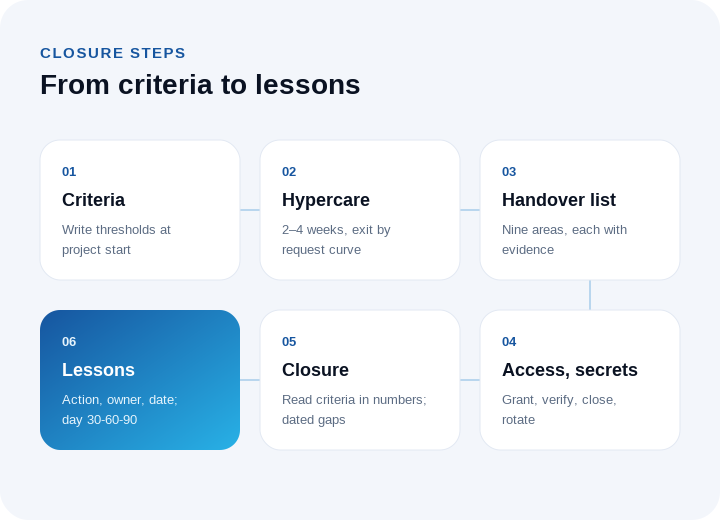
- Write the criteria: Set thresholds before the project starts.
- Open hypercare: Write the duration and exit threshold.
- Fill in the handover list: Mark all nine areas with evidence.
- Hand over access and secrets: Follow grant, verify, close, rotate.
- Hold the closure meeting: Read the criteria in numbers; put gaps on a dated list.
- Learn lessons: Assign the actions and schedule the day 30, 60 and 90 checks.
Common mistakes: treating acceptance as closure, closing access without verifying it, not renewing secrets, and leaving accounts under the developer's name. With an outside team, knowledge can stay with one person; our software outsourcing guide covers this. For contract clauses and source code ownership, see our guide to getting custom software developed.
We recommend reading: How to Decommission and Retire a Legacy System: Usage Evidence, Archive, License and Shutdown Guide
We recommend reading: SSL Certificate Management: How to Manage Domains, DNS and Certificates (Ownership, TTL, Renewal and Inventory Guide)
We recommend reading: How to Hire Software Developers: Technical Interviews, Scoring Rubric and the First 90 Days
Project Delivery and Handover with İnovabil
At İnovabil our focus is building company-specific software from scratch. The six steps on our process page end with release and then maintenance and support; we suggest writing the closure criteria and handover list together during requirements. The figures are representative, not a commitment.
We built CRM, purchasing and mobile for Avcılar İnşaat; a purchasing system for İZBAN; logistics and shipment planning with wholesale order management for Karyak; and warehouse management plus a complaint and support management system for Sleepy. Send us a short summary of your closure expectations and we will write the criteria together.
We recommend reading: Our software development process: step by step from analysis to release
Frequently Asked Questions
What is software project closure?
It is the formal end point where acceptance, handover, open items and lessons are recorded. Acceptance shows the product does what was asked; closure shows the business can run the system without the developer.
What is handed over in a handover?
The code repository, environments and access, secrets, domain and certificate accounts, third-party licences, backup, monitoring and alert recipients, the operations manual and known issues. Evidence is kept for each.
In what order is access handed over?
First to the new owner, then the new owner verifies, then the old access is closed. Closing everything at once locks the system if the receiving side hits a problem. Every secret the developer team knew is also rotated.
How long should the post-launch support window last?
Typically 2–4 weeks. The request curve decides the length, not the calendar; write the exit threshold in advance.
What should be tracked after closure?
Handover-caused requests in the first 90 days and the share of work that depends on the developer in the first 30. If both fall, the handover worked; if not, documentation or training is missing.