

A customer sends a drawing, a few dimensions and a delivery date. There is no finished design and no bill of materials, yet they want a price tomorrow. Estimating costs for custom product quotes means producing a reasonably accurate cost before production starts, for a control panel, machine, piece of equipment or furniture designed for one customer, and then turning that cost into a quote price.
This guide covers why the quoting stage is hard, which estimating method to use when, parametric and subsystem calculations, the risk allowance, how margin relates to price, how to feed estimation error back into the process, and how to set it up in an ERP. All example figures are illustrative, not sector averages or real prices. For after-the-fact costing see our product cost guide, and for overhead drivers see activity-based costing; here we only discuss the estimate made at quote time.
Why Is Costing a Custom Product Quote Hard?
Because at quote time the product does not exist yet: the design is unfinished, there is no bill of materials, labor time is guessed from similar jobs, and the customer expects a fast answer. A standard product has a recipe and a price list; an optioned standard product is solved by combination rules (see our product configurator article). Here the product will exist for the first time.
Risk therefore comes from three places: scope that is misunderstood, time estimates that are optimistic, and purchasing or subcontracting prices that change after the quote. Whether to make to order or to stock is a separate decision; see make-to-order versus make-to-stock.
Which Estimating Method Should You Use at Which Stage?
Accuracy rises as information grows, so give a rough range at the first conversation and fix the price only in the detailed quote.
| Stage | Method | Input | Illustrative accuracy |
|---|---|---|---|
| Concept, first call | Analogy (similar past job) and expert judgment | Product type, rough size | ±30% |
| Preliminary design | Parametric (cost per kg, m², kW) | Weight, size, power | ±12% to 20% |
| Detailed quote | Subsystem build-up (bottom-up) | Subsystem list, supplier quotes | ±10% |
| After contract | Project budget and estimate at completion | Actual spend | ±5% |
The ranges are illustrative. The last row is covered in our project cost and profitability tracking guide.
How Does Parametric Estimating Work?
You find how cost relates to a measure in past jobs (weight, for example) and apply it to the new job's measure. It takes minutes once the drawing arrives.
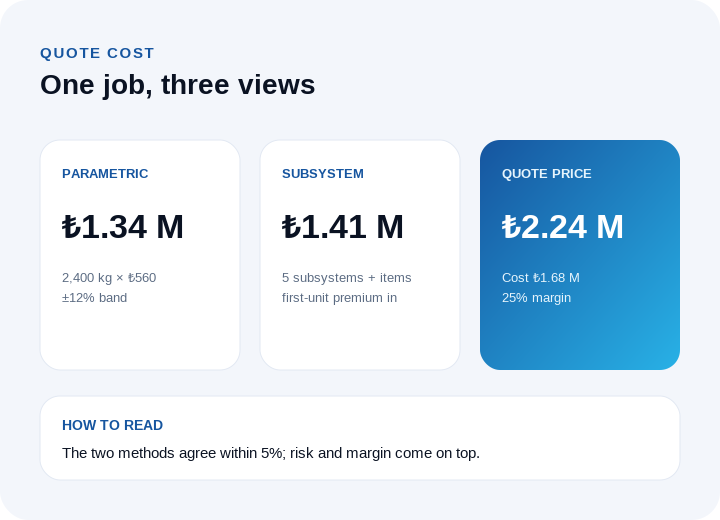
Illustrative example: across 50 similar jobs, cost per kilogram averages ₺560 with a standard deviation of ₺67.2 (12%). For a 2,400 kg job the average-based estimate is 2,400 × 560 = ₺1,344,000, and a one-standard-deviation band runs from ₺1,182,720 to ₺1,505,280 (88% and 112%). If you fit a linear relationship to the same jobs (fixed ₺90,000 plus ₺520 per kg in the example) you get ₺90,000 + 520 × 2,400 = ₺1,338,000; the fixed part captures costs such as design and fixtures that do not grow with weight.
The limit: it works only for similar jobs. If the product family changes, weight can mislead and you need a cross-check with a second method. And if you quote from a rough estimate and cost overruns by 30%, a 25% margin falls to 2.5% (1 − 0.75 × 1.30).
How Do You Build the Cost from Subsystems?
Split the product into subsystems, estimate material, labor hours and subcontracting for each, then add them up. This is the main method for detailed quotes.
The example uses a production labor rate of ₺650 per hour.
| Subsystem | Material | Labor hours | Subcontract | Total |
|---|---|---|---|---|
| Frame and body | ₺168,000 | 240 | ₺36,000 | ₺360,000 |
| Drive and mechanics | ₺142,000 | 120 | ₺0 | ₺220,000 |
| Electrical panel and wiring | ₺118,000 | 150 | ₺0 | ₺215,500 |
| Controls and software | ₺54,000 | 180 | ₺0 | ₺171,000 |
| Surface finishing and paint | ₺22,000 | 20 | ₺28,000 | ₺63,000 |
| Total | ₺504,000 | 710 | ₺64,000 | ₺1,029,500 |
Labor is 710 hours × ₺650 = ₺461,500. The frame row is 168,000 + 240 × 650 + 36,000 = ₺360,000. Items not in the table come on top: a 6% scrap allowance on frame material (₺10,080), engineering at 160 hours × ₺900 = ₺144,000, assembly at 90 hours × ₺650 = ₺58,500, and testing and commissioning at 60 hours × ₺650 = ₺39,000. Add ₺24,000 for freight and commissioning and ₺36,000 for tooling and the total, before any first-unit premium, is ₺1,341,080.
Take hours from similar jobs. In the example four similar jobs ran 0.289, 0.305, 0.292 and 0.300 production hours per kg; the average of 0.2965 × 2,400 kg ≈ 711 hours agrees with the subsystem total of 710. Those jobs were repeat designs, however, and the first unit of a new design takes longer because of learning. The example applies a first-unit premium of 15%: 710 × 0.15 = 106.5 hours × ₺650 = ₺69,225. At 10% it would be ₺46,150 and at 25% ₺115,375; choose the rate from your own first-unit observations.
Which Cost Items Are Easy to Forget?
Most quote losses come not from items that were miscalculated but from items never written down. A checklist:
- Material and scrap: cutting and heat-treatment scrap, material left over from minimum order quantities.
- Labor: design and engineering, production, assembly, testing; each with its own hours and rate.
- Subcontracting: surface finishing, heat treatment and other outside work; see our subcontract manufacturing guide.
- Non-standard purchases: parts that are not in stock and have long lead times.
- Tooling and fixtures: one-time costs.
- Freight, commissioning, warranty provision, overhead.
Tooling example: a ₺36,000 fixture. If the repeat-order probability is 30% and a repeat would bring three more units, expected total units are 1 + 0.3 × 3 = 1.9, so the per-unit share is 36,000 ÷ 1.9 ≈ ₺18,947. Spreading it this way lowers the price by about ₺22,737 (17,053 ÷ 0.75), but if no repeat comes (70%), ₺17,053 goes unrecovered. Unless the contract commits to repeat orders, charging the whole cost to this job is the safe choice, and the example does so.
How Do You Calculate the Risk and Uncertainty Allowance?
Take a three-point estimate for each cost group: optimistic (O), most likely (M) and pessimistic (P). The PERT expected value is (O + 4M + P) ÷ 6 and the standard deviation is (P − O) ÷ 6; see our risk management article for more.
| Cost group | O | M | P | Expected | Std. dev. |
|---|---|---|---|---|---|
| Material and subcontract | ₺540,000 | ₺578,080 | ₺700,000 | ₺592,053 | ₺26,667 |
| Production labor | ₺480,000 | ₺530,725 | ₺720,000 | ₺553,817 | ₺40,000 |
| Engineering | ₺120,000 | ₺144,000 | ₺220,000 | ₺152,667 | ₺16,667 |
| Assembly and test | ₺85,000 | ₺97,500 | ₺140,000 | ₺102,500 | ₺9,167 |
| Tooling and freight | ₺55,000 | ₺60,000 | ₺75,000 | ₺61,667 | ₺3,333 |
The most likely values sum to ₺1,410,305 and the expected values to ₺1,462,703. If the items are assumed independent, the total standard deviation is the square root of the sum of squares: √(26,667² + 40,000² + 16,667² + 9,167² + 3,333²) ≈ ₺51,808. Adding them directly would give ₺95,833; the independence assumption shrinks uncertainty, whereas scope changes can move items together, so write the assumption down.
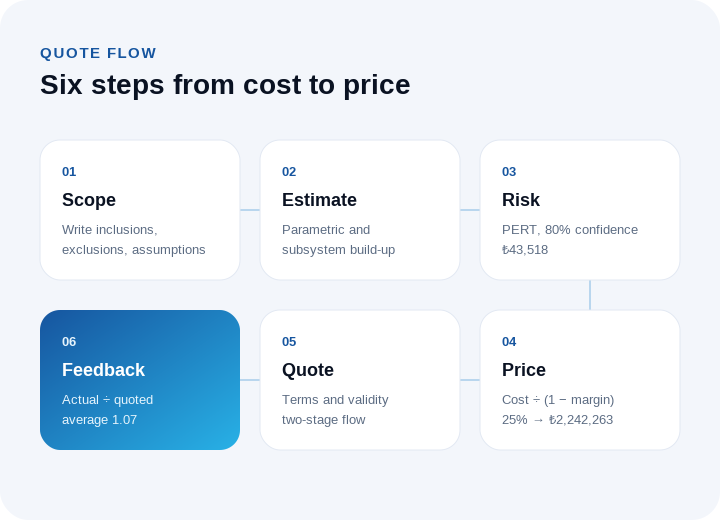
For 80% confidence use the common normal-distribution value of 0.84: allowance = 0.84 × 51,808 ≈ ₺43,518. The target cost is 1,462,703 + 43,518 = ₺1,506,222, which is 6.8% above the most likely total. Then add a warranty provision (1.5% = ₺22,593) and an overhead share (10% of the ₺1,528,815 subtotal = ₺152,882): the quote cost is ₺1,681,697.
How Do You Set the Quote Price?
Price is cost divided by one minus the target margin: price = cost ÷ (1 − margin). At a 25% margin, 1,681,697 ÷ 0.75 = ₺2,242,263 and profit is ₺560,566. Do not confuse margin with markup: adding 25% to cost gives ₺2,102,121, a margin of 20% (1 − 1 ÷ 1.25).
A higher margin lowers the chance of winning; the right point is found with expected contribution: probability × (price − cost). The probabilities are illustrative and should come from your own history.
| Margin | Price | Profit | Win probability | Expected contribution |
|---|---|---|---|---|
| 15% | ₺1,978,467 | ₺296,770 | 55% | ₺163,224 |
| 25% | ₺2,242,263 | ₺560,566 | 35% | ₺196,198 |
| 35% | ₺2,587,226 | ₺905,529 | 15% | ₺135,829 |
In the example 25% gives the highest expected contribution. The table is only a decision aid.
What Is the Winner's Curse in Quoting?
In competitive bids the job usually goes to whoever estimates the lowest cost, so the jobs you win are the ones where your estimate was most optimistic. Variance on won jobs is therefore systematically positive. The remedy is feedback: when a job ends, record actual cost divided by quoted cost.
In the example the ratio over the last 20 jobs averages 1.07 with a P80 of 1.14 (illustrative). That means cost overran by 7% on the average job, and by 14% or more on one job in five. If you leave no risk allowance, a 25% target margin actually becomes 1 − 0.75 × 1.07 = 19.75%. The target cost in this article is 1.068 times the most likely total, very close to 1.07, so the allowance is large enough to cover past overruns. Recompute the ratio every quarter and split variance by cause: design change, subcontractor delay, material price, first-unit problems and missed scope.
How Do You Write Quote Scope and Terms?
List what is included and what is not (basic drawings, software, freight, assembly, training), state assumptions (customer drawings, material grade, operating environment), and add that customer change requests are priced separately, the quote validity period and a price-adjustment clause. Clause wording and penalties are contract matters and should be settled with legal counsel.
How Can You Shorten Quote Preparation Time?
A detailed quote is expensive: in the example 18 hours per quote at a 25% win rate means 18 ÷ 0.25 = 72 hours per won job, or ₺36,000 at ₺500 per hour. A two-stage quote reduces this: send a 5-hour preliminary quote first (parametric, ±12% to 20%) to test budget fit, and prepare a detailed quote only for those who proceed.
Across 100 enquiries, a single-stage flow uses 100 × 18 = 1,800 hours. With two stages, 100 × 5 = 500 hours of preliminary quotes plus 40% proceeding (40 × 18 = 720 hours) totals 1,220 hours; that saves 580 hours (32%) and brings effort per won job to 48.8 hours. Assuming the win rate stays the same is illustrative. To keep quote costs current when the recipe changes on a won job, see our BOM revision guide.
How Do You Apply Quote Costing in an ERP?
Four parts are enough. First, a quote cost card: items, hours, assumptions and version number in one record. Second, similar-job search: retrieve past jobs by product type, weight and size and extract cost per kg and hours automatically. Third, handing a won quote to the work order and project budget, so the quote cost becomes the budget and is compared with actuals. Fourth, end-of-job feedback: the actual-to-quoted ratio is written to the record.
| Measure | Formula | Example |
|---|---|---|
| Cost accuracy | Actual ÷ quoted cost | Average 1.07; P80 1.14 |
| Margin realized | 1 − actual cost ÷ price | Target 25%, actual 19.75% |
| Win rate | Won ÷ quotes sent | 50 ÷ 200 = 25% |
| Quote time | Hours from enquiry to quote | 18 hours, target 12.2 |
| Variance by cause | Extra cost by reason | Design change is largest |
How Do You Calculate the Payback?
There are two gains. Loss-making jobs: with 200 quotes a year and 50 won jobs, if 10 lose money at an average ₺60,000 loss, cutting that to 6 saves 4 × 60,000 = ₺240,000. Quote effort: 200 quotes at 18 hours is 3,600 hours; with two stages it falls to 200 × (5 + 0.4 × 18) = 2,440 hours, and 1,160 hours × ₺500 = ₺580,000.
The total is ₺820,000; with ₺120,000 running cost the net is ₺700,000. With a ₺600,000 investment, payback is 600,000 ÷ (700,000 ÷ 12) ≈ 10.3 months. If only half the gains materialize, net is 410,000 − 120,000 = ₺290,000 and payback ≈ 24.8 months. The numbers are illustrative; recompute them with your own volumes.
How Do You Set It Up in Six Steps?
- Collect the last 20 jobs: compare quoted and actual cost.
- Extract parameters: cost and hours per kg, m² or kW.
- Write a subsystem template: item list and checklist.
- Define the risk allowance: three-point estimates and a confidence level.
- Set margin and price rules: target margin and a floor.
- Build the feedback loop: end-of-job ratio and quarterly calibration.
We recommend reading: What is quote management software? Approval, margin protection and conversion to orders
We recommend reading: How to do production planning: MRP, net requirements and capacity
We recommend reading: How to estimate software development cost
ERP and Custom Software for Made-to-Order Products with İnovabil
At İnovabil our focus is building custom software from scratch for your company. A quote cost card, similar-job search and end-of-job feedback are designed around your own product structure; we make no claim of a ready-made module, and we put the scope in writing during requirements analysis.
We have built logistics and shipment planning with wholesale order management for Karyak, warehouse management for Sleepy, CRM, purchasing and mobile for Avcılar İnşaat, and a purchasing system for İZBAN. Send a short summary of your current quoting process and past jobs, and we will first work out together which items should move into the system.
We recommend reading: Our ERP development service and our software development process
Frequently Asked Questions
What is custom product quote costing?
It is estimating the cost of a product designed and built for one customer, before design and bill of materials exist, and deriving a price with margin from that cost. Depending on the stage the estimate uses analogy, parametric or subsystem build-up.
How accurate should a quote cost be?
It depends on the stage. In the example, ±30% at the first conversation, ±12% to 20% at preliminary design and ±10% for detailed quotes. Fix the price only after the detailed stage, and measure the ranges from your own history.
How is the risk allowance determined?
Take optimistic, most likely and pessimistic estimates for each cost group, compute PERT expected values and standard deviations, sum the squares, take the root and multiply by the chosen confidence factor. In the example the 80% allowance is ₺43,518.
What is the difference between margin and markup?
Margin is profit as a share of price; markup is the percentage added to cost. Adding 25% to cost gives a 20% margin. If your target is margin, compute price as cost ÷ (1 − margin).
How do you avoid the winner's curse in quoting?
Record actual cost divided by quoted cost when each job ends and track the average and P80. If the ratio is clearly above 1, increase the risk allowance and first-unit premium, and recalibrate every quarter.