

A contract is signed, the work is delivered, the invoice goes out, and yet whether the project actually made money often only becomes clear months later, when the books close. Tracking project costs and profitability (job costing) means recording the revenue and cost of every project on its own, comparing budget with actuals, and forecasting how much profit will be left at the end while the work is still running. In construction, contracting, consulting, software and field services, where every job behaves like a small company, a company-wide profit and loss statement cannot replace it: a good project hides a bad one and the problem stays invisible.
In this guide we cover project codes, cost categories, hourly cost, budget versus actuals, the estimate at completion (EAC), profitability, overhead allocation, progress billing, early-warning thresholds and a six-step setup. Every number in the examples is representative.
What Is Job Costing (Project Cost and Profitability Tracking)?
Job costing tracks the revenue, direct cost and shared overhead of each project separately so that profit can be calculated per project. The question it answers is not "did the company make a profit this month?" but "which projects make money, which lose it, and why?"
Four views in the same business look alike but answer different questions. Putting them side by side avoids confusion.
| View | Question it answers | Unit | Our guide |
|---|---|---|---|
| Company profit and loss | Did the company close the period at a profit? | Period | Pre-accounting |
| Job costing | What will this project cost and earn? | Project | This article |
| Project plan and SPI | Is the work on schedule? | Task, duration | Project plan |
| Product cost | What is the unit cost of one product? | Product | Product cost |
Schedule and cost move together but are measured separately: the SPI in the project plan shows the calendar and a task tracking tool shows the tasks; this article deals only with money, meaning the CPI and profit.
We recommend reading: Our accounting software service
How Do You Set Up Project Codes and Cost Centers?
Every project gets one permanent code, and no cost is posted without it. The whole tracking system rests on that rule.
- Project code: A short code with year and sequence (PRJ-2026-014). The client name stays out; names change, the code stays.
- Task code: Splits the project into the main parts that carry the budget (structure, electrical, finishing); matching the work breakdown structure in the project plan keeps budget and schedule in one language.
- Cost type: Materials, labor, subcontractor, other direct cost, overhead share.
- Cost center: The pool of shared costs not charged directly to a project (office, management, vehicles), allocated later with a key.
The rule is simple: an invoice without a project code is not paid, and a timesheet entry without one is not accepted.
What Are the Project Cost Categories?
Project cost has four main categories: materials (purchasing and warehouse issues), labor (timesheet × hourly cost), subcontractors (progress claims and invoices) and an overhead share. The first three belong directly to the project; the fourth is shared and allocated with a key.
On the subcontractor row, if work is done but the invoice has not arrived, the cost has in fact occurred; accrue it to the project and leave the booking method to your financial advisor (certified accountant). For purchasing discipline see our procurement software guide.
How Do You Calculate Timesheets and Hourly Cost?
Hourly cost is what one project hour really costs the business; you get it by dividing total monthly employer cost by the hours that can be booked to projects, not by dividing salary by working hours.
Take a representative employee. Total monthly employer cost is ₺79,200; tax and social security details are left to your financial advisor (certified accountant). There are 22 days × 8 hours = 176 paid hours a month. After leave, meetings, training and work that cannot be booked to a project, the bookable time is 132 hours (75%).
- Naive hourly cost: ₺79,200 ÷ 176 = ₺450.
- Project-hour cost: ₺79,200 ÷ 132 = ₺600.
The gap is ₺150 an hour, so the naive calculation understates cost by 25% (150 ÷ 600) and quoted prices fall short by the same proportion. If the selling rate on time-and-materials work is ₺900, the contribution is ₺300 an hour, or 33.3%.
Incomplete timesheets hurt in two directions. A team of 20 has 20 × 132 = 2,640 project hours a month; 10% missing entries is 264 hours. If half belongs to billable work, 132 × ₺900 = ₺118,800 cannot be invoiced; if half belongs to fixed-price work, 132 × ₺600 = ₺79,200 of cost is charged to no project and that margin looks higher than it is. So timesheets should be weekly, with project and task as mandatory fields.
How Do You Compare Budget with Actuals?
Freeze the budget line by line at the start, track actual spending against the same lines, and put each line's spend ratio next to the percent complete. The total variance shows that there is a problem; the line variance shows where it comes from.
Example project A is an office fit-out: contract price ₺1,500,000, cost budget at completion (BAC) ₺1,200,000, physical progress 60% and ₺780,000 spent so far.
| Line | Budget | Spent | Spend ratio |
|---|---|---|---|
| Materials | ₺500,000 | ₺340,000 | 68.0% |
| Labor | ₺300,000 | ₺210,000 | 70.0% |
| Subcontractors | ₺280,000 | ₺170,000 | 60.7% |
| Overhead share | ₺120,000 | ₺60,000 | 50.0% |
| Total | ₺1,200,000 | ₺780,000 | 65.0% |
The work is 60% done but 65% of the budget is gone. The cause shows in the lines: labor at 70% and materials at 68% are ahead of progress. The weekly meeting should ask "why are labor and materials ahead?", not "why is the total over?"; waste, overtime or a thin budget can only be told apart at line level. The risk register in our project risk management guide also helps manage the causes.
How Do You Calculate Percent Complete, Earned Value and EAC?
EAC, the estimate at completion, shows what the project's total cost will be at the end; you get it by dividing the budget by the value of work done per unit of money spent.
- Earned value (EV): Percent complete × BAC. Example A: 60% × ₺1,200,000 = ₺720,000. "The budgeted value of the work done."
- Cost performance index (CPI): EV ÷ AC, where AC is the actual cost. ₺720,000 ÷ ₺780,000 = 0.92. For every 1 lira spent, 0.92 lira of work was produced; below 1 is bad.
- EAC: BAC ÷ CPI. ₺1,200,000 ÷ 0.9231 = ₺1,300,000. If the variance continues at this rate, the project finishes ₺100,000 over.
A second method assumes the overrun is temporary: EAC = AC + (BAC − EV) = ₺780,000 + ₺480,000 = ₺1,260,000. The two values give a range: ₺1,260,000 to ₺1,300,000 for A, so expected profit of ₺240,000 to ₺200,000. A one-off mistake supports the first; a continuing inefficiency the second.
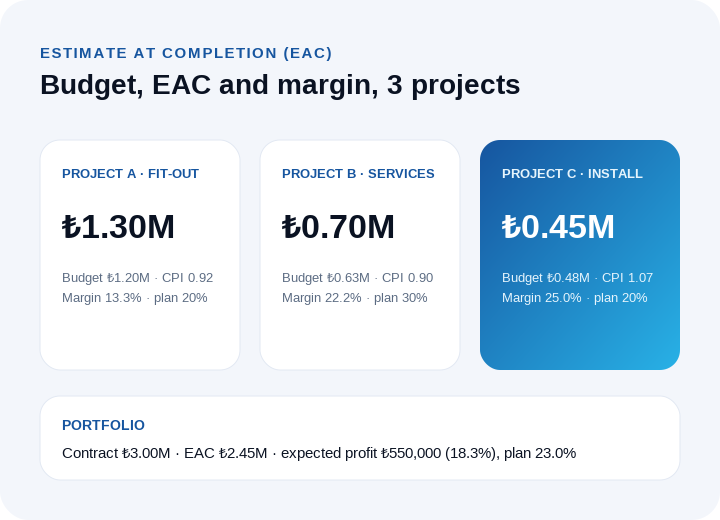
The same calculation on three projects follows; B is a consulting-and-services project and C a field installation.
| Project | Contract | BAC | AC | Complete | EV | CPI | EAC | Expected profit | Margin (plan) |
|---|---|---|---|---|---|---|---|---|---|
| A fit-out | ₺1,500,000 | ₺1,200,000 | ₺780,000 | 60% | ₺720,000 | 0.92 | ₺1,300,000 | ₺200,000 | 13.3% (20%) |
| B services | ₺900,000 | ₺630,000 | ₺350,000 | 50% | ₺315,000 | 0.90 | ₺700,000 | ₺200,000 | 22.2% (30%) |
| C installation | ₺600,000 | ₺480,000 | ₺180,000 | 40% | ₺192,000 | 1.07 | ₺450,000 | ₺150,000 | 25.0% (20%) |
| Portfolio | ₺3,000,000 | ₺2,310,000 | — | — | — | — | ₺2,450,000 | ₺550,000 | 18.3% (23.0%) |
The portfolio forecasts ₺550,000 of profit instead of the planned ₺690,000: ₺140,000 short (A +₺100,000 and B +₺70,000 overrun; C −₺30,000 saving). C's saving masks the other two; someone who looks only at the portfolio margin will not see the problem.
How Do You Measure Project Profitability?
Project profitability is read in two stages: the contribution margin left after direct costs (gross margin), and the project profit left after the overhead share. One shows the project's own work, the other the burden it places on the company.
In project A's plan: contract ₺1,500,000; direct cost ₺500,000 + ₺300,000 + ₺280,000 = ₺1,080,000; contribution ₺420,000 (28.0%). After the ₺120,000 overhead share, project profit is ₺300,000 (20.0%). On the EAC basis, profit falls to ₺200,000 (13.3%); the margin drift is 20.0 − 13.3 = 6.7 points.
Looking only at contribution ignores shared cost; looking only at net profit can unfairly mark small projects as losses. Use the contribution floor when pricing quotes and the net margin for the annual target.
How Is Overhead Allocated to Projects?
The shared cost pool is allocated according to a measure of what each project used that month, and the measure should fit the nature of the project. The two most common keys are labor hours and direct cost.
Say this month's shared cost pool is ₺225,000. The projects' hours and direct cost for the month: A 200 hours and ₺300,000, B 150 hours and ₺120,000, C 100 hours and ₺80,000 (total 450 hours, ₺500,000).
| Project | Hours key (₺225,000 ÷ 450 = ₺500/hour) | Cost key (₺225,000 ÷ ₺500,000 = 45%) | Difference |
|---|---|---|---|
| A | 200 × ₺500 = ₺100,000 | 45% × ₺300,000 = ₺135,000 | +₺35,000 |
| B | 150 × ₺500 = ₺75,000 | 45% × ₺120,000 = ₺54,000 | −₺21,000 |
| C | 100 × ₺500 = ₺50,000 | 45% × ₺80,000 = ₺36,000 | −₺14,000 |
| Total | ₺225,000 | ₺225,000 | ₺0 |
The total does not change; only who carries it does. For hour-intensive work such as services, hours is the fairer key; for material-intensive work, cost is. Pick one, write it down and do not change it during the year, or comparison with past projects breaks.
How Do Progress Billing and Invoices Relate to Project Cost?
On the revenue side there are three separate amounts: the value of work done, the progress billing invoiced, and the money collected. They can differ, and the gap means cash and risk.
In project A, 60% of the contract is complete: value of work done 0.60 × ₺1,500,000 = ₺900,000. ₺750,000 has been invoiced as a progress claim, so ₺150,000 of work is unbilled. Of the invoiced amount ₺600,000 has been collected and ₺150,000 is a receivable. Between ₺780,000 spent and ₺600,000 collected, the cash position is −₺180,000; the business has to carry that gap.
That is why the weekly report should show "unbilled work" and "outstanding receivables" next to cost. See our customer account tracking and cash flow guides. In which period revenue is recognized is a matter of accounting standards; consult your financial advisor (certified accountant).
What Are the Early-Warning Thresholds?
Three indicators are enough: the CPI, the drift of expected margin from plan, and timesheet completeness. If thresholds are written in advance, the report produces action rather than debate.
| Indicator | Green | Amber | Red | Action |
|---|---|---|---|---|
| CPI | ≥ 0.95 | 0.90 up to below 0.95 | < 0.90 | Cause analysis on amber, scope and price talks on red |
| Expected margin drift (vs plan) | ≤ 5 points | 5 – 10 points | > 10 points | Line-by-line review |
| Recorded hours ratio | ≥ 98% | 95% – 98% | < 95% | Chase the team with missing entries |
In our examples A and B are amber (B is borderline with a CPI of 0.90; margin drift is 6.7 points for A and 30.0 − 22.2 = 7.8 for B) and C is green (CPI 1.07, margin 5.0 points better than plan). The thresholds are representative; calibrate them once to your own project types and keep them for the year.
How Do You Set Up Project Cost Tracking in Six Steps?
Setup is a matter of rules and discipline before software; the tool only carries them. Work through six steps.
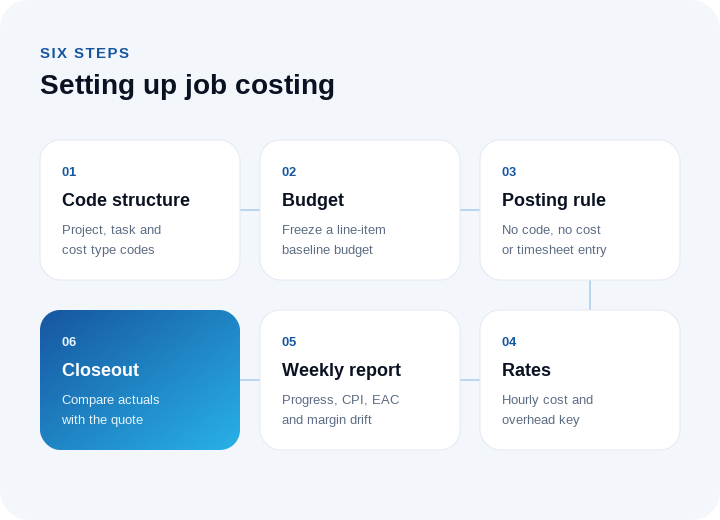
- Code structure: Define project, task and cost type codes; make them mandatory fields on purchasing, warehouse and timesheet screens.
- Budget: Freeze a line-item cost budget with the contract; changes enter as a "revision" and never erase the original.
- Posting rule: No invoice without a code is paid and no timesheet without a code is accepted; claim approval carries a task code.
- Rates: Write down the hourly cost (₺600 in the example) and the overhead allocation key; update them once a year.
- Weekly report: Progress, CPI, EAC, margin drift, unbilled work and outstanding receivables on one page; ambers and reds set the agenda.
- Closeout: Compare actual cost with the quote; feed variances back into the next quotes' assumptions.
Here is the payback with a representative calculation. The ₺118,800 monthly gap of unbillable hours is the pre-setup position; setup (posting rules, reports, training) costs ₺300,000. If the system closes 75% of the gap, the gain is 0.75 × ₺118,800 = ₺89,100; after ₺14,100 of monthly running cost the net is ₺75,000 and payback is ₺300,000 ÷ ₺75,000 = 4 months. If only half closes, the net is ₺59,400 − ₺14,100 = ₺45,300 and payback about 6.6 months. Savings from overruns avoided are not counted, so the calculation is conservative.
We recommend reading: How to estimate software development cost: effort, rates and three-year cost guide
What Are the Common Mistakes in Project Cost Tracking?
- Deriving percent complete from spending: The CPI stays at 1 and the problem is hidden.
- Never charging the overhead share: Contribution looks great and the company still loses money.
- Using salary instead of hourly cost: Cost comes out 25% low and quoted prices fall short by the same proportion.
- Leaving the report to month end: You cannot intervene in an overrun you learn about at month end; the report must be weekly.
We recommend reading: How to Do Budgeting and Variance Analysis: Flexible Budgets, Price-Volume Breakdown and Rolling Forecast Guide
We recommend reading: How to Do Customer Profitability and Cost-to-Serve Analysis: Net Contribution, the Whale Curve and Action Guide
We recommend reading: How to Set Up Time Tracking and Timesheet Software: Time Entry, Utilization and Payback Guide
We recommend reading: How to Do Resource and Capacity Planning for Project Teams: Net Capacity, Heat Map and Overload Guide
We recommend reading: How to Do Activity-Based Costing (ABC Costing) and Overhead Allocation: Drivers, Idle Capacity and Decision Guide
We recommend reading: How to Estimate Costs for Custom Product Quotes: Estimating Methods, Risk Allowance and Quote Pricing Guide
We recommend reading: What Is Project Portfolio Management (PPM)? How to Prioritize Projects, Match Capacity and Decide What to Stop
Custom Software and Process Digitization with İnovabil
At İnovabil our focus is building software from scratch, specific to your company: custom software, ERP, CRM, e-commerce, web, mobile and integration. If you need project-based cost tracking, we suggest first writing down in the requirements analysis which codes and which hour and cost sources you will work with.
We developed CRM, purchasing and mobile for Avcılar İnşaat; a purchasing system for İZBAN; logistics and shipment planning with wholesale order management for Karyak; and warehouse management plus a complaint and support management system for Sleepy. The examples in this article are representative calculations for education and do not describe any customer's module; let us scope your project-based cost need together.
We recommend reading: Our software development process: step by step from analysis to launch
Frequently Asked Questions
What is job costing (project cost and profitability tracking)?
It is calculating profit per project by tracking each project's revenue, direct cost (materials, labor, subcontractors) and overhead share separately under a project code. The aim is to forecast how much profit will remain at the end while the project is still running.
How is EAC (estimate at completion) calculated?
EAC = BAC ÷ CPI, where the CPI is the ratio of the value of work done (EV) to actual cost (AC). In the example BAC is ₺1,200,000, EV ₺720,000 and AC ₺780,000, so the CPI is 0.92 and EAC is ₺1,300,000. If the overrun is treated as temporary, EAC = AC + (BAC − EV) = ₺1,260,000 is used as well.
Is hourly cost salary divided by hours?
No. Total monthly employer cost is divided by the hours that can be booked to projects. In the example ₺79,200 ÷ 132 = ₺600, while ₺79,200 ÷ 176 = ₺450 understates cost by 25%. For tax and social security details consult your financial advisor (certified accountant).
How is overhead allocated to projects?
The shared pool is split with a key that fits the work (labor hours or direct cost). In the example a ₺225,000 pool charges project A ₺100,000 under the hours key and ₺135,000 under the cost key; write the key down and do not change it during the year.
How often should project costs be reviewed?
Weekly. An overrun learned about at month end cannot be acted on; CPI, EAC, margin drift, unbilled work and outstanding receivables should appear on one page every week.