

In a business that sells on credit, a sale is not finished when the invoice goes out; it is finished when the money lands in the bank. Customers place orders on the promise of paying in 30, 45 or 60 days, and if nobody knows who calls on the due date, what they say and whether shipments continue, receivables quietly pile up. B2B collections and receivables management is the discipline of tying that process to written rules, measurements and named owners instead of to people's memory.
In this guide we cover the aging report, DSO and the collection effectiveness index (CEI), reminder steps, collection priority, payment promises and disputes, payment matching, a shipment-hold rule and the early-payment discount decision. All example figures are illustrative; they are not industry averages or real customer data.
What Is B2B Collections and Receivables Management?
It is monitoring, reminding, escalating and measuring a receivable from a credit sale until it is collected. Account tracking shows which customer owes how much; collections management decides who does what, and when, so the debt closes on time. We covered the customer account card, reconciliation and the basic DSO calculation in our guide to tracking customer accounts (current accounts); this article adds prioritization, payment promises, disputes, CEI and the discount decision on top. For the effect on your bank balance, see our cash flow article.
We recommend reading: Our accounting and pre-accounting software service
How Do You Read a Receivables Aging Report?
By splitting the open balance into buckets by due date. Days overdue are counted from the due date, not the invoice date. Illustrative example: ₺12,000,000 of credit sales per month, 30-day terms, and ₺14,600,000 open at month end.
| Bucket | Amount | Share | What to do |
|---|---|---|---|
| Not yet due | ₺9,600,000 | 65.8% | Watch the calendar only |
| 1–30 days overdue | ₺3,000,000 | 20.5% | Reminders, get a promise |
| 31–60 days | ₺1,200,000 | 8.2% | Manager involvement |
| 61–90 days | ₺480,000 | 3.3% | Shipping restriction, written plan |
| Over 90 days | ₺320,000 | 2.2% | Doubtful-receivable candidate |
| Total | ₺14,600,000 | 100.0% | Overdue: ₺5,000,000 |
The report should answer two questions: how much in total, and where is the late part? In the example, 60% of the overdue amount (₺3,000,000) sits in the first bucket, so the problem is mostly forgetting. The ₺800,000 older than 60 days is only 5.5% of the total, but it is solved by a rule and a decision, not by a friendly conversation.
How Do You Calculate DSO, Overdue Rate and CEI?
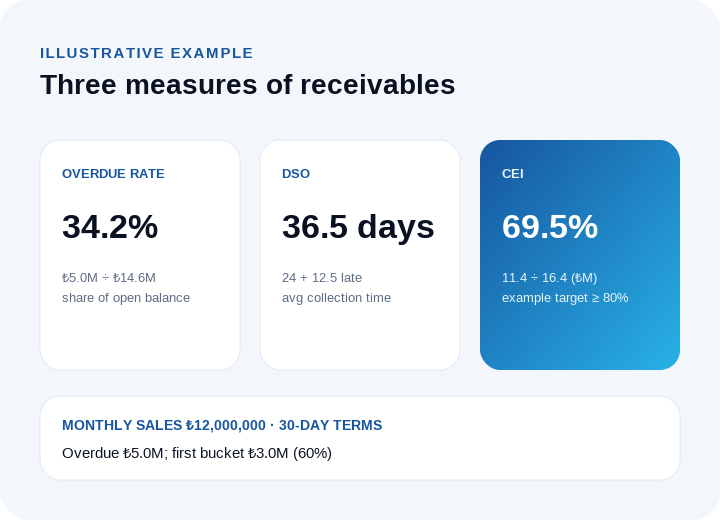
DSO gives the average collection time, the overdue rate gives the size of the problem, and CEI shows how much of the collectible receivable the team actually collected.
- DSO = open receivable ÷ period sales × days = 14,600,000 ÷ 12,000,000 × 30 = 36.5 days.
- Best possible DSO (BPDSO) uses only receivables not yet due: 9,600,000 ÷ 12,000,000 × 30 = 24 days.
- Average days delinquent (ADD) = DSO − BPDSO = 36.5 − 24 = 12.5 days.
- Overdue rate = 5,000,000 ÷ 14,600,000 = 34.2%.
When sales rise, DSO falls and looks good even if lateness stays the same. Read DSO together with BPDSO; the gap is the real lateness.
CEI = (opening receivable + period credit sales − closing total receivable) ÷ (opening receivable + period credit sales − closing receivable not yet due) × 100
With an opening receivable of ₺14,000,000, the numerator is 14,000,000 + 12,000,000 − 14,600,000 = 11,400,000 (collected) and the denominator is 14,000,000 + 12,000,000 − 9,600,000 = 16,400,000 (collectible). CEI = 11,400,000 ÷ 16,400,000 = 69.5%. The 80% target here is the example's own; take yours from your own past periods.
How Do You Set Reminder Steps and Message Tone?
Write the channel and tone of each step in advance. Tone does not get harsher as lateness grows, it gets clearer: first information, then a promise, then a decision.
| Timing | Message and tone | Channel |
|---|---|---|
| 5 days before due | Information: invoice no., amount, due date, order no. | |
| Due date | Reminder: payment details or link | |
| +7 days | Polite follow-up: "we have not received your payment; if it is on its way, please let us know" | |
| +15 days | Get a promise: ask for date and amount, record it | Phone |
| +30 days | Decision notice: signed by a manager, payment plan requested, new shipments conditional | Written |
Every message must say which invoice, how much and by what date, and give a single reply address for disputes. For formal written demands, consult your legal counsel.
Which Receivable Should Be Called First?
The one that is large, long overdue and from a risky payer. The suggested score is priority = amount score × lateness score × risk score. Amount: under ₺100,000 is 1, 100–250 thousand is 2, 250–500 thousand is 3, 500 thousand to 1 million is 4, 1 million and above is 5. Lateness: 1–15 days is 1, 16–30 is 2, 31–60 is 3, 61–90 is 4, over 90 is 5. Risk: 1 for good payment history, 2 for variable, 3 for frequent late payers or promise breakers.
| Customer | Amount | Overdue | A × L × R | Priority |
|---|---|---|---|---|
| B | ₺300,000 | 75 days | 3 × 4 × 3 | 36 |
| A | ₺1,200,000 | 45 days | 5 × 3 × 2 | 30 |
| E | ₺520,000 | 35 days | 4 × 3 × 2 | 24 |
| D | ₺90,000 | 110 days | 1 × 5 × 3 | 15 |
| C | ₺850,000 | 20 days | 4 × 2 × 1 | 8 |
Ranking by amount alone would give A, C, E, B, D, and the risky, overdue B would fall behind. The score gives an order, not a verdict: a disputed invoice is resolved first, and a talk with a strategic customer is led by the sales owner.
How Do Owner Assignment and Escalation Work?
As lateness grows, the person who decides moves up, and each step has one owner and one next action. Example rule:
- Before due – 7 days: collections specialist; automatic reminders.
- 8–30 days: collections specialist and sales rep; phone call, promise, short payment plan.
- 31–60 days: finance and sales managers; lower the limit, conditional shipping.
- 61–90 days: finance leadership; written plan, hold shipments.
- Over 90 days: finance leadership and legal counsel; recovery method, candidate list to the financial advisor (certified accountant).
The sales rep knows the customer best, and tying their commission to collection reduces the appeal of sales that never get paid. To keep a trail of decision steps, the threshold and delegation logic in our workflow and approval software article applies.
How Do You Track a Payment Promise (Promise-to-Pay)?
By recording it with a date, an amount and a channel. "We will pay in the coming days" is not a promise; "₺180,000 by bank transfer on 15 December" is. The rule: the promise date is at most 7 days out, payment is checked on the business day after, a promise broken once stays with the specialist, and a second break moves up one level.
Illustrative example: in one month 40 promises worth ₺1,800,000 were taken and 31 were kept. By count that is 31 ÷ 40 = 77.5%; if the kept promises total ₺1,440,000, by amount it is 1,440,000 ÷ 1,800,000 = 80.0%. The ₺360,000 of the 9 broken promises goes to escalation.
How Do You Manage Invoice Disputes?
Put the dispute into its own queue, assign an owner and measure its duration. A collection reminder on a disputed invoice annoys the customer; dropping the dispute from the list and forgetting it leaves the receivable open forever. The disputed amount appears in a separate column of the aging report. Example: ₺900,000 (18%) of the ₺5,000,000 overdue is disputed; 25 disputes were opened against 400 invoices in the month (25 ÷ 400 = 6.25%).
| Dispute reason | Count | Avg. time to close | Prevention |
|---|---|---|---|
| Price difference | 8 | 26 days | Lock the contract price into the order |
| Delivery or quantity difference | 6 | 24 days | Tie the delivery receipt to the invoice |
| Missing document (order no.) | 5 | 9 days | Make the order no. a required field |
| Wrong or duplicate invoice | 3 | 12 days | Duplicate check when sending |
| Damage or return | 3 | 33 days | Manage returns linked to the invoice |
The average time to close is (8 × 26 + 6 × 24 + 5 × 9 + 3 × 12 + 3 × 33) ÷ 25 = 532 ÷ 25 ≈ 21.3 days. If the missing-document disputes are prevented, the count falls to 20 and the rate to 5.0%, yet the average time rises to 487 ÷ 20 ≈ 24.4 days because the easy ones are gone. Read duration together with the dispute rate. For sending the invoice correctly, see our e-invoice (e-Fatura) integration article; for price and delivery terms, our contract management article.
How Do You Match Partial and Unreferenced Payments?
With ordered rules: reference first, then amount, then oldest invoice, and if none fits, an unidentified-receipts account.
- Reference: The invoice or order number in the description decides.
- Amount: A ₺340,000 transfer with no description; open invoices are F-1 ₺250,000, F-2 ₺180,000 and F-3 ₺90,000. F-1 + F-3 = 340,000 matches exactly, so both close and F-2 stays open.
- Oldest invoice: With no exact match, start from the oldest due date; the last invoice closes partially.
- Unidentified receipt: The amount waits in an "unmatched" account, written confirmation is requested, and a decision is made after a set time (for example 2 business days).
If ₺245,000 arrives against a ₺250,000 invoice, the remaining ₺5,000 (2%) is usually the customer's own deduction; it is not left silently open but opened as a dispute. Illustrative measure: if 410 of 500 monthly payments match automatically, the rate is 82%; the other 90 take 90 × 12 min = 1,080 min = 18 hours by hand.
How Do You Stop Shipments When the Credit Limit Is Exceeded?
By placing a limit and lateness check between order approval and shipping; when the rule runs in the system, the decision stops being a personal preference. We described how the limit is set in our customer and dealer onboarding article. Two conditions are checked: limit usage = open receivable + approved but not yet invoiced orders + the new order; and lateness = any open invoice older than the written threshold (for example 30 days).
Example: limit ₺1,000,000, open receivable ₺780,000, new order ₺300,000. Usage is 780,000 + 300,000 = ₺1,080,000, ₺80,000 over the limit, so the order goes on hold. If the customer pays at least ₺80,000, usage falls to ₺1,000,000 and the shipment is released. The lateness rule is separate: even within the limit, an invoice older than 30 days makes the new shipment conditional.
What Is a Doubtful Receivable and How Does Aging Relate to It?
A doubtful receivable is an accounting and tax concept for a receivable that has become hard to collect. Aging does not make that decision; it produces a candidate list. In the example, the ₺320,000 over 90 days (2.2%) is the first pool, and your internal criterion could be "older than 90 days, no valid promise and no open dispute". Provisioning, tax effect and documentation are for your financial advisor (certified accountant); enforcement, interest and legal recovery methods belong to your legal counsel.
When Does an Early-Payment Discount Make Sense?
When it costs less than the financing value of the money received early. "2/10 net 30" means 2% off if paid within 10 days, otherwise the full amount on day 30. The annual effective cost is (1 + discount ÷ (1 − discount)) ^ (365 ÷ days gained) − 1, with 30 − 10 = 20 days gained.
- 2/10 net 30: (1 + 2 ÷ 98) ^ 18.25 − 1 ≈ 44.6% (by simple rate, 2 ÷ 98 × 365 ÷ 20 ≈ 37.2%).
- 1/10 net 30: (1 + 1 ÷ 99) ^ 18.25 − 1 ≈ 20.1%.
The benchmark is your own cost of funds. A monthly 3% (illustrative) equals 1.03 ^ 12 − 1 ≈ 42.6% a year. On a ₺1,000,000 invoice, the value of cash received 20 days early under 1/10 is 990,000 × (1.03 ^ (20/30) − 1) ≈ ₺19,703; the discount is ₺10,000, a net gain of about ₺9,703. Under 2/10 the value is 980,000 × 0.019901 ≈ ₺19,503 against a ₺20,000 discount, a net loss of about ₺497: borderline and not worth it. To stop a customer from taking the discount and paying on day 30, state in writing that it applies only to payment within the window, and do not accept automatic deductions. For the accounting treatment and tax effect, consult your financial advisor (certified accountant).
When Does Collections Automation Pay for Itself?
The gain comes from two places: a lower financing burden on late receivables and less time in spreadsheets. Illustrative assumptions: monthly financing cost 3%; hourly cost ₺300; investment 60 person-days × ₺9,000 = ₺540,000; monthly running cost ₺12,000. Automatic reminders collect ₺1,500,000 of the undisputed late balance.
| Item | Before | After |
|---|---|---|
| Overdue receivable | ₺5,000,000 | ₺3,500,000 |
| Overdue rate | 34.2% | 26.7% (3.5 ÷ 13.1) |
| DSO | 36.5 days | 32.75 days (13.1 ÷ 12 × 30) |
| CEI | 69.5% | 78.7% (12.9 ÷ 16.4) |
| Monthly financing cost (3%) | ₺150,000 | ₺105,000 |
| Effort: reminders 77 + reports 48 + matching 18 | 143 h | 34 h (20 + 8 + 6) |
Effort saving: 143 − 34 = 109 h × ₺300 = ₺32,700; financing saving: 150,000 − 105,000 = ₺45,000; gross ₺77,700, and after running cost a monthly net of ₺65,700. Payback: 540,000 ÷ 65,700 ≈ 8.2 months. If the improvement is only half (overdue falls to ₺4,250,000), the financing saving is ₺22,500, gross ₺55,200 and net ₺43,200; payback becomes 540,000 ÷ 43,200 = 12.5 months. Reminder work is 30 messages a day × 7 min × 22 days = 77 hours; report preparation is 12 hours a week × 4 = 48 hours. If you run on spreadsheets today, see our guide to moving from Excel to software.
How Do You Build Collections Management in Six Steps?
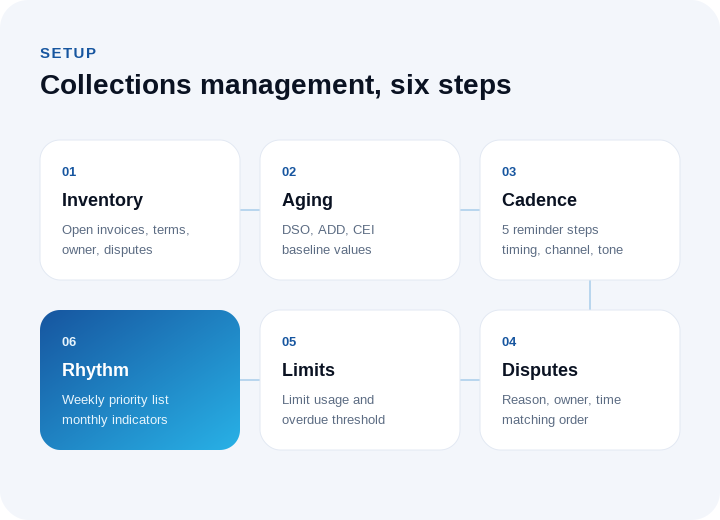
- Inventory: Put all open invoices in one list with due date, customer, owner and dispute flag.
- Aging: Calculate the buckets, DSO, BPDSO, ADD, overdue rate and CEI and record them as baseline values.
- Cadence: Write the timing, channel and owner of the five reminders; try them first on one customer group.
- Disputes and matching: Define dispute reasons, owners and a closing target, plus the matching order.
- Limits and shipping: Run the shipping rule tied to limit usage and the lateness threshold through an approval flow.
- Rhythm and measurement: Aging report on Monday, a weekly priority list and a month-end indicator review; if indicators do not improve, revisit the rules.
We recommend reading: How to Do Customer Profitability and Cost-to-Serve Analysis: Net Contribution, the Whale Curve and Action Guide
We recommend reading: How to Reconcile Online Payments: Order, Provider and Bank Matching, Net Payout and Chargeback Guide
We recommend reading: How to Manage the Order-to-Cash Process: Cycle Time, Perfect Order Rate and Cash Impact Guide
We recommend reading: How to Manage Credit Limits and Order Holds: A Credit Hold Process Guide
Digitizing Collections and Receivables Processes with İnovabil
At İnovabil our focus is building software from scratch, tailored to each company; we do not claim to have a separate collections product. In most businesses collections sit where sales, finance and shipping systems meet, so the value of a solution lies in those systems sharing data in the same shape. We recommend writing the process down during requirements analysis.
We built the prepaid cargo system on Sürat Kargo for Kredili Kargo, and a CRM, purchasing and mobile solution for Avcılar İnşaat. Briefly describe your current receivables process and the delays you face; we can map the process together and prepare a written scope.
We recommend reading: Our software development process: from analysis to launch
Frequently Asked Questions
What is B2B collections and receivables management?
It is monitoring, reminding, escalating and measuring a receivable from a credit sale until it is collected. The goal is to tie receivables to rules, measurements and owners rather than to individuals.
What is the difference between DSO and CEI?
DSO shows the average collection time and is affected by sales volume. CEI measures, by amount, how much of the collectible receivable was collected in the period. Read both together with BPDSO and the overdue rate.
When should reminders start?
A few days before the due date. Then move step by step on the due date, +7, +15 and +30 days, sharpening channel and tone as lateness grows.
When should an early-payment discount be offered?
When its annual effective cost is below your own financing cost. In the example, 1/10 net 30 costs about 20.1% and 2/10 net 30 about 44.6%; with 42.6% financing, 2/10 is not worth it and 1/10 is.
Who decides what is a doubtful receivable?
The collections team prepares the candidate list; provisioning and tax effect are for the financial advisor (certified accountant), and enforcement and legal recovery for legal counsel.