

Every business that sells on credit lives with the same dilemma: ship the order at once and you may create a receivable you cannot collect; hold every doubtful order and you lose good customers. A credit limit and order hold (credit hold) process ties that dilemma to written rules and measurement instead of personal judgment: you decide how much credit each customer gets, check every order against the limit, stop the order when it is exceeded, and let one named person release or reject it, with the reason on record.
In this guide we cover how to set the limit, what the used limit includes, at which moment an order should be checked, the types of hold, release authority, queue management, and the balance between wrongful holds and bad debt. The sample customers and figures are representative; they do not describe a real company or an industry average.
What Does a Credit Policy Contain?
A policy is the written, person-independent form of the rules. It has four parts: customer classes, limit-setting criteria, hold and exception rules, and review frequency. Classes are built on payment behavior, and each class is checked at a different intensity.
| Class | Payment score | Limit share | Review | Shipping check |
|---|---|---|---|---|
| A | 85 and above | Full needs ceiling | Yearly | Only when the limit is exceeded |
| B | 70–84 | 80% of the needs ceiling | Every six months | Limit and overdue balance |
| C | 50–69 | 50% of the needs ceiling | Quarterly | Approval on every shipment |
| Prepay | Below 50 | No credit limit | When behavior improves | Advance payment or collateral |
Four criteria are read together when setting a limit: financial indicators (equity and leverage if financial statements exist), payment history, the age and standing of the business, and collateral. For a new customer the first two are missing, so a separate starting rule is needed; we cover it below.
How Is a Customer Credit Limit Set?
Two methods are common and they are used together. The first calculates a sales-based needs ceiling: average monthly sales × terms in days ÷ 30 × buffer. The buffer is the allowance for order volume swinging within a period. The second trims that ceiling by payment score. The ceiling says how much credit the customer could use; the score says how much of it you can safely extend.
| Customer | Monthly sales | Terms | Buffer | Needs ceiling | Score | Factor | Suggested limit |
|---|---|---|---|---|---|---|---|
| North | ₺300,000 | 45 days | 1.2 | ₺540,000 | 88 | 1.0 | ₺540,000 |
| South | ₺180,000 | 30 days | 1.2 | ₺216,000 | 74 | 0.8 | ₺172,800 |
| East | ₺500,000 | 60 days | 1.1 | ₺1,100,000 | 58 | 0.5 | ₺550,000 |
| West | ₺90,000 | 30 days | 1.3 | ₺117,000 | 41 | 0 | Prepay or secured |
Working through North: ₺300,000 × 45 ÷ 30 × 1.2 = ₺540,000. For East the needs ceiling is ₺1,100,000, yet with a score of 58 the limit halves. Large volume does not make up for weak payment behavior. We described another way to set limits with a risk factor in a dealer network in our dealer management system guide. How the payment score is produced and the reminder flow are in our customer account tracking article; here we use the score as a ready input.
We recommend reading: How to track customer accounts
How Is the Used Limit Calculated?
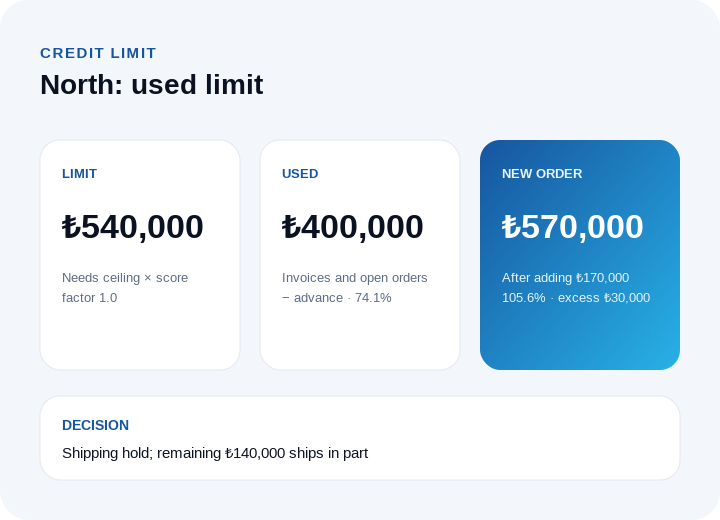
The used limit is not just the open balance in accounting; goods promised to the customer but not yet invoiced also carry risk. The correct formula: used limit = open balance (not yet due + due) + open orders not yet shipped + invoices in transit − advance payments received. An invoice in transit is one that has been issued but not yet posted to the customer account. Say North's limit is ₺540,000:
| Item | Amount | Effect |
|---|---|---|
| Open invoices not yet due | ₺180,000 | + |
| Unpaid invoices past due | ₺40,000 | + |
| Invoices in transit | ₺60,000 | + |
| Open orders not yet shipped | ₺150,000 | + |
| Advance payment received | ₺30,000 | − |
| Used limit | ₺400,000 | 74.1% utilization |
The total: 180,000 + 40,000 + 60,000 + 150,000 − 30,000 = ₺400,000; the remaining limit is ₺140,000. If North places a new ₺170,000 order, usage rises to ₺570,000: 105.6%, an excess of ₺30,000. A system that ignores open orders only sees this excess after shipping.
Where Should the Check Happen at Order Time?
There are two check points, and they need not be equally strict. A check at order entry gives the salesperson an early warning: "This order exceeds the limit." A soft warning is usually enough here, because the customer may be about to pay. A check at shipping approval is the moment goods leave the door; the hard rule stops here. Reversing after shipment is far more expensive.
The rule for partial orders is written in advance. In North's ₺170,000 order the remaining limit is ₺140,000; if the policy says "ship the shippable part and hold the rest", the first shipment is ₺140,000 and the remaining ₺30,000 is released as payment arrives. For the order's place in its lifecycle see our order management system article.
When Is an Order Put on Hold?
Four hold reasons are common: limit excess, an overdue balance threshold (for example, a balance older than 30 days exceeding ₺25,000 or 10% of the limit), customer status (inactive, disputed, documents missing) and repeated violations (three limit excesses in 90 days, say). The hold type is chosen separately for each reason.
| Hold type | Behavior | When suitable |
|---|---|---|
| Soft | Warns, continues with approval | Small excess, class A customer |
| Hard | Stays stopped until released | Overdue threshold, class C, inactive customer |
| Order hold | The order is never confirmed | Disputed customer or missing documents |
| Shipping hold | Order accepted, goods do not leave | Limit excess; preparation can continue |
A shipping hold is smarter in most cases: the order is recorded, preparation starts, and only the exit stops. When approval or payment arrives, the order leaves without delay. How stopping shipments works on the collections side is covered in our B2B collections article.
How Is a Held Order Released?
Release is tiered by the size of the excess. The salesperson opens the request and the credit side decides; the salesperson does not approve their own request. A reason is mandatory, every decision is kept in an audit trail, and the target time is 4 business hours.
| Excess amount | Decision maker | Required record |
|---|---|---|
| Up to ₺25,000 or 5% of limit | Credit analyst | Reason |
| ₺25,001–₺100,000 | Finance manager | Reason + promised payment date |
| Over ₺100,000 | Finance director | Reason + collateral or advance payment |
An exception should be time-limited: a temporary limit valid for 7 days, for example. When the time ends, the limit returns to its old value; a permanent increase is a separate limit-change decision. An open-ended exception is the easy way to raise the limit silently. When building the authority matrix, the least-privilege and separation-of-duties principles in our role-based access control article apply as they are; to run the approval chain in software see our workflow and approval article.
How Is the Held-Order Queue Monitored?
A held order costs time rather than money, and an unwatched queue grows silently. Two things should be visible every day: how many orders and how much value are waiting, and for how long. A sample queue, 38 orders and ₺2,100,000:
| Queue age | Orders | Value |
|---|---|---|
| 0–4 hours | 14 | ₺700,000 |
| 4–8 hours | 11 | ₺560,000 |
| 8–24 hours | 8 | ₺420,000 |
| Over 24 hours | 5 | ₺420,000 |
Orders past the four-hour target number 11 + 8 + 5 = 24: 63.2% of the queue. The average order is ₺55,263. The five orders older than 24 hours total ₺420,000; if 15% cancel, revenue at risk is ₺63,000, and at a 25% contribution margin the lost contribution is ₺15,750. It repeats every day and also wears down customer trust.
How Do You Balance Wrongful Holds Against Bad Debt?
There are two kinds of error: holding a good customer wrongly and extending too much to a bad one. A limit increase decision puts both in one table. Expected loss = default probability × exposure × loss rate. Example: a customer is to receive ₺200,000 of extra limit; default probability is 2% and loss rate 60% (after collateral and partial recovery): 200,000 × 0.02 × 0.60 = ₺2,400. The extra limit brings ₺1,600,000 of additional yearly sales and a 10% contribution margin gives ₺160,000; the financing cost of the extra balance at 40% a year is ₺80,000.
| Default probability | Expected loss | Net contribution (160,000 − 80,000 − loss) |
|---|---|---|
| 2% | ₺2,400 | ₺77,600 |
| 10% | ₺12,000 | ₺68,000 |
| 30% | ₺36,000 | ₺44,000 |
The decision rule: if extra contribution − financing cost − expected loss is positive and total exposure stays within the policy ceiling, the limit is granted. The model ignores that a default also ends the relationship and that several customers can struggle at once, which is why asking for collateral or advance payment on large increases is sensible. For the legal details of collateral and payment guarantees consult your legal counsel, and for provisions and tax effects your accountant.
What About Payments, New Customers, Groups and Foreign Currency Orders?
When a payment arrives, the limit should refresh automatically. If payment matching lags, the customer is held even though the money has been paid. In the example, 96 of 640 monthly holds (15%) are wrongful for this reason; if the matching delay falls from 2 days to 0.5 days, then under a linear assumption wrongful holds drop to 24. At a representative ₺650 per wrongful hold for review, customer contact and delay, the monthly gain is 96 × 650 − 24 × 650 = ₺46,800.
For a new customer there is no data; a low-start, fast-increase rule is used. If the estimated need is ₺400,000, the starting limit is ₺50,000 (12.5%), and every two invoices paid on time double it: 50,000 → 100,000 → 200,000 → 400,000. The customer reaches the ceiling in about six months. For the whole new-customer acceptance process see our onboarding article.
For corporate groups there is a parent limit. Even if four branches' individual limits are 300,000 + 300,000 + 250,000 + 200,000 = ₺1,050,000, with a group limit of ₺800,000 total use cannot exceed that ceiling. Current use is 280,000 + 250,000 + 160,000 + 90,000 = ₺780,000 (97.5%); a ₺40,000 order from the second branch stays within its own limit but would make the group total ₺820,000, so it is held.
For foreign currency orders the limit is converted to lira and a margin is added for rate uncertainty. On a €2,500 order at a rate of 40.00 the amount is ₺100,000; with a 5% margin for how far the rate may move during the terms, ₺105,000 is deducted from the limit.
When Does a Limit Change, and How Is the Customer Told?
Two triggers are watched. Persistent lateness: three consecutive invoices paid more than 15 days late cut the limit by 25% and trigger a class change. Volume growth: three months in a row with usage above 90% and on-time payments opens an increase review. The decision still goes through the authority matrix.
The hold notice sent to the customer should be short, non-accusatory and solution-oriented: "Your order is waiting at shipping approval because the credit limit has been reached. If you share your open balance and payment plan, we will review it and reply the same day." Customer and commercial information is processed under data protection law; consult your legal counsel for details.
Which Measures Should Be Tracked?
Five measures are enough. In the example 640 of 5,200 monthly orders are held.
| Measure | Calculation | Sample value |
|---|---|---|
| Held-order rate | 640 ÷ 5,200 | 12.3% |
| Release rate | 480 ÷ 640 | 75.0% |
| Released orders paid on time | 456 ÷ 480 | 95.0% |
| Limit excess events | Hold reason split: 288 ÷ 640 | 288 events (45%) |
| Bad debt rate | ₺240,000 yearly ÷ ₺48,000,000 | 0.5% |
The hold reasons are 288 limit excesses, 224 overdue balances (35%), 48 customer status cases (7.5%) and 80 repeated violations (12.5%); total 640. The held rate alone is neither good nor bad; the wrongful-hold share (15%) and bad debt are read together. For the cash-side effect see our cash flow guide.
What Is the Payback if the Process Moves into Software?
Three items produce gains. If the bad debt rate falls from 0.5% to 0.3%, yearly loss drops from ₺240,000 to ₺144,000: ₺96,000 a year, ₺8,000 a month. Approval effort falls from 640 holds × 15 min = 160 hours to 640 × 6 min = 64 hours once information is gathered automatically; 96 hours × ₺300 = ₺28,800. Fewer wrongful holds add ₺46,800. The total monthly gain is 8,000 + 28,800 + 46,800 = ₺83,600; after ₺9,600 of running and maintenance the net is ₺74,000. With an investment of ₺444,000, payback is 444,000 ÷ 74,000 = 6 months. If gains halve, the net is 41,800 − 9,600 = ₺32,200 and the time stretches to about 13.8 months.
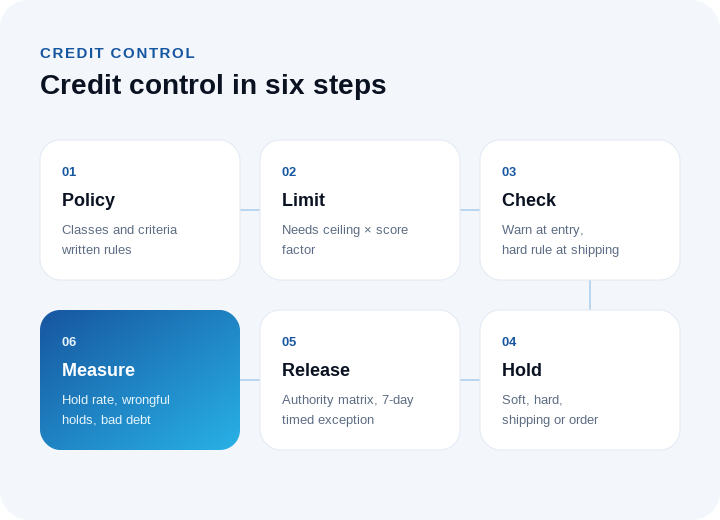
The six steps: 1) write the classes and criteria, 2) set limits with both methods, 3) put the used-limit formula in the system, 4) choose check points and hold types, 5) build the authority matrix and time-limited exceptions, 6) watch the five measures weekly. For margin and discount approval at the quote stage see our quote management article, and for the end-to-end flow from order to cash our order-to-cash guide.
We recommend reading: How to Design B2B Company Accounts, Sub-Users and Purchasing Permissions: Roles, Limits and Approvals
How Can İnovabil Help with This Process?
Credit control is not a separate product but a business rule where orders, customer accounts and approval flows meet. We developed CRM, purchasing and mobile for Avcılar İnşaat; a purchasing system for İZBAN; logistics and wholesale order management for Karyak; warehouse management plus a complaint and support system for Sleepy; and a prepaid cargo system for Kredili Kargo. Our recorded role-based permissions and audit logs form a base for tracking hold and release decisions. We can write your limit rules with you at the requirements stage and hand them over as an analysis deliverable.
We recommend reading: Our software development process: from analysis to launch
Frequently Asked Questions
What is a credit limit and order hold process?
A process in which the amount of credit sale extended to a customer is capped, every order is checked against it, and on excess the order or shipment is stopped until an authorized person releases it.
What is included in the used limit?
Open balance, open orders not yet shipped and invoices in transit are added, and advance payments received are deducted. In the example 180,000 + 40,000 + 60,000 + 150,000 − 30,000 = ₺400,000.
Should the order or the shipment be held?
In most cases a shipping hold is better: the order is recorded and preparation continues, only the exit stops. For a disputed customer or missing documents an order hold is chosen.
Who can release a held order?
It is tiered by excess amount: a credit analyst for small sums, the finance manager or director for larger ones. The salesperson does not approve their own request; the reason and duration are recorded.
How do you reduce wrongful holds?
By shortening payment matching delay, measuring the triggers and using soft holds. In the example, cutting the delay from 2 days to 0.5 days reduces wrongful holds from 96 to 24.