

At month end three piles form on the accounting desk: PDF invoices attached to emails, paper invoices, and e-documents that landed in the system. One does not match its purchase order, one arrived twice, and nobody knows whose approval another is waiting on. Automating accounts payable and incoming invoice processing means putting the chain from receiving a supplier invoice to paying it under rules, and calling in a person only for the exceptions.
This guide covers the general process: channels, data capture, duplicate detection, matching tolerance, coding, approval, the payment plan, bank detail change controls, metrics and payback. We use a representative business with 2,400 invoices a month; all figures are illustrative, not real prices or industry averages. Legal and tax details are left to your tax advisor and legal counsel.
What Steps Does the Incoming Invoice Process Go Through?
The process has nine steps: receipt, data capture, validation, matching, coding, approval, payment plan, payment and reconciliation. The output of each step is the input of the next, so a missing rule carries an error forward and magnifies it.
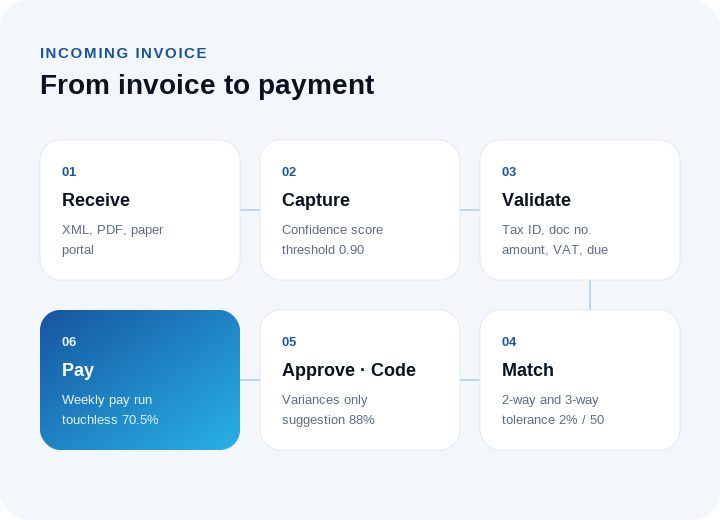
This article is about the payable side, not the receivable side. In customer account tracking the customer owes you and the goal is collection; here you owe, and the goal is to pay the right amount, on the right date, to the right account, exactly once. E-invoice integration, which issues outgoing invoices, is a different flow: on the incoming side an invoice reaches you from someone else, and accepting, rejecting or disputing it is your decision. Ask your tax advisor and the tax authority about procedures and deadlines.
Three traps are common when automating. The first is treating every channel alike: XML and paper have different error profiles and need separate rules. The second is leaving the exception queue without an owner; a queue nobody owns becomes the main source of late payments. The third is measuring speed alone; a fast but wrong payment costs more than a slow, correct one. We do not write rules for accepting, rejecting or disputing an invoice or for retention duties; those belong to your tax advisor.
Which Channels Do Invoices Arrive Through and How Is the Data Captured?
There are four channels: the e-invoice inbox, PDF by email, paper and a supplier portal. In the representative business, 55% of 2,400 invoices are structured e-documents, 30% are PDFs and 15% are paper.
| Channel | Count | Manual entry (min) | Error rate | Monthly time |
|---|---|---|---|---|
| E-document (XML) | 1,320 | 5 | 1% | 6,600 min |
| PDF by email | 720 | 10 | 5% | 7,200 min |
| Paper | 360 | 15 | 8% | 5,400 min |
| Total | 2,400 | avg. 8 | 3.25% | 19,200 min = 320 h |
The error rate is 13.2 + 36 + 28.8 = 78 invoices out of 2,400, or 3.25%. In XML the fields are already structured, so you map fields instead of reading. PDFs and paper need image-based reading (OCR or AI-assisted capture), and per-field accuracy is misleading.
Take eight critical fields: supplier, tax ID, document number, date, currency, VAT, total and due date. If each field is 97% accurate, the chance that all eight are right on one invoice is 0.97⁸ = 78.4%. At 99% field accuracy it becomes 92.3%, and at 99.5% it is 96.1%. That is why the success measure is invoice-level accuracy, not field accuracy.
The answer is a threshold on the capture confidence score. Of the 720 PDFs, 504 (70%) pass automatically with high confidence; 216 go to a person.
| Group | Invoices | With errors | Person catches (95%) | Errors left |
|---|---|---|---|---|
| High confidence, automatic | 504 | 20 | none | 20 |
| Low confidence, human check | 216 | 136 | 129 | 7 |
| Total | 720 | 156 | 27 (3.75%) |
Without a threshold, 720 × (1 − 0.784) ≈ 156 invoices would carry errors; with the threshold and human check, 27 remain and invoice-level accuracy is 96.25%. The person looks at only 216 invoices, 30% of the total. Validation rules (tax ID format, totals that add up) lower the remainder further.
We recommend reading: What is business process automation? Priority score and payback guide
How Are Duplicate Invoices Caught?
The same invoice can arrive once as an e-document and again by email or as a supplier reminder. The key is the combination of supplier, document number and amount; date and tax ID serve as extra checks. The document number is normalized against differences in case, spaces and prefixes.
In the example, 38 of 2,400 invoices are duplicates (1.58%). With an average invoice of ₺14,500, the amount at risk is 38 × ₺14,500 = ₺551,000. If manual checking catches 31, 7 get paid: ₺101,500. If the automatic key catches 37, one remains: ₺14,500. The difference is ₺87,000. The effort of recovering money and the strain on the supplier relationship are not in this figure.
How Are Invoices Matched with Orders and Receipts?
Matching comes in three types, depending on what the invoice is compared with. With ordered purchases it is also verified that the goods or service were actually received. The amount example for three-way matching is in our procurement software article; here we look at the scope of each type.
| Type | Compared | Suitable purchase | Representative count |
|---|---|---|---|
| 2-way | Invoice ↔ order | Ordered services | 600 |
| 3-way | Invoice ↔ order ↔ receipt | Stocked goods | 1,200 |
| No order | Invoice ↔ contract or history | Rent, energy, subscriptions | 600 |
The 600 invoices without an order split into three: 180 fixed-amount (rent, subscriptions; the expected amount sits in the contract record), 240 variable recurring (energy, telecom; a reasonable range based on the last three months' average) and 180 one-off. For the first two, the invoice moves on automatically unless the amount leaves the rule; if 216 stay in range, 396 pass automatically.
Tolerance is set as the smaller of a percentage and an absolute amount for unit price; for quantity, the received quantity is the basis. Example: an order of 40 units × ₺125 = ₺5,000, with the rule "±2% or ₺50, whichever is smaller". 2% is ₺100, the cap is ₺50, so the tolerance is ₺50. An invoice of 40 × ₺126 = ₺5,040 is ₺40 off and passes; 40 × ₺129 = ₺5,160 is ₺160 off and becomes an exception. If 40 units were received but the invoice says 41, the quantity tolerance is zero, so it is an exception.
Of the 1,800 invoices with orders, 72%, or 1,296, match within tolerance. The remaining 504 exceptions break down as follows.
| Exception | Count | Resolution time | Owner |
|---|---|---|---|
| Price variance | 210 | 2 days | Purchasing |
| Quantity variance | 150 | 3 days | Warehouse, purchasing |
| Invoice with no receipt | 96 | 5 days | Warehouse |
| Tax mismatch | 48 | 1.5 days | Accounting |
| Total | 504 | avg. 2.82 days |
The average is (210 × 2 + 150 × 3 + 96 × 5 + 48 × 1.5) ÷ 504 = 1,422 ÷ 504 ≈ 2.82 days. Invoices with no receipt wait longest; usually the goods arrived but nobody entered the receipt, so the fix lies in warehouse discipline (see our goods receiving guide). Give every exception an owner and a time limit, or it will sit forgotten in the queue.
How Do Coding and Approval Get Automated?
Coding decides which expense account and cost center the invoice is booked to. Suggestions come from the supplier's past invoices; in the example the suggestion is 88% correct: of 2,400 invoices, 2,112 are suggested correctly and 288 are corrected. When one invoice spans several cost centers the amount is split, and corrections feed back into learning.
The basic principle in approval is not repeating on the invoice the approval already given on the order. An invoice that matches within tolerance does not go back for approval; only variances, invoices with no order and one-off invoices do. In the example business, 1,296 matched and 396 recurring invoices flow untouched; a person looks at the other 708. Approval authority is set by amount, account and cost center; delegation, time-outs and threshold design are covered in our workflow and approval software article.
The touchless rate is therefore 1,692 ÷ 2,400 = 70.5%. Today, in the same business, 840 invoices (35%) pass untouched.
How Is the Payment Plan Built and Bank Detail Changes Controlled?
An approved invoice enters the payment plan by its due date. In a weekly pay run the rule is: an invoice due before the next run is paid in this run. With weekly runs an invoice is paid on average 3.5 days early; with daily runs, about 0.5 days early. On ₺34,800,000 of monthly payments, a 3-day difference is 34,800,000 ÷ 30 × 3 = ₺3,480,000 of cash staying in hand for that much longer; critical suppliers are prioritized and go first when cash is limited. For the link to cash forecasting, see our cash flow article.
Where an early-payment discount is offered, the measure is the capture rate. In the example, 120 invoices a month carry a discount, averaging ₺300, so the potential is ₺36,000. If capture rises from 40% to 85%, the gain goes from ₺14,400 to ₺30,600, an increase of ₺16,200. Early payment carries a cash cost, so each opportunity is weighed against financing cost.
From a defensive angle, the most critical control is the change of a supplier's bank details; a fake "our account has changed" request is a common route to an unauthorized payment. Controls: a call-back to the registered number when the request did not arrive through a registered channel, a different person making the change and approving it, a waiting period and extra approval for the first payment to a new account, and writing the change to the audit log. At 216 requests a year × 15 minutes of call-backs = 54 hours = ₺16,200; if one unauthorized payment of ₺145,000 is prevented, you gain about 9 times the control cost (145,000 ÷ 16,200 ≈ 8.95).
Segregation of duties separates three roles: the person who enters the invoice, the person who approves it and the person who runs the payment are different people, and whoever changes bank details is none of them. Build the role model with the least-privilege principle from our role-based access control article.
Before the payment file goes to the bank, three checks apply: the total matches the approved invoices, no invoice number appears twice, and account numbers match the registered details. After payment, the bank movement is matched to the invoice; unmatched outflows fall into a daily reconciliation list, and a paid invoice moves to "paid" only after that match.
How Do You Make Purchases Without an Invoice Visible?
A purchase that has been received but not yet invoiced means missing expense and liability at month end. The "received, not invoiced" report is the gap between received lines and matching invoices. In the example, 164 lines worth ₺2,460,000 are waiting without an invoice at month end; 12 lines older than 60 days are ₺310,000 (12.6%). The report becomes an input to the closing accrual; for the accounting entry, see the month-end close guide and your tax advisor.
Which Metrics Should You Track?
| Metric | Before | After |
|---|---|---|
| Cost per invoice | ₺85 | ₺22 |
| Receipt to payment plan | 9 days | 3 days |
| Touchless rate | 35% | 70.5% |
| Matching exception rate | 38% | 28% |
| On-time payment | 94% | 98.5% |
| Duplicate payments | 7 | 1 |
| Discount capture | 40% | 85% |
The time breakdown: before, 2 days recording, 2 days matching, 1 day coding, 3 days approval, 1 day planning = 9 days; after, 0.5 + 0.5 + 0.5 + 1 + 0.5 = 3 days. Cost: ₺85 ≈ 17 minutes × ₺5 a minute; ₺22 is a representative value covering labor and running cost together. The exception rate in the example applies only to invoices with orders: 504 ÷ 1,800 = 28%; the earlier 38% means 684 exceptions on the same base. Track not only headcount but also exception resolution time and on-time payment.
How Is Payback Calculated?
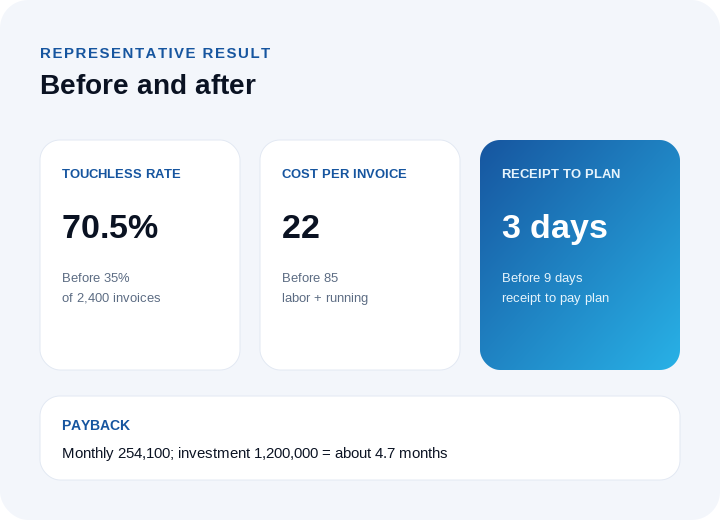
Four items are counted. Process cost: 2,400 × (₺85 − ₺22) = ₺151,200. Duplicate payments: (7 − 1) × ₺14,500 = ₺87,000, and ₺43,500 if half is assumed unrecoverable. Late payment: when on-time payment rises from 94% to 98.5%, late payments fall from 144 to 36; (144 − 36) × ₺400 of interest and penalty = ₺43,200. Discounts: ₺16,200. Monthly total: 151,200 + 43,500 + 43,200 + 16,200 = ₺254,100.
With an investment of ₺1,200,000 (setup, integration, training), payback is 1,200,000 ÷ 254,100 ≈ 4.7 months. In a cautious scenario where the saved working time is not redeployed and does not turn into cash, only 43,500 + 43,200 + 16,200 = ₺102,900 remains and payback stretches to about 11.7 months. If half of the process saving is realized (₺75,600), the total is ₺178,500 and payback takes 6.7 months. Recalculate with your own volume.
How Do You Implement Incoming Invoice Automation?
- Measure: Record channel mix, time per invoice, errors, duplicates and on-time payment for a month.
- XML first: Automate e-document invoices through field mapping; this is the lowest risk and fastest gain.
- Write the rules: Put tolerance, approval and bank detail change rules in writing.
- PDF capture: Start with a confidence threshold: automatic when high, human when low.
- No-order invoices: Add fixed and recurring expenses through templates.
- Keep measuring: Watch the touchless rate, exception time and on-time payment monthly.
For spend breakdowns and merging supplier names, the spend analysis guide helps; for a channel where the supplier enters its own invoice and account details, see our supplier portal article.
We recommend reading: What Is Expense Management Software? Receipts, Policy, Advances, Approval and Accounting Export
Procurement and Accounting Processes with İnovabil
At İnovabil our focus is building software from scratch, tailored to the company: custom software, ERP, CRM, e-commerce, web, mobile and integration. We built a procurement system for İZBAN, CRM, procurement and mobile for Avcılar İnşaat, logistics and order management for Karyak, and warehouse management for Sleepy. We make no claim of a ready-made incoming invoice product; in requirements analysis we recommend writing down your channel mix, tolerance rules and approval chain, and then designing the integration with your accounting and purchasing systems.
We recommend reading: Our software development process: from analysis to launch, step by step
Frequently Asked Questions
What is incoming invoice automation?
It is running the receipt, capture, validation, order matching, coding, approval and payment of supplier invoices by rules. A person looks only at exceptions.
What is the touchless invoice rate?
It is the share of invoices that reach the payment plan without human intervention. In the example, 1,692 ÷ 2,400 = 70.5%, against 35% at the start.
How are duplicate invoices prevented?
By building a key from supplier, document number and amount, and checking every invoice from every channel against it. The document number is normalized against differences in letters and spaces.
What is the difference between two-way and three-way matching?
Two-way compares only the invoice and the order; three-way also compares the receipt. Three-way suits stocked goods, two-way suits ordered services.
What should you do when a supplier asks to change bank details?
Call back on the registered number, have a different person approve, wait and add extra approval for the first payment to the new account, and write it to the audit log. If the request came by email, do not trust that channel alone.