You have built a dealer order management application and want to sell it by subscription. The product is ready, but what number goes on the price tag, and what will the customer pay for? If the price is too low, the product cannot fund itself; if it is too high, nobody converts after the trial. Pricing and packaging a SaaS product means building a structure the customer understands and the business can survive on.
This guide walks through every step, from choosing a value metric to testing the price, using a dealer order and stock application as the example. All figures are illustrative; they are not the price of a real product or market.
What Is the Difference Between SaaS Pricing, Packaging and Plan Design?
Packaging decides what goes into which package, pricing decides how much each package costs, and plan design makes the two work together through usage limits and upgrade rules. If the three are designed separately, customers cannot see why they pay more when they upgrade.
| Concept | Question it answers | Example decision |
|---|---|---|
| Pricing | How much does the customer pay? | Growth costs 3,600 per month |
| Packaging | Which feature sits in which package? | API access only from Growth upward |
| Plan design | How do limits, overage and upgrades work? | Warning at 4,000 orders, add-on after the limit |
For MRR, churn and subscription models see our SaaS guide; for the technical side of invoicing see subscription billing software. Here we focus on building the price structure.
Recommended reading: What is SaaS? Multi-tenant architecture, MRR, churn and development guide
How Do You Choose a Value Metric?
The value metric is the unit the bill grows with: user, transaction, storage, module or branch. A good metric meets four conditions: it rises together with the value the customer receives, the customer understands it easily, the system can measure it reliably, and it does not produce surprise bills at month end.
| Metric | Advantage | Disadvantage |
|---|---|---|
| User (seat) | Easy to grasp, predictable | Spreading usage is penalised; account sharing begins |
| Transactions (orders) | Tied directly to value | The bill fluctuates; customers fear the meter |
| Storage | Matches cost | Not a signal of value for the customer |
| Module | Clear feature separation | Packages multiply, confusion grows |
| Branches or dealers | Reflects business size | Large and small dealers pay the same fee |
Comparing the bills of the same three customers under different metrics makes the choice easier. The example assumes 400 per user, 0.80 per order and 20 per dealer.
| Customer | Usage | Per user | Per order | Per dealer |
|---|---|---|---|---|
| Small | 3 users, 20 dealers, 800 orders | 1,200 | 640 | 400 |
| Medium | 15 users, 120 dealers, 4,200 orders | 6,000 | 3,360 | 2,400 |
| Large | 40 users, 500 dealers, 16,000 orders | 16,000 | 12,800 | 10,000 |
The medium customer pays 6,000 under per-user pricing, yet the value mostly grows with the number of orders processed. So in the example we use order volume as the metric and the user count as a package limit.
How Do You Calculate the Price Floor?
The floor comes from the monthly variable cost per customer and the target gross margin. The items are infrastructure, support and payment commission per customer. Formula: minimum price = (infrastructure + support) ÷ (1 − commission rate − target margin). The example uses a 2.5% commission and a 70% target gross margin, so the denominator is 1 − 0.025 − 0.70 = 0.275.
| Package | Infrastructure + support | Minimum price | List price | Gross margin |
|---|---|---|---|---|
| Starter | 280 | 1,018 | 1,200 | 74.2% |
| Growth | 750 | 2,727 | 3,600 | 76.7% |
| Enterprise | 2,000 | 7,273 | 9,600 | 76.7% |
Gross margin = (price × 0.975 − cost) ÷ price. For Starter that is (1,170 − 280) ÷ 1,200 = 74.2%. The minimum price is only the "we cannot go below this" line. For infrastructure cost per customer see our multi-tenant architecture guide.
How Much Are Customers Willing to Pay? How Do You Measure Price Sensitivity?
You ask customers four questions: at what price is the product so cheap that you doubt its quality, at what price is it cheap but acceptable, at what price is it expensive but you would still consider it, and at what price is it too expensive to buy? The method reads the acceptable range from where the curves of these four answers cross. Assume we received 40 responses from dealer companies.
| Monthly price | Too cheap | Cheap | Expensive | Too expensive |
|---|---|---|---|---|
| 1,500 | 40% (16) | 70% (28) | 0% | 0% |
| 2,500 | 15% (6) | 45% (18) | 10% (4) | 0% |
| 3,500 | 2.5% (1) | 20% (8) | 30% (12) | 10% (4) |
| 4,500 | 0% | 7.5% (3) | 60% (24) | 35% (14) |
| 5,500 | 0% | 0% | 85% (34) | 65% (26) |
The lower end is where "too cheap" crosses "not cheap" (100 − cheap): at 1,500 it is 40% against 30%, at 2,500 it is 15% against 55%, so linear interpolation puts the crossing near 1,700. The upper end is where "too expensive" crosses "not expensive" (100 − expensive): at 4,500 it is 35% against 40%, at 5,500 it is 65% against 15%, which gives about 4,590. The acceptable range is 1,700 to 4,590, and 3,600 for Growth sits inside it. Forty responses is a small sample; the result shows direction, not a verdict.
How Many Packages Should There Be and What Goes in Them?
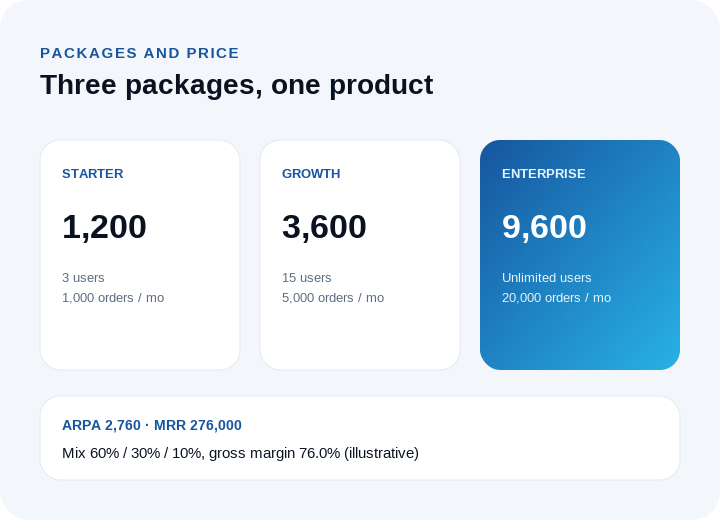
Three packages are a good start: entry, middle and top. Three options let the customer compare and make the middle package an anchor. The distribution is a result you measure with your own customers; too many packages make choosing harder.
Two tools control content: a feature gate (a feature opens only in certain packages) and a usage limit (the feature exists everywhere but in different amounts). The core job appears in every package; management, security and integration features go to the top package because growing customers are the ones who need them.
| Feature | Starter | Growth | Enterprise |
|---|---|---|---|
| Monthly price | 1,200 | 3,600 | 9,600 |
| Users | 3 | 15 | Unlimited |
| Orders per month | 1,000 | 5,000 | 20,000 |
| Price per order | 1.20 | 0.72 | 0.48 |
| API access | None | Read | Full, with quota management |
| Role-based access, single sign-on | Basic roles | Custom roles | Custom roles and single sign-on |
| Support | Priority | Assigned |
For quota and usage logic of API plans see our API key and quota guide. The gap between Growth and Enterprise is 2.67 times (9,600 ÷ 3,600); a customer in between may need an add-on.
How Do You Calculate the Package Mix and ARPA?
ARPA (average revenue per account) = total MRR ÷ customers. If 60% of 100 customers are on Starter, 30% on Growth and 10% on Enterprise, MRR = 60 × 1,200 + 30 × 3,600 + 10 × 9,600 = 72,000 + 108,000 + 96,000 = 276,000 and ARPA = 2,760. On the cost side: 60 × 280 + 30 × 750 + 10 × 2,000 = 59,300; commission 276,000 × 2.5% = 6,900; gross profit 276,000 − 59,300 − 6,900 = 209,800, or 76.0%.
If 5 customers upgrade from Starter to Growth each year, MRR rises by 5 × 2,400 = 12,000 to 288,000 and ARPA to 2,880 (4.3%). If the same upgrade happens every year and the customer count stays fixed, three-year revenue is 12 × (276,000 + 288,000 + 300,000) = 10,368,000; without upgrades it is 276,000 × 36 = 9,936,000. The difference is 432,000.
Recommended reading: How to calculate customer lifetime value (CLV)
How Do You Set Annual Discounts, Trials and Setup Fees?
Annual payment. "Two months free" means charging 10 months for 12; the discount is 2 ÷ 12 = 16.7%. If 40 of 100 customers pay annually upfront at ARPA 2,760, each pays 10 × 2,760 = 27,600; in the first month 40 × 27,600 = 1,104,000 comes in, whereas monthly billing would bring only 110,400. The cash advantage is 993,600. The cost is 40 × 2 × 2,760 = 220,800 of lost revenue per year (6.7%).
Trial and free plan. A 14-day trial, a limited free plan and a demo do different jobs. A demo suits enterprise sales, a trial suits a product that explains itself; a free plan carries support cost and should stay narrow. If 18% of 1,000 trials convert, you win 180 customers. With support of 45 per trial the total is 45,000, or 250 per paying customer. If conversion falls to 12%, the cost rises to 375; a drop from 18% to 14% means 40 × 2,760 = 110,400 of lost MRR.
Setup fee. A one-off fee covers preparation work: a setup costing 12 hours × 300 = 3,600 can be priced at 4,500. Custom adaptation is a separate project; see off-the-shelf vs custom software for the difference.
How Do You Manage Overage and Discount Policy?
Cutting a customer off at the limit annoys them. A better path is a warning at 80% of the limit (4,000 orders for Growth) and an add-on or upgrade offer after it. Let overage cost 0.50 per order. A Growth customer who processes 8,000 orders pays 3,600 + 3,000 × 0.50 = 5,100. Overage should not exceed the gap to Enterprise: at (9,600 − 3,600) ÷ 0.50 = 12,000 extra orders, i.e. 17,000 orders, Growth plus overage reaches 9,600 and the customer is offered Enterprise.
Put a ceiling on discounts: in the example 15% at most, with an approval step. Growth at 3,600 with a 15% discount becomes 3,060 and gross margin falls to (3,060 × 0.975 − 750) ÷ 3,060 = 73.0%. If the margin floor is 70%, the largest allowed discount is 1 − 2,727 ÷ 3,600 = 24.2%. The "endless discount" trap is stacking: 15% on top of 15% totals 27.75%, the price drops to 2,601 and margin to 68.7%, below the floor. So discounts are not multiplied; apply the single best one. For licensing forms see our software license guide.
How Do You Handle Price Increases and Old Packages?
A simple calculation reduces the fear: if you raise the list by 10% and 3% of customers leave, MRR is 97 × 2,760 × 1.10 = 294,492, which is +18,492 against today's 276,000. The churn at which the increase turns into a loss is 1 − 1 ÷ 1.10 = 9.1%. Churn is an estimate; measure it in a first group before extending the increase to everyone. For causes of churn and prevention see our customer churn guide.
For existing customers there are three options: keep the old price for a period (grandfathering), raise gradually, or add an inflation or exchange-rate index clause to the contract. The contract sets the notice period (60 days is illustrative); the right to change prices and cancellation terms should be settled with a legal advisor. When closing an old package, sell only the new plan to new customers, keep the old ones on a "legacy" plan at the protected price and announce an end date.
How Do You Test a Price?
A test shows two prices at random to new customers. Example: Growth at 3,600 against 4,200. For the new price to earn the same revenue, conversion must not fall below 3,600 ÷ 4,200 × 18% = 15.4%. If you want to detect a 4-point difference, you need about n ≈ 16 × p(1 − p) ÷ d² = 16 × 0.18 × 0.82 ÷ 0.04² ≈ 1,476 observations per variant; for a 2.6-point difference about 3,494. With 1,000 trials a month split 500 each, the first threshold takes about 3 months and the second about 7.
There is a trust risk: two customers may compare notes and see different prices for the same product. Test only new customers and honour the displayed price.
How Do You Arrange the Pricing Page, Contract, VAT and Currency?
On the pricing page show packages in a comparison table, highlight the middle package, use "contact us" for Enterprise and add a short FAQ. State clearly that you sell a ready product, not custom development. Cancellation and refund terms go to a legal advisor; VAT display and invoice timing go to an accountant. If you price in local currency, set up an update routine for exchange rates and inflation.
Which Metrics Track Pricing and When Does It Pay Back?
| Metric | Example | Calculation |
|---|---|---|
| ARPA | 2,760 | 276,000 ÷ 100 |
| Upgrade rate | 8.3% | 5 ÷ 60 Starter customers per year |
| Trial conversion | 18% | 180 ÷ 1,000 |
| Discount share | 2.3% | 12 customers × 540 = 6,480 ÷ 276,000 |
| Gross margin | 76.0% | 209,800 ÷ 276,000 |
Say repackaging takes 24 person-days × 9,000 = 216,000 (plan gates, billing setup, pricing page, tests). The monthly net gain from upgrades is 12,000 × 0.975 − 5 × (750 − 280) = 9,350, so payback is 216,000 ÷ 9,350 ≈ 23.1 months. A 10% increase with 3% churn adds about 18,030 net (18,492 × 0.975); with both, 27,380 per month and payback of about 7.9 months. If no upgrades come, the increase alone pays back in about 12.0 months. For how the effort is estimated see our software project cost guide.
To keep scope small at the start see What is an MVP; for the domain of the example product see dealer management system. Retail product pricing is a separate topic: our price optimization guide.
Building a Subscription Product with İnovabil
At İnovabil our focus is building custom software from scratch for your company. For a business that wants to sell a product by subscription, the multi-tenant architecture, the infrastructure that enforces plans and usage limits, and the billing and payment integrations are defined together in requirements analysis; NetKasam and Shopiyz are our own SaaS products. We do not offer pricing consulting or promise figures; the pricing decision belongs to you, because you know your customers.
We developed CRM, purchasing and mobile for Avcılar İnşaat; a purchasing system for İZBAN; shipment planning and wholesale order management for Karyak; and warehouse management plus a complaint and support system for Sleepy. Send a short summary of your product idea and we will settle the scope in a written analysis.
Recommended reading: Our software development process: step by step from analysis to release
Frequently Asked Questions
How do you price a SaaS product?
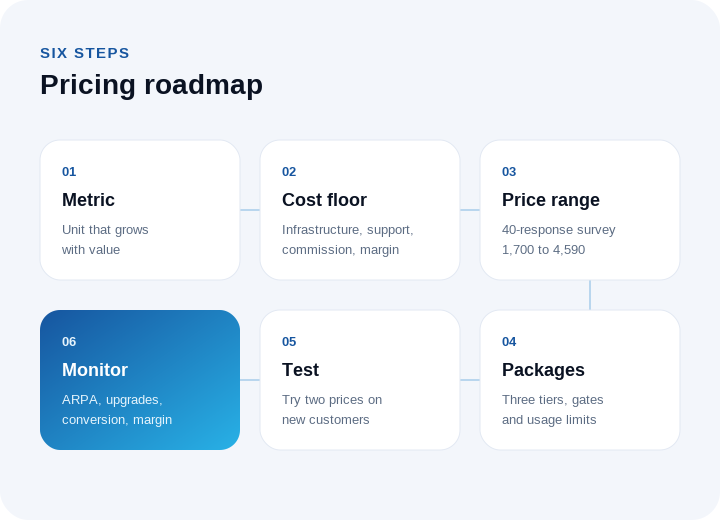
You choose a value metric, calculate the cost floor, learn the acceptable price range, build three packages and test the price on a small group of new customers.
Should the value metric be users or orders?
Choose the unit that grows with value and is easy to measure: transactions if value follows volume, users if it follows teamwork. You can use one as the metric and the other as a package limit.
How many packages should there be and how are prices set?
Three packages are a good start. The price is set above the cost floor and inside the acceptable range, then tested.
How big should an annual payment discount be?
Two months free is a 16.7% discount. The decision compares the cash advantage with the lost revenue; in the example 993,600 of extra cash is traded for 220,800 of yearly revenue.
How do I limit customer loss when raising prices?
Measure in a small group first, protect the old price for a period, give notice as the contract requires and compare churn with the break-even rate (9.1% in the example).