

When you buy software, you usually do not buy the software itself; you buy the right to use it under certain conditions. The document that defines that right is the software license. Businesses that sign without reading it tend to be surprised in three places: the invoice when the user count grows, the overuse finding when an audit arrives, and the question of who holds the data and the source code when they want to leave.
In this guide we explain what a software license is, how it differs from ownership, the six license models, the comparisons of perpetual versus subscription and per-user versus concurrent-user, how to measure unused licenses, the two general families of open-source licenses, how to handle source code and intellectual property in custom software, license audits, and eight questions to ask when choosing a license. All example figures are illustrative; they are not the price of any product or an industry average.
What Is a Software License?
A software license is the contract or permission text through which the rights holder tells another person or organization on what terms the software may be used. Software is not an object you buy once and use freely forever like a book; the rights holder keeps most of the rights and grants the other side only a defined permission to use.
A license text typically sets: the number of users or devices, the period of use, the place of installation (your own server or a hosted environment), permission to copy and modify, transfer to third parties, the right to support and updates, and the consequences of a breach. When any of these changes, cost or risk changes with it.
We recommend reading: What is custom software? Types, layers, cost and decision guide
What Is the Difference Between a License and Ownership?
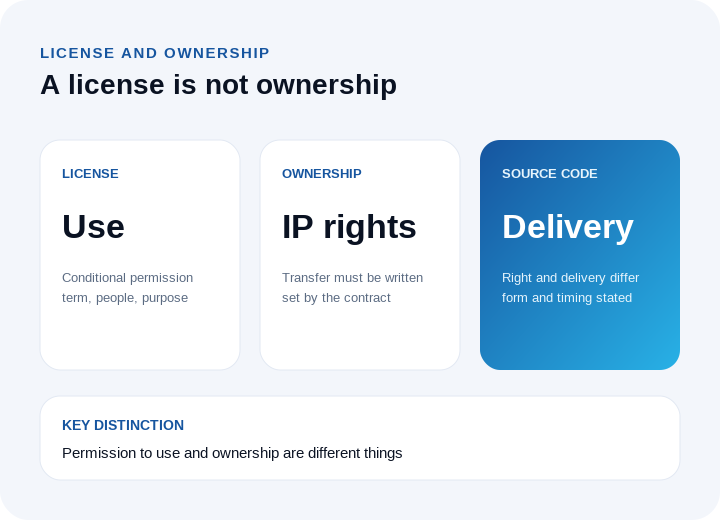
A license is permission to use; ownership is about who holds the intellectual property rights in the software. The two may or may not sit with the same party, and the difference matters most when you commission software.
- With off-the-shelf software: The intellectual property stays with the vendor and you receive a license. You do not see the source code; you only use the running version.
- With custom software: Rights are set by the contract. Transferring the rights to your business, granting only a usage license, or a mixed arrangement are all possible; if the contract does not say which, a dispute follows.
- Source code is a separate matter: Delivery of the source code must appear in the contract separately from the right to use or the ownership.
What Are the Software License Models?
Six models are common. Each one makes cost grow with something different.
| Model | How it works | How cost grows | Watch out for |
|---|---|---|---|
| Perpetual license | One-time fee for indefinite right of use | High upfront; then annual support and updates | When support ends, updates and security patches may stop |
| Subscription | Monthly or yearly fee for a time-limited right | Linearly with time and users | If payment stops, access stops |
| Per user (named) | One license assigned to each person | With the number of registered people | A leaver's license is wasted if not reclaimed |
| Concurrent user | As many licenses as people who may be signed in at once | With peak simultaneous use | A login queue can form at peak hours |
| Usage or transaction based | Charged by transactions, records or data volume | With business volume | If the volume forecast is wrong, the bill drifts |
| Enterprise agreement | Fixed package for the whole organization or a limited scope | By negotiation; usually annual | Scope and renewal terms must be explicit in the contract |
We covered the general comparison between using a ready-made product on subscription and commissioning custom software in our off-the-shelf versus custom software guide. For the logic of products that run on subscription, see our SaaS article.
Is a Perpetual License or a Subscription Cheaper?
In the short run a subscription is usually cheaper and in the long run a perpetual license is, but the crossover depends on the number of users and the support fee. In an illustrative example, take a business with 40 users and compare the two options:
- Subscription: ₺600 per person × 40 users = ₺24,000 per month; ₺24,000 × 12 = ₺288,000 per year.
- Perpetual license: ₺500,000 one-time + annual support and updates at 20% = ₺100,000.
Over three years the subscription costs ₺288,000 × 3 = ₺864,000; the perpetual license costs ₺500,000 + ₺100,000 × 3 = ₺800,000. The crossover: ₺500,000 + ₺100,000 × t = ₺288,000 × t → t = ₺500,000 ÷ ₺188,000 ≈ 2.66 years, about 32 months. In year five the perpetual license totals ₺500,000 + ₺500,000 = ₺1,000,000, while the subscription reaches ₺1,440,000.
This comparison covers the license fee only. A subscription usually includes hosting; with a perpetual license, servers, backups and administration must be costed separately. We calculated how the hosting choice affects cost in our cloud versus on-premise guide.
Should You Choose Per-User or Concurrent-User Licensing?
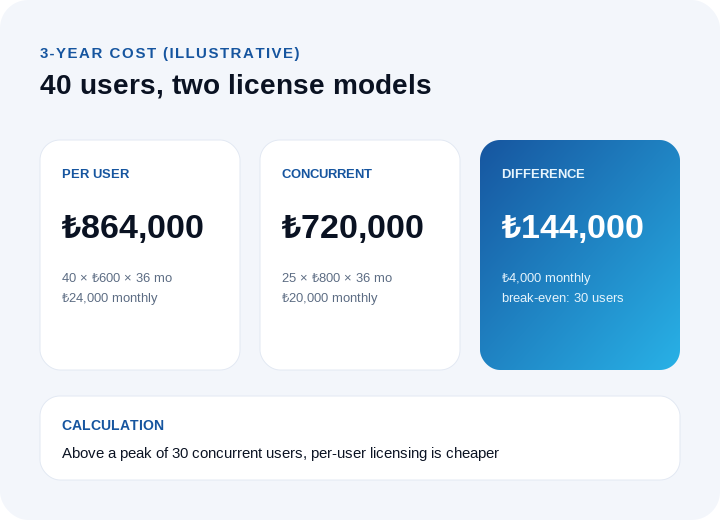
If most users do not use the software at the same time throughout the day, a concurrent license can pay off, but its unit price is usually higher. In an illustrative example, 40 users work in shifts, so at most 25 people are in the system at once:
- Per user: 40 × ₺600 = ₺24,000 per month; over three years ₺24,000 × 36 = ₺864,000.
- Concurrent: 25 × ₺800 = ₺20,000 per month; over three years ₺20,000 × 36 = ₺720,000.
The monthly difference is ₺24,000 − ₺20,000 = ₺4,000; over three years ₺864,000 − ₺720,000 = ₺144,000. Break-even: ₺600 × 40 = ₺800 × c → c = 30. Up to a peak of 30 concurrent users, concurrent licensing is cheaper; above 30, per-user licensing is.
| Peak concurrent users | Concurrent (monthly) | Per user (monthly) | Cheaper |
|---|---|---|---|
| 20 | 20 × ₺800 = ₺16,000 | ₺24,000 | Concurrent |
| 25 | 25 × ₺800 = ₺20,000 | ₺24,000 | Concurrent |
| 30 | 30 × ₺800 = ₺24,000 | ₺24,000 | Equal |
| 35 | 35 × ₺800 = ₺28,000 | ₺24,000 | Per user |
Measure the peak from session logs, not from a guess. With concurrent licensing, a user who cannot sign in at the peak is lost work; include that cost in the comparison.
How Do You Calculate the Unused License Rate?
The unused license rate shows how much of what you bought is really used. Formula: active users ÷ total licenses. In an illustrative example, 31 of 40 licenses were signed in at least once in the last 90 days: 31 ÷ 40 = 77.5%. The idle licenses number 40 − 31 = 9.
The wasted amount: 9 × ₺600 = ₺5,400 per month; per year ₺5,400 × 12 = ₺64,800; over three years ₺5,400 × 36 = ₺194,400. If you keep 2 licenses as a buffer, the licenses you could cut are 9 − 2 = 7: 7 × ₺600 = ₺4,200 per month, ₺50,400 per year.
- Measurement: Write down the definition of active (for example, at least one sign-in in the last 90 days) up front.
- Reclaiming: Put a process in place to take back the license of people who leave or change roles.
- Calendar: Count at least a month before renewal; in many contracts licenses can only be reduced at renewal.
How Do Open-Source Licenses Work?
Open source does not mean free of conditions; it is a type of license under which the source code may be used and modified on certain terms. Although there are many licenses, they fall into two general families.
| Family | What it asks | Effect on your product |
|---|---|---|
| Permissive | Usually asks you to keep the copyright notice; allows the code to be used alongside closed-source code in your own product | Relatively easy to use in a commercial product |
| Requires sharing source code | If you use and distribute the code, asks you to share the source of the derived work under the same terms | An obligation to open your own code may arise; it depends on how you use it |
What obligation a given license creates for a given way of using it depends on the license text and on the use. Before using such code in a commercial product, have a lawyer make this assessment. Security patches for open-source components are also your responsibility; how that ties to aging code is touched on in our technical debt article.
Who Owns the Source Code and Intellectual Property in Custom Software?
Law alone does not decide this; what the contract says does. That is why, when commissioning custom software, the right to use, ownership and source code must each be written separately.
| Topic | What the contract must state explicitly |
|---|---|
| Right to use | Duration (indefinite or not), scope (one company or including affiliates), user or installation limit |
| Intellectual property | Whether the rights pass to your business or stay with the developer, and the boundary of any mixed arrangement |
| Source code | Whether it is delivered, when (at each milestone or at handover), in what form, and with documentation or not |
| Ready-made components | The list of third-party and open-source components and their own licenses |
| Other customers | Whether the developer may let others use the same solution or parts of it |
| Exit | Support for transferring code, data and knowledge if the contract ends |
How to phrase these headings as contract clauses is the lawyer's job. Your job is to state the outcome you want clearly. We covered the whole commissioning process in our guide to getting custom software developed and what a specification should contain in our software RFP guide.
We recommend reading: What is a software maintenance agreement (SLA)?
What Is a License Audit and the Risk of Overuse?
A license audit is a check, by the rights holder or a third party, of whether the amount of software you use matches your licenses. Many contracts include this right.
Illustrative example: 40 licenses were bought, but the records show 46 people using the software. Overuse is 46 − 40 = 6 people. At a list price of ₺600, the yearly gap is 6 × ₺600 × 12 = ₺43,200; looking back two years, 6 × ₺600 × 24 = ₺86,400. The overuse terms in your contract (list price, surcharge or other consequences) may differ; this calculation is only a sense of scale.
- Keep records: Keep the number of licenses, the assigned person, the assignment date and the reclaim date in one table.
- Avoid shared accounts: Sharing one license among several people is a breach under most licenses.
- Virtual environments and test copies: Find out whether test and backup environments need their own licenses.
- Yearly internal count: Do your own count before an audit arrives.
Why Do You Need a Third-Party Component Inventory?
Software is not made only of the code you wrote; it contains many ready-made libraries and components. Each has its own license, and your product is subject to the terms of all of them.
Illustrative inventory: of 120 components, 84 are permissive, 26 are from the family that requires sharing source code, and the license of 10 is unclear. The unclear share is 10 ÷ 120 = 8.3%; the total is 84 + 26 + 10 = 120. The real work is to examine how the second family and the unclear group are tied into the product; not all of them are a problem, but all of them must be seen.
- The list: Component name, version, license family, where it is used and the responsible person.
- Updates: Add a step that checks the license whenever a new component is added.
- At handover: When you receive custom software, ask for the component list and a license summary.
Which Eight Questions Should You Ask When Choosing a License?
- How many people will use it? Write down today's and the three-year user count.
- How many at the same time? Measure peak concurrent use; compare per-user and concurrent models.
- For how long? Calculate total cost over three and five years.
- Are support and updates included? Find out on what condition security patches arrive.
- What happens to the data? If the contract ends, in what format and how fast do you get it back?
- Who holds the source code and the rights? For custom software, put it in writing.
- What are the overuse terms? Audit right, surcharge and tolerance.
- How do renewal and price increases work? Automatic renewal and a cap on increases should be in the contract.
What Are the Common License Mistakes?
- Accepting a license without reading it: Overuse and transfer terms become a problem later.
- Buying the user count by guesswork: Buy too many and you overpay; buy too few and you face overuse.
- Not reclaiming a leaver's license: A silent cost item.
- Not discussing ownership in custom software: The assumption "we commissioned the code, so it is ours" causes a dispute if the contract does not back it.
- Not checking open-source component licenses: Obligations can arise when the product is distributed.
- Comparing only the first year: The gap between perpetual and subscription only shows over three to five years.
We recommend reading: What Is Version Control (Git)? Commits, Branches, Merging, Tags and Source Code Ownership Guide
We recommend reading: What Is Contract Management Software? Life Cycle, Renewal Alerts and Payback Guide
We recommend reading: How to Drive Software Adoption: User Training, Champion Network, Rollout and Measurement Guide
We recommend reading: How to Manage Software Inventory and Shadow IT: Discovery, Risk Score and Approval Rule Guide
We recommend reading: How to Set Up a Software Bill of Materials (SBOM) and Dependency Update Management: Vulnerability Matching, Priority and Payback Guide
We recommend reading: How to Do a Software Technical Due Diligence: Code and Architecture Audit, Scorecard and Decision Guide
Source Code and Ownership in Custom Software with İnovabil
At İnovabil our focus is building bespoke software from scratch for your company. If you commission custom software, we recommend that the right to use, intellectual property and source code delivery be written explicitly in the contract, that you settle them during requirements analysis, and that a lawyer reviews the final text. We do not promise a license model or a price here; the aim is for the decision to be made consciously from the start.
We built CRM, purchasing and mobile for Avcılar İnşaat; a purchasing system for İZBAN; logistics and shipment planning with wholesale order management for Karyak; and warehouse management plus a complaint and support management system for Sleepy. Send us a short summary of the license situation of your current software or the scope of the work you are considering, and we will look at it together.
We recommend reading: Our software development process: step by step from analysis to launch
Frequently Asked Questions
What is a software license, in short?
It is the permission and contract text in which the rights holder sets who may use the software, with how many people, for how long and for what purpose. A license grants a right to use; it does not grant ownership or source code.
Is buying software the same as licensing it?
No. With most off-the-shelf software, what you buy is the right to use, not the software itself. With custom software, whatever the contract says about who gets the rights applies, which is why it must be made explicit in the contract.
What is the difference between per-user and concurrent licensing?
With per-user licensing each user is assigned a license; with concurrent licensing you buy as many licenses as the number of people who can be signed in at once. In the example the concurrent unit price is ₺800 against ₺600 per user, so break-even is 30 concurrent users; recalculate with your own figures.
Who holds the source code in custom software?
It depends on what the contract says. Whether the source code is delivered, when and in what form, and who holds the intellectual property should each be written separately. Prepare this text with a lawyer.
Is open-source software free and usable anywhere?
It may be free of charge, but it is not unconditional. Permissive licenses make commercial use relatively easy; licenses that require sharing source code can create an obligation to open your own product's code. Have a lawyer assess the license text before you use it.