

You asked three software companies for a quote. One sent a single-page price, one sent a thirty-page presentation, and the third said "let's talk." You cannot tell which is cheaper or which covers more, because each company answered a different question. The problem is not the bids; it is the way they were requested. A software RFP (request for proposal) is the written document that asks every vendor the same question so that you get answers you can actually compare.
In this guide we cover the difference between an RFP, an RFI and an RFQ, the sections of the document, how to write requirements, fixed-price and time-and-materials bid formats, weighted scoring with a four-bid worked example, the timeline, the Q&A round and reference checks. We covered preparing a brief and the general comparison of bids in our guide to getting custom software developed; here we pick up from that point and focus on the RFP document itself. All figures are representative, not real prices or market rates.
What Is a Software RFP (Request for Proposal)?
A software RFP is a written document, sent to several vendors at once, that describes a project's problem, scope, requirements, delivery terms and how the bids will be evaluated. Its purpose is to collect written, comparable bids on equal terms.
Writing one looks like extra work at first. In practice it moves the work forward: debates about scope surface before the contract, and when the bids arrive you can see what each vendor assumed. The analysis that feeds the document is requirements work; we explained how to do it in our guide to software requirements analysis.
We recommend reading: Our custom software service
What Is the Difference Between an RFP, an RFI and an RFQ?
All three ask vendors for written input; the difference is what is asked at which stage. An RFI asks for information, an RFQ asks for a price, and an RFP asks for the solution and the price together.
| Document | Stands for | What it asks for | When to use it |
|---|---|---|---|
| RFI | Request for information | Information on a vendor's capabilities, experience and approach | While exploring the market or building a shortlist |
| RFQ | Request for quotation | Price only, for a well-defined piece of work | For standard work with a fixed scope |
| RFP | Request for proposal | Solution approach, timeline, team, references and price | For projects where the scope is defined but the solution path is open |
In custom software the RFP is used most often, because two vendors can solve the same problem with different architectures and in different timeframes. If your candidate list is long, a short RFI first can narrow it to 3–5 vendors, and you then send the long RFP only to them.
What Sections Does a Software RFP Contain?
An RFP does not have to be long, but it should have all ten sections. The table below summarizes what to write in each.
| Section | Contents |
|---|---|
| 1. Company and context | Who you are, industry, number of employees and users, existing systems |
| 2. Problem and goal | The problem to solve and a measurable goal (e.g. shorten order entry time) |
| 3. Scope and out of scope | What will be built and what will explicitly not be built |
| 4. Requirements | Mandatory and desired items, each measurable |
| 5. Technical and integration terms | Systems to connect, data migration, hosting preference, source code expectation |
| 6. Security and KVKK expectations | Permission model, audit trail, backups, approach to personal data |
| 7. Delivery and payment plan | Milestones, acceptance criteria, payment terms, warranty and maintenance |
| 8. Bid format | What you want and in what form: price table, timeline, team, references |
| 9. Evaluation criteria | Criteria, weights and elimination conditions |
| 10. Timeline and contact | Question deadline, submission date, decision date, a single contact person |
In the security and personal data section, write your expectations, not the legal detail: where the data will be kept, who will access which data, what your backup expectation is. For legal compliance (KVKK, Turkey's personal data protection law) and contract clauses, consult your legal counsel. To make the backup expectation concrete, the RPO and RTO concepts in our business data backup guide help.
How Do You Write Requirements in an RFP?
Each requirement should contain one sentence, one outcome and one way to verify it. A phrase like "must be user-friendly" is understood differently by each vendor; "a new user must be able to enter an order after 30 minutes of training" can be tested.
| Weak statement | Strong statement |
|---|---|
| The system must be fast | The order list must open in under 3 seconds with 10,000 records |
| It must integrate with accounting | An approved order's invoice must transfer to the accounting system automatically at the end of the day |
| It must be secure | Each user must see only their own dealer's orders; every change must be logged with user and time |
| It must have reporting | A monthly order summary by dealer must be exportable as a table |
Split the items into two groups. Mandatory items eliminate a bid if not met; desired items earn points. If everything is written as mandatory, the distinction disappears and vendors cannot tell what matters most. For a prioritization method, see the MoSCoW explanation in our requirements analysis article.
Bid Format: Fixed Price or Time and Materials?
The most effective way to make bids comparable is to request them in the same format. There are two common formats: fixed price and time and materials (the effort actually spent is billed).
| Topic | Fixed price | Time and materials |
|---|---|---|
| Fee | A single amount for a defined scope | Person-days spent × daily rate |
| Risk | The vendor carries the effort risk and builds a margin into the price | You carry the effort risk |
| Scope change | Separate quote and approval | Naturally increases the effort |
| Suitable when | The project has a clear scope and written requirements | The project is discovered as it progresses |
| Comparison | Direct | Needs an effort estimate and a cap |
For time-and-materials bids, require the effort estimate and a capped fee; without them the bids cannot be compared. Representative example: 70 person-days × ₺9,000 = ₺630,000 estimate. If the estimate carries ±20% uncertainty, the range is 56 to 84 person-days, that is ₺504,000 to ₺756,000. Ask the vendor to commit to a cap at the upper end of that range. We calculated step by step how effort, uncertainty margin and daily rate are built in our guide to estimating software development cost.
Beyond the price format, also ask for: the person-day breakdown and team roles, a milestone-based payment plan, the timeline, a list of assumptions, the work the vendor excluded from scope, maintenance and support terms, and a three-year total cost of ownership. For the three-year cost, maintenance and infrastructure items should be written separately.
How Do You Set Evaluation Criteria and Weights?
Weighted scoring reduces bids to a single number, but what matters is not the number; it is that you wrote the weights before the bids arrived. That ends the "the best presenter won" debate.
| Criterion | Weight | How it is scored |
|---|---|---|
| Price | 30% | Lowest price ÷ bid price × 100 |
| Scope fit | 25% | Panel score (0–100) against the requirements list |
| Experience and references | 20% | Panel score (0–100) from similar projects and reference calls |
| Delivery time | 15% | Shortest time ÷ bid time × 100 |
| Maintenance and support | 10% | Panel score (0–100) from the maintenance rate and response time commitment |
The weights must add up to 100: 30 + 25 + 20 + 15 + 10 = 100. Price and time are calculated by formula; the other three by panel score. At least three people give the panel score independently and the scores are averaged; the scoring rubric (for example "meets all mandatory items and most desired ones = 90–100") is written in the RFP or the panel notes.
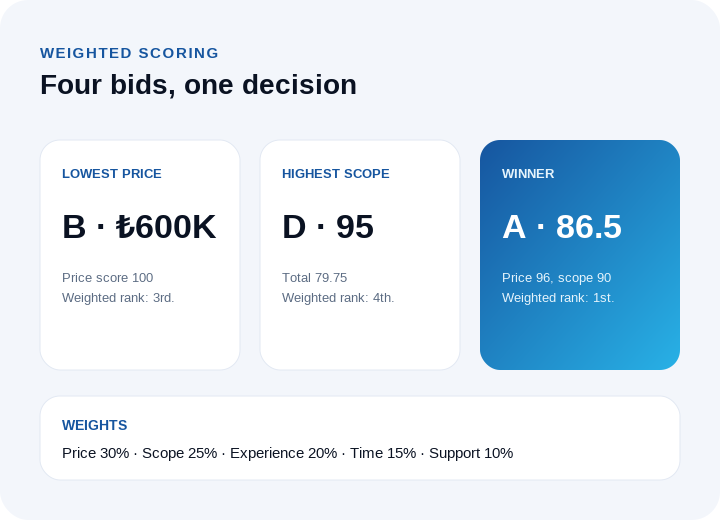
Example: four vendors submitted fixed-price bids to the same RFP (representative). The lowest price is ₺600,000 and the shortest time is 16 weeks.
| Bid | Price | Time | Price score | Time score | Scope | Experience | Support |
|---|---|---|---|---|---|---|---|
| A | ₺625,000 | 20 weeks | 96 | 80 | 90 | 80 | 72 |
| B | ₺600,000 | 25 weeks | 100 | 64 | 85 | 75 | 60 |
| C | ₺750,000 | 16 weeks | 80 | 100 | 80 | 90 | 85 |
| D | ₺800,000 | 32 weeks | 75 | 50 | 95 | 85 | 90 |
Price scores: 600 ÷ 625 = 0.96 → 96; 600 ÷ 600 → 100; 600 ÷ 750 = 0.80 → 80; 600 ÷ 800 = 0.75 → 75. Time scores: 16 ÷ 20 = 0.80 → 80; 16 ÷ 25 = 0.64 → 64; 16 ÷ 16 → 100; 16 ÷ 32 = 0.50 → 50. Now multiply the scores by the weights and add them up.
| Bid | Price × 0.30 | Scope × 0.25 | Experience × 0.20 | Time × 0.15 | Support × 0.10 | Total | Rank |
|---|---|---|---|---|---|---|---|
| A | 28.80 | 22.50 | 16.00 | 12.00 | 7.20 | 86.50 | 1 |
| C | 24.00 | 20.00 | 18.00 | 15.00 | 8.50 | 85.50 | 2 |
| B | 30.00 | 21.25 | 15.00 | 9.60 | 6.00 | 81.85 | 3 |
| D | 22.50 | 23.75 | 17.00 | 7.50 | 9.00 | 79.75 | 4 |
Check for A: 28.80 + 22.50 = 51.30; + 16.00 = 67.30; + 12.00 = 79.30; + 7.20 = 86.50. Had price alone been considered, the order would be B (100), A (96), C (80), D (75), and the bid with the weakest support score would have been chosen. With weighted scoring, B came third. The gap between A and C is only 1 point: in that case the presentation, the reference calls and the contract negotiation decide. The score does not replace the decision; it structures it.
How Do You Run the Timeline and the Q&A Round?
After the RFP is released, all vendors must follow the same timeline and receive the same information. A representative timeline closes in ten weeks.
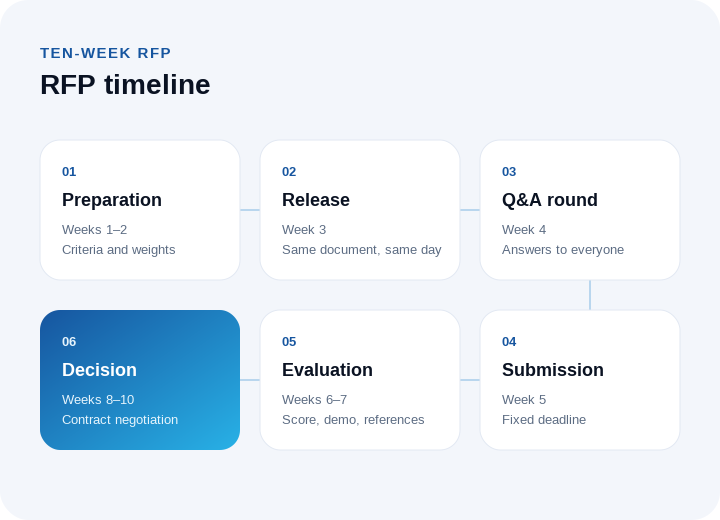
- Preparation (weeks 1–2): Requirements, criteria and weights are written; the panel is chosen.
- Release (week 3): The same document is sent to all vendors on the same day.
- Q&A (week 4): Questions are accepted in writing; the question deadline is one week after release. Answers go out in a single document to all vendors together; information given verbally to one vendor creates inequality among the others.
- Bid submission (end of week 5): Three weeks after release; the submission date is fixed.
- Evaluation (weeks 6–7): Written scoring, presentations and demos with the shortlisted vendors, and reference calls.
- Decision and contract (weeks 8–10): The winner is notified; scope, timeline and payment plan are finalized in the contract.
Do not make the bid period too short: three weeks is a reasonable starting value for a medium-sized project; increase it with the size of the project. A very short period leads vendors to add a large uncertainty margin to the price. Once the scope is settled, you can build the schedule with the method in our project plan guide.
How Do You Check References?
A bid is a written promise; a reference call shows whether that promise was kept in the past. The "experience" criterion in the scoring table is meaningful only if the calls are made.
- Ask for similar projects: At least two references of similar scale and complexity; do not settle for satisfied customers chosen only by the vendor, and if possible pick one extra reference yourself.
- Ask the same questions: Was the schedule kept? How was scope change managed? When a problem appeared after delivery, how quickly did they respond? Was it the same team throughout?
- Ask about the team: Get written confirmation that the people named in the bid will actually work on the project.
- See the live system: If possible, review the running system at the reference customer through a demo.
- Record the notes: Call notes feed into the panel score and are kept under the same headings for every vendor.
The logic of scoring supplier bids is the same as the weighted bid score in our procurement software article, where price, lead time, quality and payment terms are weighted.
What Are the Common Mistakes in a Software RFP?
- Vague scope: A sentence like "a dealer portal and all necessary features" leads each vendor to price a different job, so the bids cannot be compared. Write the scope and what is out of scope.
- Looking only at price: As in the example, the lowest price is often not the best bid; missing scope and weak support come back later as extra fees.
- Excessive detail: A hundred-page requirements list produces a document nobody can read and to which vendors reply with boilerplate. Define the outcome, not the solution path; leave room for the vendor to propose an approach.
- Setting criteria after the bids arrive: Changing the weights after seeing the bids makes the decision contestable.
- Not sharing the Q&A with everyone: Information given verbally to one vendor breaks equal competition.
- Forgetting technical terms: If existing systems, data migration and source code expectations are not written, these items become surprises in the contract.
- Hiding the budget or never thinking about it: Sharing a rough budget range lets vendors bid at the right scale. If you do not want to disclose a price, at least give the scale and the priorities.
Some projects do not need an RFP at all: if you already know one vendor or the project is small, a short brief is enough. For the choice between ready-made and custom, see our off-the-shelf vs custom software article, and for what custom software covers, our guide to custom software.
We recommend reading: What is a software maintenance and support agreement (SLA)?
We recommend reading: What Is a Software License?
We recommend reading: What Is Software Outsourcing?
We recommend reading: Software Project Risk Management: Risk Register, Scoring and Response Strategies
We recommend reading: How to Do User Acceptance Testing (UAT): Scenarios, Defect Severity, Acceptance Rule and Sign-Off Guide
We recommend reading: How to Build a Business Case for a Software Investment: NPV, Payback and Sensitivity Guide
We recommend reading: Software Proof of Concept (PoC): How to Run a PoC and Pilot Project, From Hypotheses to Go/No-Go
The Process After the RFP with İnovabil
At İnovabil our focus is building software from scratch, specific to each company: custom software, ERP, CRM, e-commerce, web, mobile and integration. In our process we first put the scope in writing through the analysis step; then we follow the design, development, testing, release, maintenance and support steps. If you have an RFP, we use it as an input to the analysis. We describe the details on our process page.
We have built CRM, purchasing and mobile for Avcılar İnşaat; a purchasing system for İZBAN; logistics and shipment planning with wholesale order management for Karyak; and warehouse management plus a complaint and support management system for Sleepy. If you have an RFP draft or only a problem statement, send us a short summary and we will clarify the scope together.
Frequently Asked Questions
What is a software RFP and what is it for?
It is a written document sent to several vendors that describes a software project's problem, scope, requirements and evaluation criteria. Its purpose is to get bids that can be compared under the same conditions.
What is the difference between an RFP and an RFQ?
An RFQ asks only for a price for a clearly defined job. An RFP asks for the solution approach, timeline, team, references and price together, and is used for projects like custom software where the solution path is open. An RFI only collects information.
How many requirements should an RFP have?
There is no fixed number; each item should be measurable and have a single outcome. Mandatory and desired items must be separated. Very long lists go unread and produce boilerplate answers, so focus on the priority items.
Should I ask for a fixed-price or a time-and-materials bid?
For a project with a written and clear scope, fixed price allows direct comparison. For a project whose scope is clarified as it progresses, time and materials is suitable, but you must ask for an effort estimate and a cap; otherwise the bids cannot be compared.
How many weeks does an RFP process take?
A representative timeline is ten weeks: two weeks of preparation, three weeks for bids (including Q&A), two weeks of evaluation and three weeks for the decision and contract. It can be shorter for small projects; a very short bid period shows up in the price as an uncertainty margin.