

The wording of order confirmations, password resets, shipping notices, invoices and reminders lives inside the code of most applications. When the support team says "the delivery sentence is confusing", the change joins the engineering queue, ships with the next release and two weeks go by. Transactional message template management means moving those texts out of the code and running them in a controlled setup with variables, channel versions, languages, approval, versioning and release.
This guide is not about deliverability (see the email deliverability guide) or push notification types (see the push guide). It covers the template itself: inventory, data model, variable contract, security, preview, versioning, approval, monitoring and payback. All numbers are representative examples.
Why Should Message Templates Be Managed Outside the Code?
If the template lives in the code, every text change is a software release. In the example business there are 60 templates and about 14 text changes a month; releases ship every two weeks, so a change waits 14 days on average. A developer spends roughly 0.25 days per change: 14 × 0.25 = 3.5 days, which at ₺9,000 per day is ₺31,500 of effort a month.
The second problem is the faulty variable. A new field is added, one customer's record does not have it, and the template prints the empty value as it is. Without template tests in the code, this is discovered in production.
| Topic | Template in code | Template outside code |
|---|---|---|
| Time to change a text | Tied to the next release; 14 days in the example | Minutes after approval; target 1 day |
| Who makes the change | Developer | Product or support, with approval |
| Faulty variable | Found in production | Caught before release by preview and contract checks |
| Rollback | A new release; 120 min in the example | Switch to the previous version; 1 min |
| Trace | In code history, not linked to the message | Every message records which version it used |
Recommended reading: What is a business rules engine and decision table?
How Do You Build a Template Inventory?
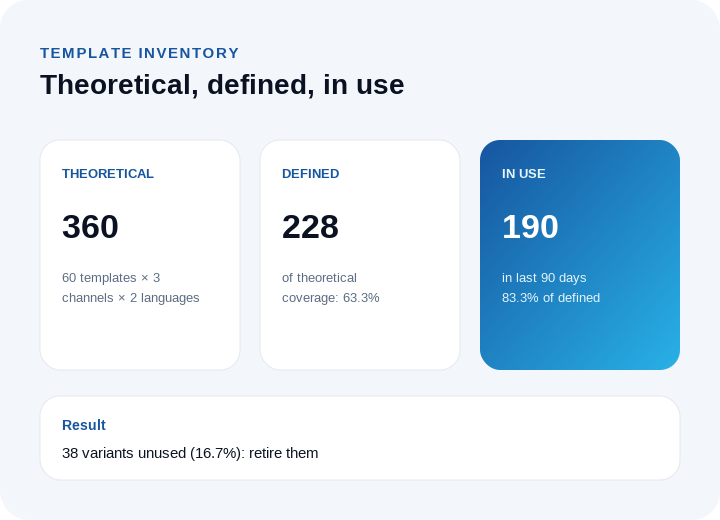
The first job is to put which event sends which message into a single table. The example system has 60 event templates; each could in theory be written in 3 channels and 2 languages: 60 × 3 × 2 = 360 variants. What actually exists is email 60 × 2 = 120, SMS 24 × 2 = 48 and push 30 × 2 = 60, a total of 228. So 228 ÷ 360 = 63.3% of the theoretical coverage has been written.
Of those, 190 variants sent at least one message in the last 90 days; the remaining 228 − 190 = 38 variants (16.7%) were never used. They are left over from removed features or wrongly mapped events, and unless they are retired they stay on the maintenance bill.
| Channel | Templates | Languages | Variants |
|---|---|---|---|
| 60 | 2 | 120 | |
| SMS | 24 | 2 | 48 |
| Push | 30 | 2 | 60 |
| Total defined | 114 channel templates | 228 |
What Should the Template Data Model Look Like?
Each template record carries a template ID, the linked event, channel, language, subject or title, body, variable schema, version number, status and owner. There are five statuses: draft, review, approved, live and retired. A live version is locked; every change creates a new version. That way the question "which text did this message go out with?" can always be answered.
The idea of a template family follows from this: the email, SMS and push versions of one event sit under a single family. The family keeps content consistent, so the order number, amount and date come from the same variable in all three channels. Channel priority and fallback (SMS if push was not delivered) are also defined at the family level.
What Is a Variable Contract and What Happens When a Variable Is Missing?
The variable contract is the schema of the data an event carries: which fields exist, which are required, their types and how they are displayed. A template may only use fields in the contract; if an author adds a field that is not there, the record is rejected before it reaches review. In the example, 150 of 214 variable uses are required (70.1%) and 64 are optional.
Amounts and dates are not formatted by hand in the template; a formatting helper uses the locale. Plurals and grammar issues are covered in our software localization guide.
| Situation | Behavior | Example |
|---|---|---|
| Required field missing | Do not send; route to the error queue and raise an alarm | Order number is empty |
| Optional field missing | Hide the related block | Tracking link not available yet |
| Personalization field missing | Defined default text | Name empty: generic greeting instead of "Hello ," |
| Type mismatch | Do not send; contract error | Amount arrived as text |
The empty-name guard is a simple rule: if the name field is empty or only whitespace, the template uses the default greeting instead of the sentence that contains the name. This rule is defined in the contract, not in the template, otherwise every author invents their own method.
How Do You Limit Conditional Blocks, Loops and the Template Language?
If authors can write code, risk appears; the answer is a deliberately small language: variable insertion, conditions, loops and formatting helpers, four constructs. There is no code execution and no outbound calls. In the example, rendering time is limited to 50 ms and loops to 200 items; a template that exceeds a limit produces an error and does not hold up the system.
How Do You Secure Templates?
Three areas stand out. The first is escaping: if text a customer typed into the name field is printed as it is into an HTML email, broken or harmful content can go out, so variable values are escaped per channel (HTML in email, URL encoding in links, plain text in SMS and push). The second is link safety: addresses may only point to allowed domains. The third is authority: the person who writes and the person who publishes should be different roles.
For role details see our role-based access control article; every release is written to a change log.
How Do You Preview and Test?
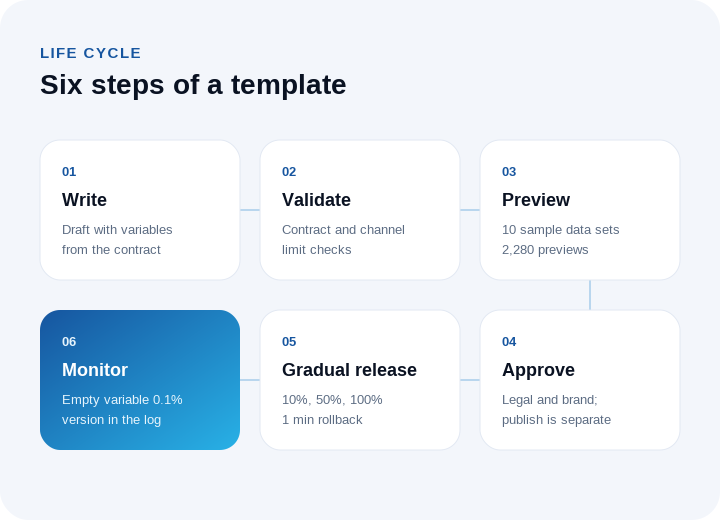
Before release, every variant is rendered with realistic sample data. The example system has 10 sample data sets per event (a long name, an empty optional field, an order with many lines, special characters and so on); 10 × 228 = 2,280 previews are generated automatically and go through these checks:
| Check | What it looks at |
|---|---|
| Contract | Is any variable unused or undefined? |
| Channel limit | Does the email subject, push title or SMS length exceed the limit? (calculations are in the SMS guide) |
| Links | Do the addresses work and sit on an allowed domain? |
| Appearance | Does the email body render properly at two screen widths? |
| Plain text | Is there a readable plain-text version of the email? |
For the 12 critical templates, 12 × 3 × 2 = 72 variants are checked by eye; at 3 minutes each that is 216 minutes, or 3.6 hours. Test sends go to test recipients, not real customers.
How Do Versioning, Gradual Release and Rollback Work?
A new version does not go to everyone at once. It opens to 10% of traffic, then 50%, then 100%, and the error and empty-variable rates are watched at each step. The send log records the template ID and version number with every message, so when a complaint arrives the text that went out is found instantly.
The difference is calculated like this. Take a template that sends 80 messages in the peak hour. If the fault is in code: 45 minutes to notice, 120 minutes for the fix release, 165 minutes in total; affected messages 80 × 165 ÷ 60 = 220. With a template system the version sits at the 10% stage, 8 messages an hour; the alarm fires within 15 minutes and rollback takes 1 minute: 8 × 16 ÷ 60 ≈ 2 messages.
Recommended reading: Integration operations: error queues and reprocessing
How Do You Manage Localization and Shared Blocks?
When the source text changes, translations go stale. The system marks the translation "stale" and shows the number waiting. In the example the English variants stand like this: of 114 templates, 98 are current (86.0%), 12 are stale (10.5%) and 4 are missing. A missing language falls back to the fallback language and its use is monitored.
Shared parts such as header, footer and signature are kept as single blocks. If the address changes across 120 email variants, fixing them one by one takes 120 × 5 min = 600 min, or 10 hours; one change to the shared block plus testing takes 15 minutes. The same feature is also a risk: a fault in a shared block hits all 120 variants at once, so a shared-block change also needs gradual release and a second approval.
What Belongs in a Transactional Message and What Does Not?
A transactional message reports the result of an action the user took. A section that adds a promotion, a campaign or a cross-sell can change the nature of the message and may require consent. Which content counts as commercial is a legal question to settle with your legal counsel; see our consent management article for the details.
Accessibility (plain-text version, alt text, color contrast) goes onto the preview checklist.
Who Edits and Who Approves?
Three roles are enough. Product and support write; legal and brand approve; publishing authority sits in a separate role and with at least two people. A template without an owner is flagged in the inventory.
| Role | Can | Cannot |
|---|---|---|
| Author (product, support) | Creates drafts, previews | Cannot publish |
| Approver (legal, brand) | Approves or returns the text | Cannot edit the text |
| Publisher | Starts gradual release, rolls back | Cannot publish their own text alone |
| Developer | Manages the variable contract | Cannot approve text |
How Do You Set Up the Send Log and Monitoring?
Every send leaves one row: event, template ID, version, channel, language, status and an empty-variable flag. At 90,000 messages a month that is 1,080,000 rows a year; at an assumed 200 bytes per row, about 216 MB.
Two indicators stand out. The empty-variable rate is messages that went out with an empty variable divided by messages sent; the threshold is 0.1%. At 3,000 sends a day, more than 3 messages is an alarm; 9 empty messages is 0.3% and fires it. The second is errors and bounces per template. A template that keeps erroring usually has a problem in the event data.
The value of the alarm is time. If a template that sends 360 messages a day breaks and goes unnoticed for 7 days without an alarm, that is 360 × 7 = 2,520 faulty messages. With an hourly check and an alarm that notices within 4 hours, it is 360 ÷ 24 × 4 = 60 messages, a 97.6% reduction.
How Do You Measure Template Performance?
The goal is clarity, not clicks; the best indicator is the support request that follows a message. In the example business, "delivery notice is unclear" requests fell from 240 a month to 90 after text fixes: 150 requests × 6 min = 900 min = 15 hours, at ₺300 per hour that is ₺4,500 a month. Ways to reduce order status requests are covered in the order tracking page article.
Which Metrics Should You Track?
| Metric | Before | Target |
|---|---|---|
| Time to change a text | 14 days | 1 day |
| Empty-variable rate | Not tracked | Below 0.1% |
| Unused variants | 38 ÷ 228 = 16.7% | Below 5% |
| Translation currency | 98 ÷ 114 = 86.0% | Above 95% |
| Messages hit by a faulty template | 220 | Below 3 |
When Does Template Management Pay for Itself?
The calculation sets build and running cost against the gains. Gains: developer effort on text changes falls by ₺31,500, replaced by review effort of 14 × 0.05 days × ₺9,000 = ₺6,300, a net ₺25,200. If faulty-message incidents fall from 6 to 1.5 a year at ₺8,000 each, that is ₺36,000 a year, or ₺3,000 a month. Fewer support requests add ₺4,500. Total monthly benefit is 25,200 + 3,000 + 4,500 = ₺32,700. With ₺4,000 a month for running and maintenance, the net is ₺28,700.
The build is 45 person-days, 45 × ₺9,000 = ₺405,000. Payback is 405,000 ÷ 28,700 ≈ 14.1 months. If the benefit halves, the net becomes ₺12,350 and payback stretches to about 32.8 months. With only a handful of templates, keeping them in code is reasonable.
How Do You Set It Up in Six Steps?
- Build the inventory: put event, channel, language and usage count in one table; retire what is unused.
- Write the contract: field, type, required flag and format for each event, plus missing-value behavior.
- Limit the template language: only variables, conditions, loops and formatting; no code.
- Build the validation line: 10 sample data sets, channel limits, link and appearance checks.
- Turn on approval and versions: separate the roles, add gradual release and one-step rollback.
- Connect monitoring: write the version to the send log and set the empty-variable alarm at 0.1%.
PDF invoices and labels need a different setup: see our PDF document generation article. For how event data arrives from outside systems, see our webhook article.
Integration and Custom Software with İnovabil
At İnovabil our focus is building firm-specific software from scratch: custom software, ERP, CRM, e-commerce, web, mobile and integration. Template management means taking the notification layer of these systems out of the code; we suggest setting it up by writing down in the requirements analysis which messages, which channels and which role separation are needed. If a ready-made solution meets your need, we say so in the analysis too.
We have built a CRM, purchasing and mobile for Avcılar İnşaat; a purchasing system for İZBAN; logistics and shipment planning with wholesale order management for Karyak; and warehouse management plus a complaint and support management system for Sleepy. Send a short summary of how your notifications work today and we will build the inventory and the contract together.
Recommended reading: our integration service and our software development process
Frequently Asked Questions
What is transactional message template management?
It is managing the texts of messages such as order confirmations, password resets and shipping notices outside the code, with a variable contract, preview, approval, versioning and rollback. The aim is to speed up text changes while catching errors before release.
Why should templates not be kept in code?
Because every text change is tied to a software release and waits for days. In the example, 14 changes a month wait 14 days on average, while the target with a template system is 1 day. Keeping them in code stays reasonable for systems with few templates and rare changes.
What should happen when a variable is missing?
If a required field is missing, the message should not be sent and should go to the error queue. A missing optional field hides the related block; a missing personalization field uses the defined default text. The behavior is defined in the variable contract, not in the template.
How do you roll back a faulty template that went live?
Live versions are locked and the previous version is kept; rollback means activating the previous version and takes 1 minute in the example. Gradual release and the empty-variable alarm limit the effect of a faulty version from the start.
When does template management pay for itself?
With the example numbers, a 45 person-day build returns in about 14.1 months at a net monthly benefit of ₺28,700. If the benefit halves it takes about 32.8 months. The more templates and the more frequent the changes, the shorter it gets; recalculate with your own numbers.