

The same customer is "Yilmaz Trading Ltd." in the ERP, "Yilmaz Trade" in the CRM and a private person's name on the online store. The invoice goes to one record, the quote to a second, the campaign to a third, and nobody sees the real picture of the customer. Master data management (MDM) is the discipline that keeps the core entities of a business, such as customers, products, suppliers and accounts, as one correct record across every system. Data quality is the measure of how far that record can be trusted.
In this guide we explain how master data differs from transactional data, how duplicate records are found and merged, what a "golden record" and field-level source priority are, how the five data quality dimensions are measured, how data ownership works, how master data is synchronized between ERP, CRM and e-commerce, a representative cost and payback calculation, and a six-step rollout. All example figures are representative; they are not the average of any real company or sector.
What Is Master Data Management (MDM)?
MDM is the set of rules, roles and tools that keeps the core data a business shares in one definition, in one source of truth, and distributes it from that source to other systems. The goal is that the question "who is this customer?" gets the same answer in every system.
Master data changes slowly and is read by many systems, so an error never stays in one place; it spreads to every system that reads it. If you are only interested in product content (attributes, images, channel copy), see our product information management guide. This article covers all master entities, such as customers, suppliers and accounts, together with the quality discipline around them.
We recommend reading: Our ERP development service
What Is the Difference Between Master Data and Transactional Data?
Master data answers "who and what", while transactional data answers "what happened". The difference determines how far an error travels.
| Topic | Master data | Transactional data |
|---|---|---|
| Examples | Customer card, product card, supplier | Order, invoice, payment, shipment |
| Rate of change | Slow; a few changes a month | Fast; thousands of records a day |
| Systems using it | ERP, CRM, e-commerce, BI | Usually created in one system |
| Impact of an error | Spreads to every linked record and report | Limited to a single transaction |
| Ownership | Needs an owner and a steward | The unit that performs the transaction |
| How it is managed | Rules, approval and quality measurement | Validation and reconciliation |
If one customer has two cards, the balance splits in two depending on which card the orders were written to. We covered the basics of account tracking in our customer account tracking guide; if master data is not clean, the ageing report is wrong too.
How Are Duplicate Records Found and Merged?
Duplicate records are records that are not identical but describe the same entity, so a simple "is it equal?" query is not enough. The method is to normalize fields, produce a similarity score per field, and decide with a weighted confidence score.
- Normalization: Phone numbers are put in one format (digits only, with country code), company suffixes such as "Ltd." and punctuation are stripped from names, abbreviations are expanded in addresses, and local characters are reduced to one form.
- Candidate generation: Instead of comparing 50,000 records with each other, records that share an e-mail, phone or tax number become candidate pairs.
- Scoring: A similarity between 0 and 1 is computed for each field and multiplied by its weight.
- Decision: Based on thresholds, the pair is merged automatically, sent to human review, or left separate.
Example weights (representative): e-mail 0.35, phone 0.30, name similarity 0.25, address similarity 0.10. The confidence score is the sum of the field similarities times these weights.
| Pair | Field similarities | Calculation | Confidence | Decision |
|---|---|---|---|---|
| 1: same company, different spelling | E-mail 1.0; phone 1.0; name 0.70; address 0.80 | 0.35 + 0.30 + 0.175 + 0.08 | 0.905 | Merge automatically (≥ 0.90) |
| 2: two people in one household | E-mail 1.0; phone 1.0; name 0.50; address 1.0 | 0.35 + 0.30 + 0.125 + 0.10 | 0.875 | Review (0.70–0.90) |
| 3: only the name matches | E-mail 0; phone 0; name 1.0; address 0.90 | 0 + 0 + 0.25 + 0.09 | 0.34 | Keep separate (< 0.70) |
This is why the second pair matters: a shared e-mail and phone are strong signals, but two different people can use the same family e-mail. If you set the threshold too low you collapse different customers into one card; if you set it too high the duplicates remain. Choose the threshold together with the cost of a mistake and with how easily a merge can be undone.
What Is a "Golden Record" and How Is Field-Level Source Priority Set?
A golden record is the single correct customer or product record created by choosing the most reliable value for each field from the merged records. The winning system for each field is written down in advance; otherwise a "last writer wins" rule lets bad data overwrite good data.
| Field | Winning source | Reason |
|---|---|---|
| Company name and tax number | ERP (invoice record) | Verified against official documents; invoices depend on these fields |
| Credit limit, payment terms | ERP | Goes through finance approval |
| Phone and e-mail | Newest verified value (CRM or e-commerce) | The system in contact with the customer knows the current value |
| Delivery address | E-commerce | The customer enters it and it is tested with every order |
| Responsible sales representative | CRM | Assigned by the sales team |
We also cover the single customer view and the customer journey across systems in our CRM guide.
How Is Data Quality Measured?
Data quality is measured along five dimensions, and each dimension is turned into a ratio. Quality that is not measured stays an impression that people argue about but never improve.
| Dimension | Question | Example measure (representative) | Ratio |
|---|---|---|---|
| Completeness | Is the required field filled? | E-mail filled 46,500 ÷ 50,000 | 93.0% |
| Accuracy | Does the value match reality? | Tax number verified 38,400 ÷ 48,000 | 80.0% |
| Consistency | Do systems hold the same value? | Same company name in ERP and CRM 38,250 ÷ 45,000 shared customers | 85.0% |
| Uniqueness | Is each entity recorded once? | 1 − 3,000 ÷ 50,000 | 94.0% |
| Timeliness | Is the record current? | Verified in the last 24 months 36,000 ÷ 50,000 | 72.0% |
The average of the five ratios is (93 + 80 + 85 + 94 + 72) ÷ 5 = 84.8%, but the average is misleading, because the lowest dimension does the most damage. In the example, timeliness (72%) and accuracy (80%) set the priorities. Give each dimension its own target (for example uniqueness ≥ 99%) and track it every month. Reports are affected as well: the number of unique customers is inflated by duplicates. RFM analysis, which segments customers by purchase behavior, produces wrong results on duplicated records.
How Are Data Ownership and Change Approval Set Up?
Every master data field needs an owner (a business unit) and a steward (a data steward). The owner is the person who says "I am responsible for this field being correct"; the steward applies the rules, manages the review queue and monitors quality.
- Customer master data: Owned by sales or customer service; finance approves financial fields (company name, tax number, credit limit).
- Supplier master data: Owned by purchasing; a change of bank details needs approval from a second person.
- Product master data: Owned by product management; cost and unit information is shared with finance.
Classify changes by how critical the field is: a low-risk field such as a phone number updates automatically; fields such as tax number, bank account and credit limit need approval. In the example, 64 critical-field requests arrive each month; at 15 minutes each, 64 × 15 = 960 minutes, which is 16 hours. For the access side, see our role-based access control guide; for legal questions such as storing and deleting personal data under KVKK (Turkey's personal data protection law), consult your legal counsel.
How Is Master Data Synchronized Between ERP, CRM and E-Commerce?
Instead of forcing all systems into one database, it is usually less risky to let each system keep its own record and to keep a cross-reference table in the middle. This table links one master customer ID to the ID in each system, and changes to the golden record are distributed through that ID.
| Architecture style | How it works | When it fits |
|---|---|---|
| Registry | Data stays at the source; the hub holds only the ID mapping | Quick start, little intervention |
| Consolidation | Copies are gathered in the hub; the golden record is used for reading and reporting | When reporting should be fixed first |
| Coexistence | The golden record is created and written back to the sources | Setups where several systems create records |
| Centralized | Records are created only in the hub and distributed to systems | Control comes first, new implementations |
Distribution can be periodic batch transfer or change-event-driven streaming. You can find the general framework for connecting systems in our API integration guide. The first move of records into a shared structure is a separate job; we described the steps in our data migration guide. On the reporting side, shared master data also gives the data warehouse clean dimension tables.
What Do Duplicate Records Cost and What Is the Payback of Master Data Management?
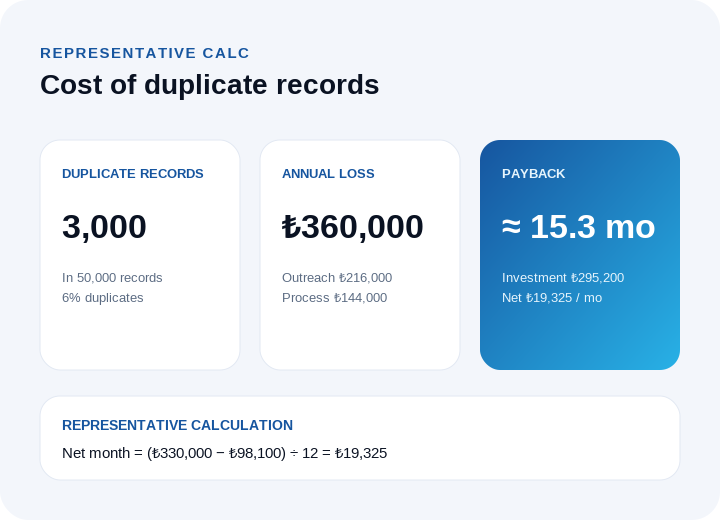
A duplicate record is an invisible cost: small one by one, large in total. The calculation below is representative and should be redone with your own numbers. Baseline: 50,000 customer records, 6% duplicates, so 50,000 × 0.06 = 3,000 extra records.
| Loss item | Calculation (representative) | Per year |
|---|---|---|
| Wasted outreach (SMS, e-mail, catalog) | 3,000 records × 12 mailings × ₺6 | ₺216,000 |
| Correcting double or wrong invoices | 120 cases × 1.5 h × ₺300 | ₺54,000 |
| Split balances and collection disputes | 240 cases × 1 h × ₺300 | ₺72,000 |
| Looking up the same customer on two cards (call center) | 900 calls × 4 min = 60 h × ₺300 | ₺18,000 |
| Total | ₺360,000 |
Clean-up and setup. Suppose we run the matching: of 3,500 candidate pairs, 2,400 are merged automatically (confidence ≥ 0.90), 800 go to human review and 300 are left separate. Of the 800 reviewed, 500 turn out to be true duplicates. If automatic merging has a 1% error rate, 2,400 × 0.01 = 24 wrong merges are rolled back; the correctly merged records are 2,376 + 500 = 2,876, and the remaining 3,000 − 2,876 = 124 duplicates are caught in the next round (0.25%).
- Review: 800 × 3 min = 2,400 min = 40 h; rule tuning 40 h; rolling back wrong merges 24 × 10 min = 4 h. Total 84 h × ₺300 = ₺25,200.
- Setup (matching rules, golden record, cross-reference and synchronization, quality dashboard): 30 person-days × ₺9,000 = ₺270,000.
- Initial investment: ₺270,000 + ₺25,200 = ₺295,200.
Annual running cost. Maintenance at 15% a year: ₺270,000 × 0.15 = ₺40,500. A data steward at 16 hours a month × ₺300 = ₺4,800, or ₺57,600 a year. Total ₺98,100.
Benefit. If the duplicate rate drops from 6% to 0.5%, the loss falls to 0.5 ÷ 6 = 1/12 of its size; the annual gain is ₺360,000 × 11/12 = ₺330,000. Net annual benefit is ₺330,000 − ₺98,100 = ₺231,900, or ₺19,325 a month. Payback is ₺295,200 ÷ ₺19,325 ≈ 15.3 months.
Sensitivity. If the duplicate rate were 3%, the loss would drop to ₺180,000; with a fall to 0.5% the gain is ₺180,000 × (1 − 0.5 ÷ 3) = ₺150,000, the net annual is ₺51,900, the monthly ₺4,325, and the payback 295,200 ÷ 4,325 ≈ 68.3 months. If the problem is small, a full rollout does not pay for itself; then it makes sense to start with rules and quality measurement only.
How Is Master Data Management Set Up? Six Steps
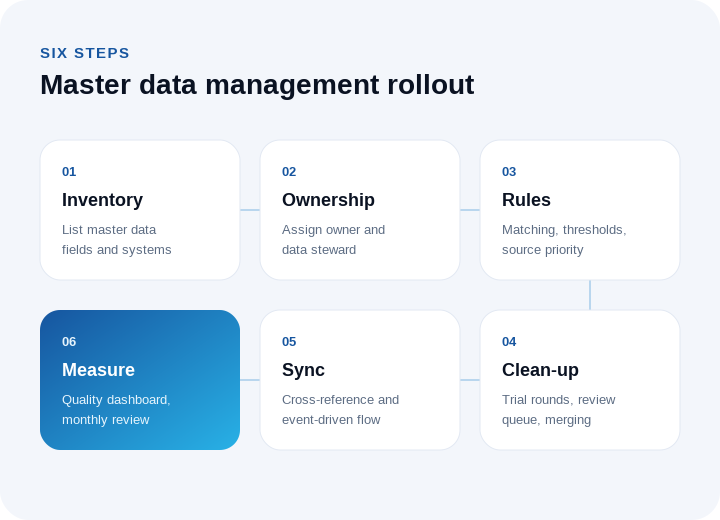
- Inventory: Which master data fields exist in which systems, who writes them and who reads them? Start with customers and suppliers; do not take everything at once.
- Ownership: Assign an owner and a steward for each field, and write the approval rule for critical fields.
- Rules: Put normalization, matching weights, thresholds and field-level source priority in writing.
- Clean-up: Run it in trial rounds, manage the review queue, and verify that merges can be undone.
- Synchronization: Build the cross-reference table; distribute changes to systems in batches or by events. A duplicate check should run when a new record is created.
- Measurement: Build the quality dashboard; track the five dimensions every month and review the thresholds.
What Are the Common Mistakes in Master Data Management?
- A one-off clean-up: Without a duplicate check at the source, the dirt returns within months.
- Merging without rules: "Last writer wins" overwrites good data; field-level priority is essential.
- Ownerless data: A field with no steward is never measured.
- Never testing the threshold: A threshold that is too low merges different customers, and if there is no way to undo, work stops.
- Taking everything at once: Customers and suppliers first; products and the rest later.
We recommend reading: What Is Marketing Automation? Email and SMS Flows, Triggers, Consent and Payback Guide
We recommend reading: How to Build a Customer and Dealer Onboarding Process: Document Tracking, Time to First Order, First 90 Days and Payback Guide
We recommend reading: How to Build Customer Consent Management: Channel-Level Records, Double Opt-In and Sync Guide
We recommend reading: How to Design Bulk Data Import from CSV and Excel: Validation, Error Report and Rollback Guide
We recommend reading: How to Set Up Self-Service Reporting: Semantic Layer, Certified Data, Access Control and Payback
We recommend reading: How to Set Up Address Data Quality and Address Validation: Standardization, Match Score and Payback Guide
We recommend reading: How to Do a Procurement Spend Analysis: Data Cleaning, Tail Spend, Price Variance and Savings Tracking Guide
We recommend reading: How to Set Up Data Governance: Roles, Critical Data Elements, Quality Rules and a 90-Day Plan
We recommend reading: How to Build a Customer 360 View: Customer Card, Data Freshness and Access Guide
We recommend reading: How to Handle Data Subject Requests (Access, Correction, Deletion) in Software: Data Map, Verification and Proof Guide
Custom Software and Data Order with İnovabil
At İnovabil our focus is building custom software from scratch: custom software, ERP, CRM, e-commerce, web, mobile and integration. We do not have a ready-made product or a separate MDM service for master data management; we suggest settling master data rules (who creates the record, which field comes from which system, duplicate checks) together in the requirements phase of ERP, CRM and integration projects.
We developed CRM, purchasing and mobile for Avcılar İnşaat; a purchasing system for İZBAN; logistics and shipment planning with wholesale order management for Karyak; and warehouse management with a complaint and support management system for Sleepy. Send us a short summary of your systems and your record problems; we will first draw up the inventory with you and give you a written assessment.
We recommend reading: Our software development process: step by step from analysis to launch
Frequently Asked Questions
What is master data management (MDM) and what is it for?
It is the set of rules, roles and tools that keeps core data such as customers, suppliers, products and accounts as one correct record across all systems. It reduces duplicate records, inconsistent reports and errors such as double invoices.
What is the difference between master data and transactional data?
Master data are slowly changing entities used by many systems, such as a customer or product card; transactional data is the record of events such as orders and invoices. A master data error spreads to every linked record, so it needs separate management.
What is a golden record?
It is the single correct record created by choosing the most reliable value for each field from the merged records. Which system supplies each field is set in advance by source priority rules.
How is data quality measured?
Each of the five dimensions, completeness, accuracy, consistency, uniqueness and timeliness, is turned into a ratio; for example uniqueness is 1 − duplicates ÷ total records. The lowest dimension sets the priority, and it is re-measured every month with the same method.
When does master data management pay for itself?
When the cost of duplicate and faulty records exceeds the cost of setup and operation. In the example, with 6% duplicates in 50,000 records, payback is about 15.3 months; at 3% it would be about 68.3 months. Recalculate with your own record counts and costs.