A supplier's truck is at the dock and the delivery note is in your hand, but three questions have to be answered before anything enters the warehouse: is this what we ordered, is the quantity right, and is it usable? The goods receiving process answers those questions in order, on the record, and then books the goods into stock. An error that slips through at receiving comes back later as wrong stock, wrong shipments and arguments with the supplier.
This guide covers the receiving steps, blind versus checked counting, the decision for each type of discrepancy, order tolerance, receiving time, the cost of slow put-away, damage evidence, the role of the ASN and the metrics to track. All example figures are representative; they are not an average for any real business or industry.
What Is the Goods Receiving Process and What Are Its Steps?
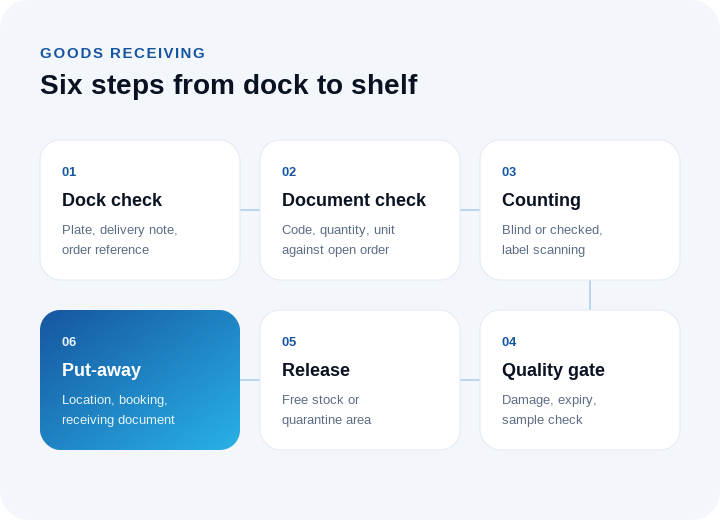
Goods receiving is the process in which delivered goods are compared with the order, counted, inspected when needed, and the accepted quantity is booked into stock. The wider flow from receiving to dispatch is covered in our warehouse management system guide; here we stay with the stretch from the dock to the shelf.
- Dock check: Vehicle and driver details, plate, delivery note number and order reference are verified. Deliveries without an appointment or an order reference are set aside at this point.
- Document check: Item code, quantity and unit on the delivery note are compared with the open order. If there is no order, the goods are not accepted; they go to quarantine until purchasing confirms.
- Counting: Pallets and cases are counted and labels are scanned. Whether the counter sees the document quantity is the subject of the next section.
- Quality gate: Packaging integrity, visible damage, expiry date and, where required, a sample check.
- Quarantine or release: Goods that pass go to free stock; doubtful goods or goods awaiting approval go to a separate area.
- Location and booking: The goods are put into a location, the accepted quantity is booked into stock and a receiving document is created.
How lot and serial data is written at booking is covered in the lot and serial number traceability guide.
We recommend reading: How to track inventory
Should You Use a Blind Count or a Checked Count?
A sensible starting point is blind counting for sensitive or high-value goods, checked counting for the rest, and a mixed method driven by supplier history. In a checked count the counter sees the delivery note quantity; in a blind count the counter does not, and writes what was actually counted.
| Topic | Checked count | Blind count |
|---|---|---|
| What the counter sees | The delivery note quantity | Only the product |
| Speed | 3 min per pallet (representative) | 4 min per pallet (representative) |
| Error detection | Lower, because people drift toward the document | Higher |
| Detection across 200 lines with 12 real gaps (representative) | 7 gaps (58.3%) | 11 gaps (91.7%) |
| Best for | Low-risk, reliable suppliers | High-value goods, suppliers with a history of gaps |
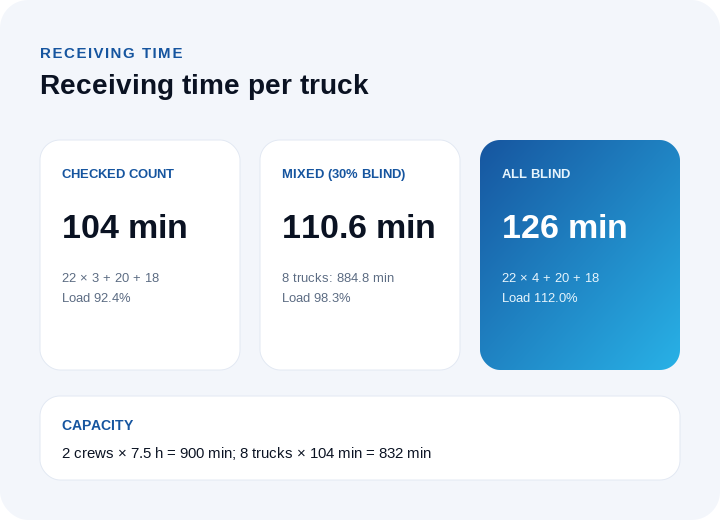
Take a truck with 22 pallets and a fixed 20 minutes for paperwork and booking. At the quality gate 3 of the 22 pallets are opened as samples at 6 minutes each: 3 × 6 = 18 minutes.
| Method | Calculation | Time per truck | Total for 8 trucks | Load on 900-min capacity |
|---|---|---|---|---|
| All checked | 22 × 3 + 20 + 18 | 104 min | 832 min | 92.4% |
| Mixed (30% blind) | 22 × (0.7 × 3 + 0.3 × 4) + 20 + 18 | 110.6 min | 884.8 min | 98.3% |
| All blind | 22 × 4 + 20 + 18 | 126 min | 1,008 min | 112.0% |
Capacity is two crews × 7.5 hours = 900 minutes. Blind-counting every truck exceeds capacity; the mixed method fits but sits at the limit with 98.3%. Apply blind counts by goods group and supplier history, and staff the dock so that load stays around 90%. The order in which trucks reach the dock is covered in the dock door appointment guide.
What Do You Decide When Receiving Finds a Discrepancy?
Every discrepancy type needs a decision written in advance; otherwise the outcome depends on the judgment of whoever is on shift that day.
| Type | What happened | Decision | Record and notice |
|---|---|---|---|
| Short | Quantity below the order | Within tolerance: accept; outside: partial receipt, remainder stays open | Shortfall and open balance |
| Over | Quantity above the order | Within tolerance: accept; the excess waits for a purchasing decision | Excess in a separate area |
| Damaged | Packaging or product is faulty | Reject or return the damaged part, accept the sound part | Photos, quantity, notice to the carrier |
| Wrong item | A different item from the one ordered | Not accepted; goes to the returns area | Written notice to the supplier |
| No paperwork | No order or delivery note | Quarantine; no stock booking until the order is confirmed | Request to purchasing |
| Late | Past the order or appointment date | Accept | Late delivery counts against the supplier score |
The numeric part of these decisions sits in tolerance. Suppose your rule is "plus or minus 2% of the order quantity"; for a 500-unit order the acceptance range is 490 to 510 units (500 × 0.98 = 490; 500 × 1.02 = 510).
| Quantity received | Deviation | Decision |
|---|---|---|
| 492 units | -1.6% | Within tolerance, accept; purchasing closes or keeps open the remaining 8 units |
| 485 units | -3.0% | Partial receipt; 15 units stay on the open order |
| 508 units | +1.6% | Within tolerance, accept |
| 512 units | +2.4% | Accept up to 510; the extra 2 units wait in a separate area for a purchasing decision |
Tolerance is a company policy, not a legal rate, and it can vary by product type. On a partial delivery the open quantity must stay visible on the order line, and the remaining delivery must attach to the same order. Quietly accepting an over-delivery moves the payable quantity beyond the order, which is why excess goods wait in a separate area.
We recommend reading: What is procurement software?
How Does Receiving Connect to Invoice Matching?
The receiving record supplies the third leg needed before a supplier invoice can be paid: the quantity that actually arrived. The logic and a worked example of order, receipt and invoice matching are in our procurement software article, so we do not repeat them here. The rule on the receiving side is simple: if the quantity is not booked correctly and on time, matching produces false differences. When the receiving document number can be attached to the invoice line, matching runs on its own.
Why Is the Gap Between Receiving and Put-Away Expensive?
Goods that are received but not yet shelved and booked are physically in the warehouse and invisible in the system. Whoever takes orders sees "out of stock", so sellable goods cannot be sold. We call this invisible stock.
A simple form of Little's law gives the size: the quantity waiting at any time equals the arrival rate times the waiting time. With 8 trucks a day, 22 pallets per truck and 20 cases per pallet, daily inflow is 8 × 22 × 20 = 3,520 cases. Over a ten-hour day that is 352 cases per hour. If dock-to-stock takes 4 hours, about 352 × 4 = 1,408 cases are invisible at any moment; at 1 hour it is 352 cases.
| Metric | Dock-to-stock 4 h | Dock-to-stock 1 h |
|---|---|---|
| Invisible stock (cases) | 352 × 4 = 1,408 | 352 × 1 = 352 |
| Tied-up value (₺85 per case) | ₺119,680 | ₺29,920 |
| Daily demand for this stock (5%) | 70.4 cases | 17.6 cases |
We assumed 5% of demand lands on invisible stock. The difference is 70.4 - 17.6 = 52.8 cases of demand a day. If 25% of that is cancelled and contribution margin is ₺30 per case, the daily loss is 52.8 × 0.25 × 30 = ₺396, or ₺8,712 a month over 22 working days. The other 75% is deferred sales. The ₺89,760 reduction in tied-up value (₺119,680 - ₺29,920) is left out of the payback below.
To shorten the gap, generate a location suggestion together with receiving approval and book at the receiving point with a mobile terminal. Record the receiving and put-away timestamps and watch the difference weekly.
How Do You Prove Damage and Shortages?
A damage claim works only if it is backed by evidence, and the evidence is collected at the moment of receiving.
- Photos: The pallet, the damaged case and the label, with the delivery note number visible.
- Quantity and description: Countable wording such as "3 cases crushed, 1 case wet"; "arrived damaged" is not enough.
- Note on the delivery note: The shortage and damage note, signed by the driver if possible.
- Timestamp: The record is made at receiving time.
The notice period to the carrier and liability depend on contract and legislation; we do not state periods or liability here. Get them from your legal counsel and write them into your procedure.
How Does an ASN Let You Plan Receiving in Advance?
An ASN (advance shipping notice) is the product, quantity, pallet and lot information a supplier sends before the goods leave. With it the receiving team prepares space, crew and the type of check before the truck arrives. The portal side is in our supplier portal guide.
The value of an ASN is measured by its accuracy. Say 176 shipments arrive in a month; 132 have an ASN and 44 do not. The ASN share is 132 ÷ 176 = 75% and the no-ASN share is 44 ÷ 176 = 25%. If 110 of the 132 ASNs match the actual receipt, ASN accuracy is 110 ÷ 132 = 83.3%. The 22 mismatched shipments point to suppliers you cannot trust yet.
How Much Do Receiving Errors Cost?
Receiving the wrong item or the wrong quantity means stock is wrong from the start: the system shows 40 units at a location, but a different product sits on the shelf, and picking produces a short or wrong shipment. We calculated late booking above.
Example: 112 receiving lines a day (8 trucks × 14 lines), 22 days a month, so 2,464 lines. Let the wrong-receipt rate be 0.5% with manual entry and 0.1% with scanning. That is 12.32 and 2.464 wrong receipts a month. If each wrong receipt costs ₺900 in later order errors, returns and corrections, the monthly cost is 12.32 × 900 = ₺11,088 versus 2.464 × 900 = ₺2,217.60, a difference of ₺8,870.40. The system side of scanning is in our barcode system guide.
Shelf counting is the subject of the inventory counting guide, and the sampling plan for the quality gate is in the quality management article.
How Do You Derive Supplier Performance from Receiving Data?
The receiving record is a reliable source because it rests on counts, not claims. Look at on-time, complete and undamaged delivery, plus the "perfect receipt" rate that meets all three at once.
| Supplier (representative) | Deliveries | On time | Complete | Undamaged | Perfect receipt |
|---|---|---|---|---|---|
| A | 46 | 43 (93.5%) | 44 (95.7%) | 45 (97.8%) | 40 (87.0%) |
| B | 40 | 34 (85.0%) | 36 (90.0%) | 40 (100.0%) | 30 (75.0%) |
B has a flawless damage record but trails on timeliness and completeness, so the conversation is about those. The same data also decides which supplier gets blind counts.
Which Metrics Should You Track in Receiving?
Four metrics are enough to manage the process. All are computed from the receiving record and reviewed weekly.
| Metric | Formula | Representative example |
|---|---|---|
| Receiving time per truck | Pallets × minutes per pallet + fixed tasks + inspection | 104 min |
| First-time-right receipt | Lines needing no correction ÷ total lines | 94% (6.72 gap lines of 112) |
| Discrepancy rate | Lines with a gap ÷ total lines | 6% |
| Dock-to-stock time | Put-away time - receiving time | 4 h, target 1 h |
The first two measure quality, the last two speed and visibility. Making one metric the only target breaks another: push only on time and counts get sloppy; push only on accuracy and the queue grows.
When Does a Software Investment Pay Back?
Paper and spreadsheets are fine at small volume; as volume grows, the hours spent resolving gaps and the cost of wrong stock justify software. We calculate three items.
- Hours spent resolving gaps: If 6% of 112 daily lines have a gap, that is 6.72 lines at 25 minutes each, or 168 minutes. At a 2% target (2.24 lines) it is 56 minutes. The daily saving is 112 minutes = 1.87 hours, about 41.07 hours over 22 days. At ₺300 an hour that is ₺12,320.
- Cost of wrong receipts: The ₺8,870.40 above (manual entry versus scanning).
- Margin lost to invisible stock: The ₺8,712 above.
Total monthly benefit is 12,320 + 8,870.40 + 8,712 = ₺29,902.40. With a monthly running cost of ₺6,000 the net benefit is ₺23,902.40. For an investment of ₺288,000, payback is 288,000 ÷ 23,902.40 ≈ 12.0 months. If the benefit halves (₺14,951.20 - ₺6,000 = ₺8,951.20 net), it stretches to about 32.2 months. Recalculate with your own volume and measured discrepancy rate; the items are assumed to be independent of each other.
How Do You Set Up the Goods Receiving Process?
We suggest six steps.
- Measure today: Record time per truck, discrepancy rate and dock-to-stock time for a week.
- Write the discrepancy decisions: Document the decision and tolerance for all six discrepancy types.
- Set the counting policy: Calculate blind and checked counting together with capacity.
- Ask for the ASN: Start with your largest suppliers.
- Move booking to the dock: Scanning and receiving approval happen in the same place at the same time.
- Review weekly: Watch the metrics and assign an action to every deviation.
We recommend reading: How to Manage Backorders: Line Status, Priority, Split Shipments and Fill Rate Guide
We recommend reading: How to Automate Accounts Payable and Incoming Invoice Processing: Capture, Matching, Approval and Payment Guide
Warehouse and Receiving Digitalization with İnovabil
At İnovabil our focus is bespoke software built from scratch: custom software, ERP, CRM, e-commerce, web, mobile and integration. We suggest assessing in writing, during requirements analysis, whether your receiving flow can be covered by an off-the-shelf tool, based on discrepancy types, truck volume and user count.
We built a warehouse management system (WMS) and a complaint and support management system for Sleepy; logistics and shipment planning with wholesale order management for Karyak; shipment planning for Bofigo; a procurement system for İZBAN; and CRM, procurement and mobile for Avcılar İnşaat. Send us a short summary of your receiving flow and its trouble spots, and we will prepare a written scope.
We recommend reading: Our software development process: from analysis to launch
Frequently Asked Questions
What is the goods receiving process?
It is the process in which delivered goods are compared with the order, counted, inspected when needed, and the accepted quantity is booked into stock.
What is the difference between a blind count and a checked count?
In a checked count the counter sees the delivery note quantity; in a blind count they do not. A blind count catches more gaps but takes longer.
What if more or fewer goods arrive than ordered?
Check the tolerance set in advance. A deviation within plus or minus 2%, for example, is accepted; for a shortfall the remaining order is closed or kept open. Excess outside tolerance waits in a separate area for a purchasing decision.
What should you do when damaged goods arrive?
Separate the damaged part and accept the sound part. Record photos, quantity and description, note it on the delivery note, and notify the carrier and supplier in writing. The notice period depends on contract and legislation; get it from legal counsel.
Why does dock-to-stock time matter?
Goods that are received but not booked are invisible, so sellable stock cannot be sold. In the example a 4-hour gap means 1,408 invisible cases against 352 at 1 hour, a difference of ₺8,712 in contribution margin a month.