

You sell the same product to dealer A at ₺880, to dealer B at ₺920 and to a new customer at ₺1,000. On top of that sit quantity breaks, a promotion, and a special deal signed last year. When all of this lives in a handful of spreadsheets, every price change becomes a risk: one file is updated, another is forgotten, and a dealer orders at the old price. How to manage B2B price lists comes down to keeping price in one place, with a clear order of precedence, a margin floor check and an approved release process.
This guide covers list structure, price resolution order, tiered and chained discounts, the margin floor, validity dates, currency-linked pricing, the effect of a bulk update and the setup steps, with numbers throughout. All example figures are illustrative; they are not real prices, rates or industry averages.
What Is B2B Price List Management?
B2B price list management is defining, updating, approving and applying the prices that different customer groups and individual customers pay. It differs from retail in that there is no single shelf price: the same product costs different amounts depending on who buys, how much they buy and on which date.
Our B2B e-commerce guide mentions price only as one feature of a dealer portal; here we take price itself apart. Dealer targets, bonuses and performance scores are a separate topic covered in our dealer management system article, and discount approval on a single quote is covered in our quote management article.
We recommend reading: Our custom software service
What Layers Make Up a Price List?
Price is held in layers: a base list, customer group lists, customer-specific deals and temporary promotions. Separating layers shows in advance who a change will affect.
| Layer | Scope | Owner | Validity |
|---|---|---|---|
| Base list | All products, starting price for everyone | Product and pricing manager | Open-ended, versioned |
| Customer group list | Groups such as A, B, C; a fixed rate off the base list or line prices | Sales management | Periodic |
| Special deal | One customer, one product or product group | Sales director | End date mandatory |
| Promotion | Specific products or groups | Marketing and sales | Start and end date mandatory |
| Quantity break | Discount or price by line quantity | Pricing manager | Together with the list |
A special deal without an end date is the most expensive error on a list: a price granted three years ago stays valid because nobody remembers it. Special deals and promotions must not be saved without dates.
How Is the Price on an Order Line Found?
The system should follow the same sequence for every line: pick the source, apply the quantity break and discount, check the margin floor, and finally apply currency conversion and rounding. "The narrowest valid record wins" resolves conflicts by rule.
| Step | What happens | Rule |
|---|---|---|
| 1 | Price source | Special price for this customer and product valid on the order date; otherwise the customer's group list; otherwise the base list |
| 2 | Quantity break | The selected source's break table; on a special price only if the deal allows it |
| 3 | Promotion and discount | Stackable or non-stackable flag; if non-stackable, the one better for the customer applies |
| 4 | Margin floor | If the price is below the floor, the line goes to approval or is rejected |
| 5 | Currency and rounding | Currency-linked prices are converted at the current rate and rounded to a defined step |
If two lists conflict within the same source, the narrowest scope wins, then the latest start date; if this is not written down, the same order gets a different price depending on who enters it.
Worked Example: What Does a ₺1,000 Product Cost a Dealer?
Take an illustrative product with a list price of ₺1,000 and a unit cost of ₺620. Group A pays 12% below list, that is ₺880. Group B pays 8% below list, that is ₺920. Group A also has a 3% break at 50–199 units and a 6% break at 200 units and above.
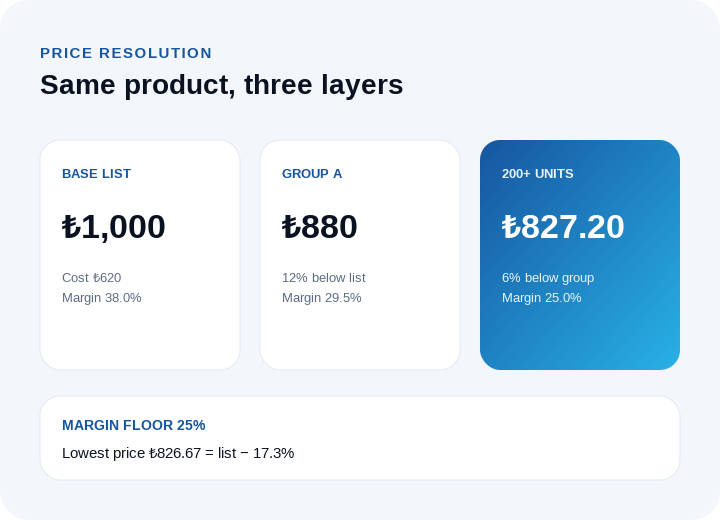
- Group A, 1–49 units: ₺880. Margin = (880 − 620) ÷ 880 = 29.5%.
- Group A, 50–199 units: 880 × 0.97 = ₺853.60.
- Group A, 200 units and above: 880 × 0.94 = ₺827.20. Margin = (827.20 − 620) ÷ 827.20 = 25.0%.
With a 25% margin floor, the lowest selling price is 620 ÷ (1 − 0.25) = ₺826.67, which means at most 17.3% discount off the list price. Lines above the floor pass automatically; lines below it go to approval. Tie the floor to cost, not to the list: when cost changes, the floor moves by itself. Cost calculation is covered in our product cost guide.
Does a Quantity Break Apply to All Units or Only the Upper Slice?
There are two methods and they give different results. The all-units method applies the new price to the whole line once the break is reached; the sliced method applies it only to units beyond the break.
| Order (group A) | All-units | Sliced |
|---|---|---|
| 199 units | 199 × 853.60 = ₺169,866.40 | 49 × 880 + 150 × 853.60 = ₺171,160.00 |
| 200 units | 200 × 827.20 = ₺165,440.00 | 49 × 880 + 150 × 853.60 + 1 × 827.20 = ₺171,987.20 |
| 250 units | 250 × 827.20 = ₺206,800.00 | 49 × 880 + 150 × 853.60 + 51 × 827.20 = ₺213,347.20 |
Under the all-units method, 200 units cost ₺4,426.40 less than 199 units (169,866.40 − 165,440.00). The customer concludes "if I buy one more, I pay less in total"; sometimes that is the behavior you want, sometimes it is margin leakage. Choose deliberately and record it.
Why Don't Chained Discounts Add Up?
A 10% discount followed by 5% is not 15%, because the second discount applies to the already reduced price. The effective rate is 1 − (0.90 × 0.95) = 14.5%.
- 10% + 5%: 1,000 × 0.90 × 0.95 = ₺855.00 (adding gives ₺850.00; difference ₺5.00).
- 10% + 5% + 3%: 1,000 × 0.90 × 0.95 × 0.97 = ₺829.35; the effective discount is 17.1%, not 18%.
- Margin check: for ₺829.35 the margin is (829.35 − 620) ÷ 829.35 = 25.2%, above the floor. The ₺820 you would get by adding gives (820 − 620) ÷ 820 = 24.4%, below the floor.
On an item selling 400 units a month, ₺5 × 400 = ₺2,000. What matters is that sales and the system compute the same thing; whether discounts add or chain must be written down.
How Are Validity Dates and Price Locks Set Up?
Every price record carries a start and end date, and an order writes the price it used into the line itself. That way changing a list later does not touch an old invoice or order.
- Order date or shipment date? Usually the order-date price applies, with a cap such as a "30-day price lock" for open orders. Decide according to your process and write it into the contract.
- Price snapshot: The order line stores unit price, discount, the ID of the list record used and the calculation date. When a dealer asks "where did this price come from", the answer is one click away.
For where this sits in the order lifecycle, see our order management system article.
How Is Currency-Linked Pricing Updated?
For imported products, price is defined in a foreign currency and paid in lira after conversion. Changing the list on every exchange-rate move confuses dealers; never changing it erodes margin. The answer is threshold-based updating.
Take an illustrative product with a list price of €25.00 and a unit cost of €16.00. At a reference rate of 40.00 the price is ₺1,000 and the cost ₺640 (margin 36.0%). The update threshold is ±2% of the reference rate, that is the 39.20–40.80 band.
- Rate moves to 41.20: The move is 3.0%, beyond the threshold. New price = 25 × 41.20 = ₺1,030. Cost = 16 × 41.20 = ₺659.20; margin = (1,030 − 659.20) ÷ 1,030 = 36.0%.
- If not updated: The price stays at ₺1,000 and the margin falls to (1,000 − 659.20) ÷ 1,000 = 34.1%, a loss of 1.9 points.
Write the rate source and update frequency into the list rule, and state which of the displayed foreign-currency and lira prices is binding for the dealer.
How Is the Effect of an 8% Bulk Price Increase Calculated?
A bulk increase is applied by rate or rule rather than product by product, but its effect must be calculated beforehand, because not all sales are affected. Illustrative annual sales are ₺24,000,000, of which 25%, that is ₺6,000,000, is locked by dated special-deal prices.
- Affected sales: 24,000,000 × 0.75 = ₺18,000,000.
- Gross profit before: with cost at 62%, 18,000,000 × 0.38 = ₺6,840,000.
- After the increase, if units fall 3%: Revenue = 18,000,000 × 1.08 × 0.97 = ₺18,856,800; cost = 11,160,000 × 0.97 = ₺10,825,200; gross profit = ₺8,031,600. The gain is ₺1,191,600, or 17.4%.
- If cost also rose 8%: Cost = 11,160,000 × 1.08 × 0.97 = ₺11,691,216; gross profit ₺7,165,584; the gain is only ₺325,584. The margin stays at 38.0%; without the increase it would have fallen to (1,000 − 669.60) ÷ 1,000 = 33.0%.
So an increase often creates no profit; it offsets a cost rise. Keep three things apart in the calculation: the locked sales share, unit sensitivity and the cost increase itself. For notice periods and resale price questions toward dealers, consult your legal advisor.
How Is a Price Change Approved and Released?
Every change goes through draft, preview, approval and scheduled release. The approval level depends on the size of the change; the thresholds below are illustrative.
| Change | Approver | Required check |
|---|---|---|
| List price up to ±5% | Pricing manager | Margin floor report |
| List price 5–10% | Sales director | Impact report and locked sales share |
| Above 10% or a margin floor change | General manager | Scenario comparison |
The preview report shows at least three numbers: how many products are below the floor, how many have stale cost, and how many customers are affected. For example, in a 1,200-product draft, 1,158 products are fine, 34 are below the floor (2.8%) and 8 have missing cost; 1,158 + 34 + 8 = 1,200. The release button stays disabled until those below the floor are fixed. Every change is logged; for separation of duties see our role-based access control article.
What Goes Wrong When Price Lists Are Managed in Excel?
Excel works for a small list; as dealers, breaks and special deals multiply, errors become inevitable. Illustrative scale: 1,200 products × 4 lists (base + 3 groups) = 4,800 prices, plus 60 customers × an average of 25 products = 1,500 special prices; 6,300 rows in total.
The errors come from structure more than scale: every file is updated by hand, "list_final_v7" copies multiply, the conflict rule changes by person, margin is checked after the sale or not at all, and nobody knows who changed what. As scale grows these turn into numbers. With a 0.5% error rate, 6,300 × 0.005 = 31.5, so about 32 wrong prices. If each one affects an average of 40 orders a month with an average ₺25 difference, one update costs 32 × 40 × ₺25 = ₺32,000, and four updates a year cost ₺128,000. For the general steps of moving from spreadsheets to a system, see our Excel-to-software guide.
How Does Price Data Flow Between ERP, CRM and the Portal?
Price needs a single owner; other systems read from it. The three systems have different jobs: the ERP is the source of cost and the product card, the CRM of customer group and quote, and the portal of the price the dealer sees. The bridge between them is the price engine.
- ERP → price engine: Product card and unit cost; when cost changes the floor is recalculated.
- CRM → price engine: The customer's group and special-deal records. When the group changes, the new list applies from the next order.
- Price engine → portal and quote: The logged-in dealer's own price, break table and validity date. If the portal caches prices, the cache must be invalidated at release; otherwise a dealer sees the old price.
- Order → ERP: The line price is passed on with its snapshot; the ERP does not recalculate it.
For data isolation and self-service on the dealer portal, see our customer portal guide.
How Is the Payback of a Price Engine Calculated?
The gain comes from two places: less manual update time and fewer price errors. Illustrative assumptions: per update 6,300 rows × 1 min = 6,300 min = 105 hours; four updates a year = 420 hours. With a system, 15 hours per update, 60 hours a year. Hourly cost is ₺300.
- Time saving: (420 − 60) × ₺300 = ₺108,000 a year.
- Error saving: ₺128,000 × 90% = ₺115,200 a year.
- Gross gain: ₺223,200 a year.
- Running cost: maintenance and infrastructure ₺60,000 a year.
- Net gain: ₺163,200 a year = ₺13,600 a month.
With an investment of 30 person-days × ₺9,000 = ₺270,000, payback is 270,000 ÷ 13,600 ≈ 19.9 months. If the error saving halves (₺57,600), the net gain is 165,600 − 60,000 = ₺105,600 a year, ₺8,800 a month, and payback stretches to about 30.7 months. Redo it with your own row count, error rate and hourly cost. Cost items are detailed in our software project cost guide.
How Is a B2B Price Management System Set Up in Six Steps?
Building a system before writing rules just moves spreadsheet chaos onto a screen.
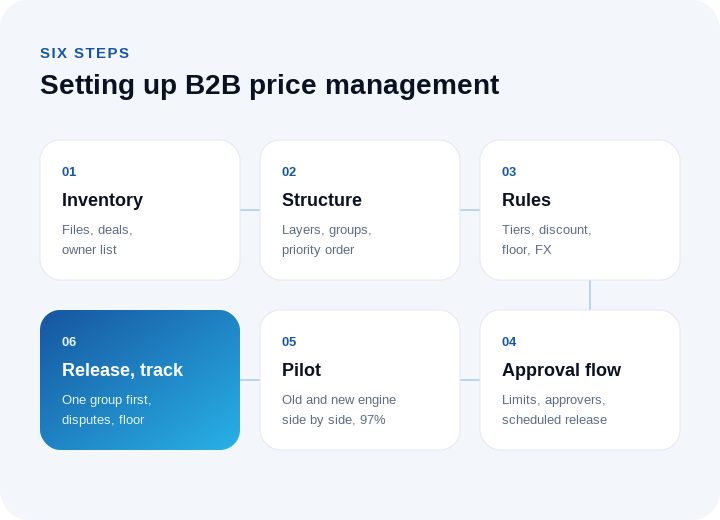
- Inventory: List every price file, special deal and owner. Flag those without an end date.
- Structure: Write down the layers (base, group, special, promotion), the customer groups and the order of precedence.
- Rules: Define the break method, how discounts stack, the margin floor, the currency threshold and the rounding step.
- Approval flow: Define thresholds, approvers and the scheduled release rule.
- Pilot: Run the new engine next to the old prices. If 194 of 200 real order lines match, agreement is 194 ÷ 200 = 97.0%; investigate each of the 6 differences.
- Release and tracking: Open one dealer group first; watch the number of price disputes, lines waiting for approval and the share of sales below the floor.
To write the scope of the rules down in advance, use our requirements analysis guide.
What Are the Common Mistakes in B2B Price Management?
- Undated special deals and adding discounts: One quietly erodes margin, the other makes the system and sales find different prices.
- Ignoring the break cliff: Under the all-units method a large order can cost less than a smaller one.
- Not keeping a snapshot: If an order is recalculated later, invoice and order will not match.
We recommend reading: How to track customer accounts
We recommend reading: What Is a Product Configurator (CPQ)? Option Rules, Pricing and Bill of Materials Guide
We recommend reading: What Is a Field Sales Mobile Order App? Visit Planning, Offline Mode, Credit Limits and Payback Guide
We recommend reading: What Is Multi-Currency and Exchange Difference Management? Realized vs Unrealized FX Gains, Revaluation and Matching Guide
We recommend reading: What Is Price Optimization and Dynamic Pricing? Elasticity, Margin Floor, Rules and Testing Guide
We recommend reading: How to Do Customer Profitability and Cost-to-Serve Analysis: Net Contribution, the Whale Curve and Action Guide
We recommend reading: What Is a Business Rules Engine and Decision Table? Rule Management, Conflict Checks and Payback Guide
We recommend reading: How to Design an E-Commerce Promotion and Coupon Engine: Order, Margin Floor and Abuse Prevention Guide
We recommend reading: How to Prevent Money and Rounding Errors in Software: Cent Differences, Decimal Types and Allocation Guide
We recommend reading: How to Design a B2B Quick Order Screen and Reorder Flow: Line Entry, Case-Pack Rules and Payback Guide
B2B Pricing and Order Processes with İnovabil
At İnovabil our focus is building bespoke software from scratch: custom software, ERP, CRM, e-commerce, web, mobile and integration. We suggest writing down price list rules and approval thresholds, together with customer and product data, at the requirements stage, so it is clear from the start what lives in the system and what stays in the process.
We have built logistics and shipment planning plus wholesale order intake and management for Karyak; CRM, purchasing and mobile for Avcılar İnşaat; a purchasing system for İZBAN; and warehouse management plus a complaint and support management system for Sleepy. Send us a short summary of your price structure, customer groups and update frequency, and we will draw up the requirements together.
We recommend reading: Our software development process: step by step from analysis to launch
Frequently Asked Questions
How do you manage B2B price lists, in short?
By keeping price in one place: combine base list, customer group list, special deal and promotion layers with a precedence rule, set a margin floor, tie every change to approval and a date, and write a price snapshot into each order.
How is a dealer-specific price defined?
By attaching the customer to a group and using the group list, or with a special-deal record for one customer and product. A special deal must have an end date and a margin; the narrowest valid record wins.
Why don't a 10% and a 5% discount make 15%?
The second discount applies to the reduced price. Since 1,000 × 0.90 × 0.95 = 855, the effective discount is 14.5%. Adding them creates a ₺5 gap and can misjudge the margin floor.
Should the price update immediately when the exchange rate changes?
Usually not. A threshold against the reference rate (for example ±2%) is defined; the price updates when the move exceeds it. In the example, when the rate reaches 41.20, a 3% move takes the price from ₺1,000 to ₺1,030 and the margin holds at 36.0%.
Does a bulk price increase raise profit?
Often it only offsets a cost increase. In the example, when both price and cost rise 8%, the gross profit gain is ₺325,584 and the margin stays at 38.0%. Calculate the effect together with the locked sales share, unit sensitivity and cost increase.