

When a team tests a new screen or sends a report to an outside party, the easiest move is to copy the live database. The easy move is often the risky one: the copy holds real customers' names, phone numbers and debt figures, and it travels outside the protections of the live system. Data masking reduces that risk by replacing personal data with values that behave like the real thing but belong to nobody. Anonymization goes one step further: it aims to make a person impossible to find again with reasonable effort.
In this guide we cover the difference between four related terms, field classification, six techniques, referential integrity, how k-anonymity measures re-identification risk, the cost of test data, and payback. The example figures are illustrative. KVKK (Turkey's personal data protection law) obligations, and whether a dataset counts as legally anonymous, are questions for your legal counsel; this article is not legal advice.
What Is Data Masking?
Data masking replaces sensitive values in a dataset with fictional ones while preserving the format. A phone number still looks like a phone number, an order is still tied to a customer, but none of it belongs to a real person. Screens and calculations can then be tested against realistic data.
Masking is applied in two ways: a permanent transformation of a copy (for test environments) and display-time covering (showing only the last four digits of a phone number). This article covers the first; for the wider process, see our secure software development guide.
We recommend reading: Our custom software service
What Is the Difference Between Masking, Pseudonymization, Anonymization and Encryption?
The four terms answer different questions: encryption is about keeping data safe, while the others are about using data without exposing identity. Treating them as interchangeable creates false confidence.
| Term | What it does | Reversible? | Typical use |
|---|---|---|---|
| Encryption | Makes data unreadable without a key | Yes, with the key | Storage and transit protection |
| Masking | Replaces a value with a fictional one | No (if the rule cannot be inverted) | Test and training environments |
| Pseudonymization | Replaces identity with a consistent alias | Yes, if a mapping table exists | Reporting and analysis |
| Anonymization | Makes re-linking to a person impractical | No, that is the goal | External sharing and long-term analysis |
The general view is that pseudonymized data can be re-linked through a mapping table, so it is still handled as personal data; the bar for legal anonymity is stricter, and the classification decision belongs to your legal counsel. For encryption, see our data encryption guide; for access, see role-based access control. Masking does not replace either; it complements them.
Which Fields Should Be Masked? How Do You Classify Them?
First you need to know what each column holds. Split fields into three groups: direct identifiers, indirect (quasi) identifiers and sensitive data. The rest is transaction data.
| Group | Examples | Masking approach |
|---|---|---|
| Direct identifier | Full name, phone, email, ID number, bank account | Always replaced; format kept |
| Indirect (quasi) identifier | Birth date, postcode, job, gender, device and network data | Generalization; harmless alone, identifying in combination |
| Sensitive data | Health, debt and credit limit, personal notes | Removed or strongly altered |
| Transaction data | Product, quantity, date, status | Usually kept as is; the link to the person is cut |
In our dealer portal example the database has 48 tables and 612 columns. The inventory finds 38 direct-identifier columns (6.2%), 71 indirect (11.6%), 14 sensitive (2.3%) and 489 transaction columns (79.9%). Fields needing rules: 38 + 71 + 14 = 123, which is 20.1% of columns. At an average of 20 minutes per field, writing the rules takes 123 × 20 = 2,460 minutes, or 41 hours.
Free-text fields are the most commonly missed: order notes, support threads. If 70 of 500 sampled rows contain a phone number or name, the rate is 70 ÷ 500 = 14%. Free text is handled with pattern scanning and, when needed, removed entirely. For the legal category of a field, consult your legal counsel.
Which Masking Techniques Are Used?
Six techniques are common, each with a different balance between usability and risk. Most datasets combine several.
| Technique | How it works | Keeps relationships? | Watch out |
|---|---|---|---|
| Fixed mask | Value covered with stars or a fixed phrase | No | Records become indistinguishable |
| Consistent pseudonym | The same real value always maps to the same fictional value | Yes | Keep the mapping key separate and restricted |
| Shuffling | Column values are swapped between records | Keeps the column distribution | Row integrity can break |
| Generalization | Exact value turned into a range | Partly | Detail is lost |
| Noise addition | Small random deviation added to a number | Approximately | Totals will not match |
| Deletion | Field removed entirely | No | Safest, least useful |
A small example shows the effect of noise. Five orders have real amounts of 1,200, 850, 2,400, 1,600 and 950; the total is ₺7,000. Adding deviations of 4%, −7%, 9%, −3% and 5% gives 1,248, 790.5, 2,616, 1,552 and 997.5, and a new total of ₺7,204. Individual amounts move by up to 9%, yet the total differs by 2.9% (204 ÷ 7,000). If totals must reconcile, choose shuffling over noise, because shuffling preserves the total exactly. The test's purpose picks the technique, not the data: if you are testing a calculation rule, amounts must stay realistic; if you are testing the interface, names and phone numbers must look realistic.
How Do You Preserve Referential Integrity?
The same customer must receive the same alias in every table; otherwise orders, invoices and support records come apart and the test becomes meaningless. This is where masking most often goes wrong technically.
Example: 20,000 customers. If the customer ID is replaced randomly and independently in each table, the chance that an order lands on its correct customer is 1 ÷ 20,000; across 20,000 records the expected number of correct matches is 20,000 × (1 ÷ 20,000) = 1. If a single mapping rule is applied in every table, all 20,000 of 20,000 records stay consistent.
The second trap is collision. If aliases are short, two different customers can receive the same value. With four hexadecimal digits (16⁴ = 65,536 values), the expected number of colliding pairs among 20,000 customers is about 20,000² ÷ (2 × 65,536) ≈ 3,052, so collisions are unavoidable. With eight digits (16⁸ ≈ 4.29 billion values) that number falls to about 0.047, still not zero. So a uniqueness check is run, and any colliding record is regenerated.
The mapping key stays in the environment where it was created and is not shipped to test. If it travels, the alias becomes reversible. For mapping and cleanup flows across environments, see our data migration guide.
What Is Re-Identification Risk and k-Anonymity?
k-anonymity is the principle that every record shares its indirect-field values with at least k − 1 other records. A person whose indirect details are known then remains one of k people. The re-identification probability is roughly 1 ÷ k: 100% at k = 1, about 33.3% at k = 3, 20% at k = 5.
Let us calculate with a small example. In 12 customer records the direct identifiers are already removed; the remaining indirect fields are age range (ten-year bands) and postcode area (three digits). The records fall into these groups.
| Age range | Postcode area | Records (k) |
|---|---|---|
| 30–39 | 340 | 3 |
| 30–39 | 341 | 2 |
| 20–29 | 340 | 2 |
| 20–29 | 341 | 1 |
| 40–49 | 340 | 1 |
| 40–49 | 341 | 2 |
| 50–59 | 342 | 1 |
| Total | 12 |
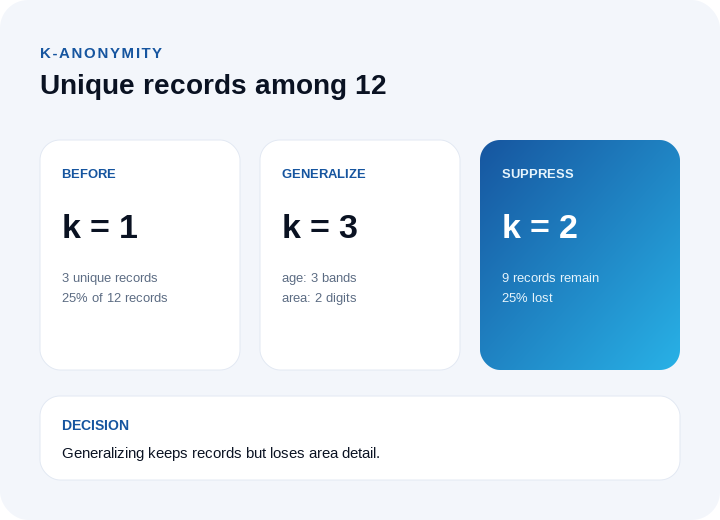
3 + 2 + 2 + 1 + 1 + 2 + 1 = 12. The smallest group is 1, so the dataset's k is 1; the three records with k = 1 (25% of 12) are unique and can be recognized when combined with outside information. There are two ways out.
- Generalization: Reduce the postcode area to two digits (34) and merge ages into three bands: 20–29, 30–39 and 40 and over. The groups become 3, 5 and 4 records; k = 3 and all 12 records are kept. The cost is that area detail disappears completely.
- Suppression (deletion): Remove the three unique records. The remaining 9 records form groups of 3, 2, 2 and 2; k = 2, but 25% of records (3 ÷ 12) are lost.
Unique records multiply quickly as indirect fields are added. Among 10,000 customers, 6 age bands × 20 districts × 2 genders make 240 cells, so the average is 10,000 ÷ 240 ≈ 41.7 records per cell. Add a job group (12) and the average becomes 10,000 ÷ 2,880 ≈ 3.5; add an income band (4) and it becomes 10,000 ÷ 11,520 ≈ 0.87, meaning most records are unique. So ask whether each new field is really needed.
There is a limit too: if every member of a group carries the same sensitive value (everyone has the same limit), information leaks even when k is large. The threshold for legal anonymity is not set by this calculation; consult your legal counsel.
How Big Should the Test Dataset Be, and What Does a Refresh Cost?
You do not need to copy all live data into every environment. A subset taken with referential integrity intact (for example 5% of customers and all their linked records) is enough for most tests, with deliberately chosen edge cases added on top.
Illustrative assumptions: the live database is 120 GB, there are three environments (development, test, acceptance), and storage costs ₺20 per GB per month. A full copy is 3 × 120 = 360 GB. The subset is 120 × 5% = 6 GB, plus 1 GB of edge cases, so 7 GB per environment and 21 GB across three.
| Item | Unmasked full copy | Masked subset |
|---|---|---|
| Total storage (3 environments) | 360 GB | 21 GB |
| Monthly storage | 360 × ₺20 = ₺7,200 | 21 × ₺20 = ₺420 |
| Yearly storage | ₺86,400 | ₺5,040 |
| Refresh effort (monthly) | 4 hours | 2 hours |
| Refresh effort (yearly) | 48 hours × ₺300 = ₺14,400 | 24 hours × ₺300 = ₺7,200 |
| Pipeline upkeep (rule updates after schema changes, yearly) | — | ₺27,000 |
| Yearly running total | ₺100,800 | ₺39,240 |
The subset cuts storage to 21 ÷ 360 = 5.8%, a reduction of about 94.2%. At a masking speed of 30 GB per hour, masking 7 GB takes 7 ÷ 30 hours = 14 minutes; the full copy needs 4 hours for 120 GB. Backups also hold unmasked real data; for their design, see our data backup guide.
Why Should Live Data Not Be Used in Testing?
Test environments have weaker access, monitoring and audit controls; more people reach them and data leaves them easily. The rule is simple: real personal data is not used in testing.
- Default ban: Live data is never copied unmasked into any environment.
- Single gate: Test data comes only out of the masking pipeline.
- Closed outward: The test environment never makes real email, SMS or payment calls.
- Bug reports: Screenshots and logs attached to a bug report follow the same rule.
For the data needs of automated tests, see test automation; for the acceptance stage, see user acceptance testing. If you build an analytics store for reporting, putting the mask in the load step of the data warehouse is sturdier than masking separately for each user.
How Is a Masking Project Run?
A six-step path is enough. The step most often skipped is verification.
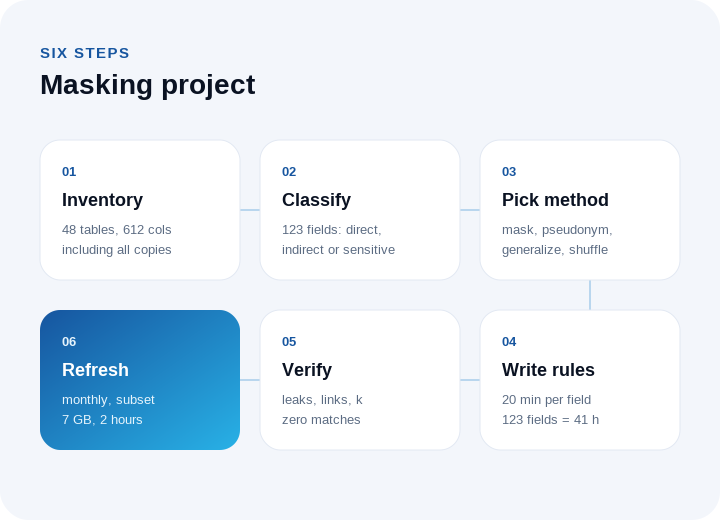
- Inventory: List every table, column, file and backup; in the example, 48 tables and 612 columns.
- Classification: Mark each column as direct, indirect, sensitive or transaction data; 123 fields need rules.
- Technique choice: Pick a technique based on the field's role in testing.
- Rule writing: Write the rules as code under version control; 41 hours.
- Verification: Run three checks. Leakage: search the masked set for 1,000 real emails; the expected match count is 0. Integrity: orphan records must be 0. Re-identification: k on indirect fields must not fall below the target.
- Refresh: Refresh monthly; tie schema changes to rule updates.
Writing the masking expectation as a requirement up front is cheaper than cleaning up later; for how to write it, see our requirements analysis guide.
How Long Does a Masking Investment Take to Pay Back?
Payback has two legs: lower running cost and lower incident risk. The second is an estimate, so show it separately. The illustrative assumptions follow.
- Setup: 30 person-days × ₺9,000 = ₺270,000 (inventory, rules, verification and automation).
- Running savings: ₺100,800 − ₺39,240 = ₺61,560 per year (table above).
- Risk reduction: The yearly probability of data leaking from a test environment falls from 4% to 0.5%, with an incident cost of ₺2,000,000. Expected yearly loss drops from 0.04 × ₺2,000,000 = ₺80,000 to 0.005 × ₺2,000,000 = ₺10,000; the gain is ₺70,000.
| Scenario | Net yearly gain | Payback |
|---|---|---|
| Running savings + risk reduction | ₺61,560 + ₺70,000 = ₺131,560 | 270,000 ÷ 131,560 ≈ 2.05 years ≈ 24.6 months |
| Running savings only | ₺61,560 | 270,000 ÷ 61,560 ≈ 4.39 years ≈ 52.6 months |
The investment does not pay back easily on cost savings alone; the main value is lower risk. Rebuild the risk assumption with your own data volume and incident cost, and consult your legal counsel on the legal side of an incident.
What Are Common Data Masking Mistakes?
- Masking only name and phone: Indirect fields identify a person once combined.
- Putting the mapping key in the test environment: The alias becomes reversible.
- Forgetting free text: Notes carry real names and phone numbers.
- Doing it once and walking away: New columns flow through unmasked as the schema changes.
- Forgetting backups and logs: Leaks often come from the copy that was out of scope.
We recommend reading: What is data encryption and key management?
We recommend reading: How to Build Customer Consent Management: Channel-Level Records, Double Opt-In and Sync Guide
We recommend reading: How to Set Up Self-Service Reporting: Semantic Layer, Certified Data, Access Control and Payback
We recommend reading: How to Manage Software Environments (Dev, Test, Staging, Production): Drift, Data Flow and Cost Guide
We recommend reading: How to Set Up a Data Archiving and Retention Policy: Data Tiers, the Archive Rule, Legal Hold and Deletion Guide
We recommend reading: How to Set Up Address Data Quality and Address Validation: Standardization, Match Score and Payback Guide
We recommend reading: How to Set Up Data Governance: Roles, Critical Data Elements, Quality Rules and a 90-Day Plan
We recommend reading: How to Handle Data Subject Requests (Access, Correction, Deletion) in Software: Data Map, Verification and Proof Guide
We recommend reading: How to Build Enterprise Search and Document Q&A with RAG: Chunking, Access Filters, Threshold and Payback Guide
We recommend reading: How to Design Secure File Upload and Storage: Validation, Scanning, Signed Links and Cost Guide
Custom Software and a Safe Test Environment with İnovabil
At İnovabil our focus is building software from scratch, tailored to the company: custom software, ERP, CRM, e-commerce, web, mobile and integration. Our software offers recorded capabilities such as role-based access, audit logs and secure hosting. We suggest writing down test data and masking expectations at the requirements stage; we do not promise a separate masking product or service.
We built CRM, purchasing and mobile for Avcılar İnşaat; a purchasing system for İZBAN; logistics and shipment planning with wholesale order management for Karyak; and warehouse management plus a complaint and support management system for Sleepy. Send us a short summary of your data structure and we will assess it together during analysis.
We recommend reading: Our software development process: from analysis to release
Frequently Asked Questions
What is data masking and what is it for?
It is replacing sensitive data with fictional values while preserving the format. It lets you work with realistic data in test, training and reporting environments without using real people's data.
Are masking and anonymization the same thing?
No. Masking changes values but can leave relationships and the chance of re-linking through extra information; anonymization aims to make it impractical to get back to the person. Which data counts as legally anonymous is for your legal counsel to decide.
What is k-anonymity, and what should k be?
It is the principle that every record has at least k − 1 look-alikes on its indirect fields. In the example, unique records were 25% at k = 1 and k became 3 after generalization. The right k depends on data sensitivity; there is no single correct number.
Why should live data not be used in a test environment?
Test environments have weaker access, monitoring and audit controls. In the example, the expected yearly loss from leakage falls from ₺80,000 to ₺10,000 with masking (illustrative).
When does a masking investment pay for itself?
In the example, setup is ₺270,000 and the net yearly gain including risk reduction is ₺131,560, so about 24.6 months; counting running savings only, about 52.6 months. Recalculate with your own volume and risk assumptions.