

You have launched your software, the code has been reviewed and the tests pass. But what could someone with bad intentions find in your system? A penetration test (pentest) answers that question before a real attacker does. It is an authorized, controlled exercise in which a specialist looks for security weaknesses the way an attacker would, proves which ones can really be abused, and reports the results.
This guide is written from the buyer's side: how a penetration test differs from vulnerability scanning and other methods, the test types, how to set the scope, authorization and rules, the stages, how findings are rated, what a report contains, effort and cost, choosing a provider and how often to test. It does not teach attack techniques; the goal is to help you ask for the right test with the right scope. Example figures are representative, not real prices or market rates.
What Is a Penetration Test?
A penetration test is an authorized specialist approaching your system with an attacker's logic, finding security weaknesses, proving whether they can actually be exploited, and reporting the outcome with remediation advice. The word "exploited" is the heart of it: a weakness existing in theory is not the same as demonstrating that data can be reached.
The test runs under rules that avoid harming real data, within an agreed scope and dates. We described how security spreads across the software life cycle in our secure software development guide; a penetration test is the independent verification step of that process.
We recommend reading: Our custom software service
How Does a Penetration Test Differ from Vulnerability Scanning, Code Review and Red Teaming?
All four test security, but each answers a different question. Vulnerability scanning asks "are there known weaknesses?", code review asks "is the code written correctly?", a penetration test asks "can an attacker get in here?", and red teaming asks "would our detection and response notice an attack?".
| Topic | Vulnerability scan | Code review | Penetration test | Red team |
|---|---|---|---|---|
| Core question | Any known weakness? | Is the code flawed? | Can it be breached? | Is the attack noticed? |
| Method | Mostly automated | A human reads the code | Specialist, manual plus tools | Long, covert, goal-driven scenario |
| Evidence | List of possible issues | Comments on code lines | Demonstrated access and impact | Defenders' reaction |
| Duration | Hours | Per change | Days to weeks | Weeks to months |
| Frequency | Continuous or weekly | Every change | After major releases, yearly | Rarely, for mature organizations |
| Best for | Everyone, basic hygiene | The development team | Any application holding data | Large setups with a monitoring team |
For most businesses the order is: continuous scanning and code review first, then a yearly penetration test. Red teaming is for mature organizations. For code review itself, see our code review guide.
What Are the Types of Penetration Testing?
A test is defined on two axes: which surface is tested, and how much the testers know about the system at the start.
| Target | What it tests | Typical question |
|---|---|---|
| External network | Internet-facing servers and services | Which doors are open from outside? |
| Internal network | Movement of someone already inside the office network | If one account is taken, how far can it spread? |
| Web application | Login, sessions, forms, permissions and business logic | Can I see someone else's order? |
| API | Endpoints, authentication, authorization, rate limiting | What does an unauthorized call return? |
| Mobile app | The app on the device, local data, server traffic | Is sensitive data exposed on the device? |
By knowledge level there are three approaches. Black box: the team knows nothing and imitates an outsider. Gray box: the team starts with limited information, such as a user account. White box: the team has the architecture and source code. Black box is realistic but cannot go deep in limited time. For business applications gray box is usually the best balance: one account per role is provided and permission flaws are covered efficiently. For designing the permission model, see our role-based access control guide.
How Is the Scope of a Penetration Test Defined?
Scope is the most important clause of the test agreement; vague scope means both neglected areas and unexpected outages. These items should be settled in writing.
- Targets: Which domains, IP ranges, applications and API versions will be tested?
- Out of scope: For third-party services (payment provider, hosting) your consent is not enough; list them as out of scope or obtain separate permission from the owner.
- Environment: The closer the test environment is to production, the more reliable the result. If testing in production, write down the load, data and downtime risks.
- Prohibited actions: Limits on load that could take the service down, emails reaching real customers, and deleting or altering data.
- Accounts and data: A test account per role; masking if real data must be used.
Is Written Authorization Required for a Penetration Test?
Yes, always. Attempting to break into a system you do not own, or without written permission, can be illegal whatever the intent. There must be a signed authorization and an agreement setting the rules between you and the testing team; if the hosting or cloud environment is not yours, its testing rules must be checked too.
Confidentiality, how findings are stored, and how accessed data is masked and deleted should also be written down. If personal data might be reached during testing, the split of responsibilities and any breach-notification duties under KVKK (Turkey's personal data protection law) should be assessed with your legal counsel.
What Stages Does a Penetration Test Have?
Most tests run in four stages, with a fifth after the buyer has fixed the issues.
- Discovery: The externally visible surface, technology stack and user flows are mapped.
- Vulnerability analysis: Automated scanning and manual review identify possible weaknesses; business-logic flaws are sought here.
- Exploitation (validation): Whether found weaknesses are really usable is shown in a controlled way within the rules; the aim is to prove impact, not to cause damage.
- Reporting: Each finding is written up with severity, evidence and a fix recommendation, plus an executive summary.
- Retest: It is verified that fixed findings are really closed and no new weakness was introduced.
How Are Findings Rated?
Findings are classified as critical, high, medium and low. A common method is the CVSS scale, which scores from 0 to 10; scores map broadly to these four bands. A report should look beyond the score to your context: the same flaw can be critical on a system holding customer data and low in an isolated test environment.
| Severity | Meaning | Example (generic) | Fix target (representative) |
|---|---|---|---|
| Critical | No authentication needed, wide data or system access | Unauthorized access to another customer's records | 7 days |
| High | Easy to abuse, serious impact | Skipping a role to reach an admin function | 30 days |
| Medium | Conditional or limited impact | Needless system detail in an error message | 90 days |
| Low | Minor impact, improvement-level | A missing security header | Next release |
What Should a Penetration Test Report Contain?
A good report serves two readers: the manager who decides and the developer who fixes. Look for these sections.
- Executive summary: Scope, dates, finding counts by severity and an overall risk view, readable without technical background.
- Method and scope: What was and was not tested, and the knowledge level used.
- Finding cards: For each finding a title, severity, affected location, reproducible evidence, impact description and fix recommendation.
- Remediation plan: A prioritized list and the retest conditions.
A finding whose evidence cannot be reproduced cannot be verified; store the report with restricted access, because a list of weaknesses is valuable to an attacker too.
How Are the Effort and Cost of a Penetration Test Calculated?
Test duration scales with scope. The example below is a gray-box test of a dealer portal: 60 API endpoints, 24 web screens and four roles. Unit efforts and the day rate are representative.
| Item | Unit effort | Quantity | Person-days |
|---|---|---|---|
| Discovery and scope validation | Fixed | — | 2 |
| API endpoints | 0.15 | 60 | 9 |
| Web screens | 0.25 | 24 | 6 |
| Permissions and business logic (4 roles) | Fixed | — | 4 |
| Reporting and presentation | Fixed | — | 3 |
| Total | 24 |
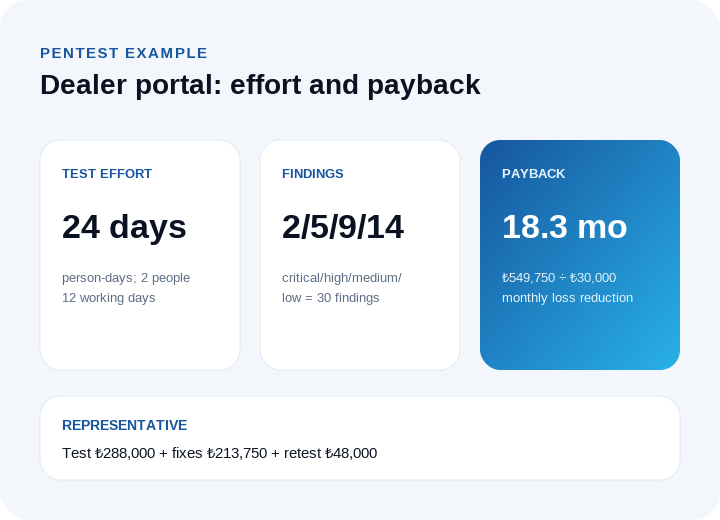
At ₺12,000 per day the test costs ₺288,000; with a two-person team it takes 24 ÷ 2 = 12 working days. The retest after fixes is 4 person-days: 4 × ₺12,000 = ₺48,000. What drives effort is the number of screens and endpoints; narrowing the scope (for example to changed modules only) cuts cost directly. For the general logic of project cost, see our software cost estimation guide.
How Are Findings Fixed and Retested?
The hidden part of the cost is remediation. Assume the example test returns 30 findings: 2 critical, 5 high, 9 medium and 14 low. The average fix effort per severity (representative) differs.
| Severity | Findings | Unit effort (person-days) | Total (person-days) |
|---|---|---|---|
| Critical | 2 | 3.0 | 6.0 |
| High | 5 | 1.5 | 7.5 |
| Medium | 9 | 0.75 | 6.75 |
| Low | 14 | 0.25 | 3.5 |
| Total | 30 | 23.75 |
At ₺9,000 per developer day the fixes cost 23.75 × ₺9,000 = ₺213,750. The critical and high findings (7 of them) take 13.5 person-days, which is 13.5 ÷ 23.75 ≈ 56.8% of the total. So 23.3% of the findings (7 ÷ 30) account for more than half the effort, which is why they are closed first. Medium and low findings are spread over planned releases.
The retest also checks side effects of the fixes; having a different team fix than test makes the gap between "I closed it" and "it is closed" visible. For general testing practice, see our software testing guide.
How Often Should a Penetration Test Be Done?
The general practice is a yearly test plus extra tests after major changes. The reason is simple: a test is a snapshot, and its validity fades as code, dependencies and environment change. A new module, an authentication change, a new integration or an architecture move calls for a focused test without waiting for the next yearly one.
A focused test is far cheaper than a full one. On the same portal, if 12 endpoints and 6 screens changed: discovery 1 + endpoints 12 × 0.15 = 1.8 + screens 6 × 0.25 = 1.5 + permissions and business logic 2 + report 1.5 = 7.8 person-days = ₺93,600. One full test (₺288,000) plus one focused test (₺93,600) comes to ₺381,600 a year, whereas two full tests would be ₺576,000. Continuous scanning and code review fill the gap between tests. For the detection and response side, our incident management guide is complementary.
What Questions Should You Ask When Choosing a Penetration Testing Provider?
A test is only as good as the team behind it, and the result is hard to verify. So ask for the following when choosing.
- References: Past work of a similar scale and type (web, API, mobile) and customers who can vouch for it.
- A sample report: With customer details removed; it shows the depth of evidence and fix advice.
- Who does the testing: The identity and experience of the testers; are they the people in the sales presentation?
- Retest: Included in the price or extra, and how long it takes.
- Independence: Any relationship with the team that built the application; testing your own work is a conflict of interest.
For claims based on certifications or standards, check the details with the relevant specialist and the official source. Comparing quotes works like the quote table in our guide to commissioning custom software: scope, effort, deliverables and retest should be compared on the same frame.
Does a Penetration Test Pay Back as an Investment?
Its return is measured as a reduction in expected loss. Representative scenario: if a critical weakness is exploited, the total loss (downtime, response, reputation, legal process) is ₺3,000,000, and the chance of it being exploited within a year is 15%. Expected annual loss is 0.15 × ₺3,000,000 = ₺450,000. If after testing and fixing the probability falls to 3%, expected loss is ₺90,000; the difference is ₺360,000 a year, or ₺30,000 a month.
| Situation | Annual probability | Expected annual loss |
|---|---|---|
| Without a test | 15% | ₺450,000 |
| After test and fixes | 3% | ₺90,000 |
| Reduction | 12 points | ₺360,000 (₺30,000 a month) |
Programme total: test ₺288,000 + fixes ₺213,750 + retest ₺48,000 = ₺549,750. Payback: ₺549,750 ÷ ₺30,000 ≈ 18.3 months. If the probability falls only from 15% to 9%, the difference is ₺180,000 (₺15,000 a month) and payback is ₺549,750 ÷ ₺15,000 ≈ 36.7 months. The calculation is a decision aid, not a forecast: probability and loss are uncertain, so run an optimistic and a pessimistic scenario.
How Is a Penetration Test Run Step by Step?
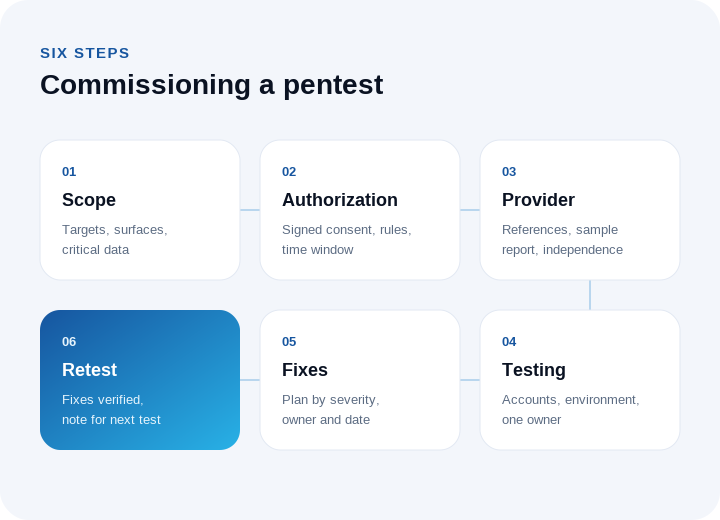
Six steps are enough of a frame for a business commissioning its first test.
- Scope and target: What are you protecting, which surfaces (web, API, mobile) will be tested, and which data matters most to the business?
- Written authorization and rules: Signed authorization, confidentiality, time window, prohibited actions and third-party approvals.
- Provider selection: References, a sample report, team identity and independence; compare at least two quotes on the same scope.
- Testing: Prepare accounts and environment, appoint one responsible person and keep the channel for critical findings open.
- Report and fixes: Read the report together with the development team; plan findings by severity and assign owners and dates.
- Retest: Have the fixes verified and turn the result into the starting note for the next yearly test.
What Mistakes Are Common in Penetration Testing?
- Treating the test as a certificate: A report is a dated measurement; it ages as code changes.
- Skipping the retest: Nobody knows whether the fix actually closed the issue.
- Neglecting backups: If something goes wrong during testing, recovery depends on your backup plan.
We recommend reading: How to secure an API: authentication, authorization and monitoring guide
We recommend reading: What Is MFA and SSO? Multi-Factor Authentication, Single Sign-On and Password Policy Guide
We recommend reading: What Is Data Encryption and Key Management? Encryption in Transit and at Rest, Envelope Encryption and Rotation Guide
We recommend reading: How to Set Up a Software Bill of Materials (SBOM) and Dependency Update Management: Vulnerability Matching, Priority and Payback Guide
Secure Custom Software Development with İnovabil
At İnovabil our focus is building bespoke software from scratch: custom software, ERP, CRM, e-commerce, web, mobile and integrations. We build security into the development process: role-based permissions, audit logs and secure hosting are the recorded parts of that approach. We do not offer penetration testing, because a team testing its own work independently is not sound. For critical systems we can plan with you for the test to be done by an independent specialist, and for the fixes and retest.
We built CRM, purchasing and mobile for Avcılar İnşaat; a purchasing system for İZBAN; logistics and shipment planning with wholesale order management for Karyak; and warehouse management with a complaint and support management system for Sleepy. We suggest settling security expectations and test frequency during requirements; see our process for the details.
Frequently Asked Questions
What is a penetration test, in short?
An authorized specialist approaches your system with an attacker's logic, finds security weaknesses, proves which can be abused, and reports with fix advice. It lets you see the weak points before a real attacker does.
Is a penetration test the same as vulnerability scanning?
No. Vulnerability scanning is mostly automated and lists known possible weaknesses. A penetration test manually verifies whether those weaknesses are really usable and finds business-logic flaws. Scanning is continuous; a penetration test is yearly and after major changes.
Is written permission required for a penetration test?
Yes. Trying to break into a system without written authorization can be illegal. Signed authorization, scope, time window and rules must be written before testing; the rules of hosting or third-party services must also be checked. For legal details, consult your legal counsel.
How long does a penetration test take and what does it cost?
It depends on scope. In the example, a portal with 60 endpoints and 24 screens needs 24 person-days (12 working days with two people); at ₺12,000 a day that is ₺288,000. The figures are representative; a real quote depends on your scope.
How often should a penetration test be done?
The general practice is once a year plus a focused test after major changes such as a new module, an authentication change or a new integration. Continuous scanning and code review reduce the gap between two tests.