

Two days before a dealer portal goes live, a security scan reveals that one dealer can see another dealer's orders. Fixing it means changing the screen, the service and the query together, and the schedule slips. The same rule could have been a single sentence in the requirements meeting: "a dealer sees only their own orders." Secure software development (Secure SDLC) means treating security not as a final check but as a way of working built into every stage of the development process.
In this guide we explain what a secure SDLC is, the "shift left" cost logic and a six-step rollout. The examples use a dealer portal and every figure is representative, not an industry average or a sourced statistic.
What Is Secure Software Development (Secure SDLC)?
A secure SDLC adds a defined security activity to each stage of the software development life cycle: planning, design, coding, testing, release and maintenance. The goal is not to catch flaws in production but to avoid creating them, or to catch them at the earliest possible stage.
We covered the life cycle itself in our software development life cycle guide. For protecting endpoints, see the API security guide; for the role model, see role-based access control. Here we focus on the process as a whole.
We recommend reading: Our custom software service
What Is Shift Left and Why Does It Reduce Cost?
Shift left means pulling security work toward the beginning of the timeline. The logic is simple: the longer a flaw lives, through coding, testing and release, the more components must change to fix it and the more people it affects.
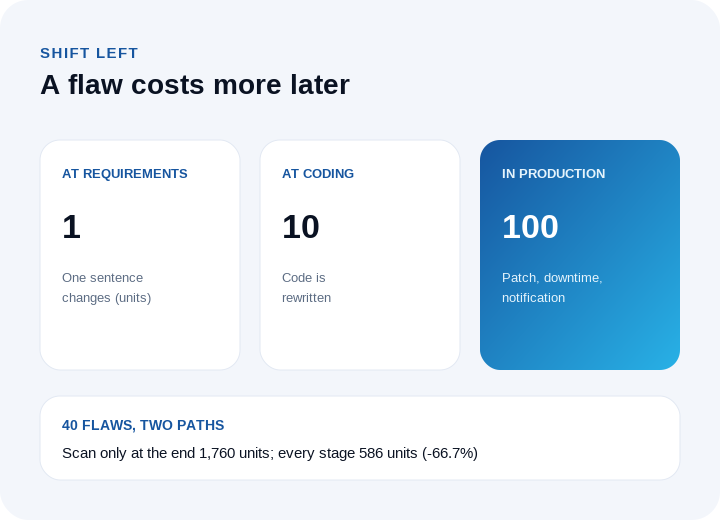
The relative cost units below are representative: they are not a sourced general statistic but a scale chosen to illustrate the logic. A flaw fixed at the requirements stage is taken as 1 unit.
| Stage where found | Relative fix cost (representative) | Why |
|---|---|---|
| Requirements | 1 | One sentence changes |
| Design | 5 | Diagrams and the data model change |
| Coding | 10 | Code is rewritten |
| Testing | 20 | Code, tests and retesting |
| Production | 100 | Emergency patch, downtime, notification, reputation |
Example: 40 security flaws arise while the dealer portal is built. If security is scanned only at the end, 28 are found in testing and 12 in production: 28 × 20 + 12 × 100 = 560 + 1,200 = 1,760 units. With work at every stage, the distribution becomes 6 at requirements, 8 at design, 14 at coding, 10 at testing and 2 in production: 6 × 1 + 8 × 5 + 14 × 10 + 10 × 20 + 2 × 100 = 6 + 40 + 140 + 200 + 200 = 586 units. The difference is 1,174 units, about 66.7% lower.
How Do You Handle Security Requirements and Data Classification?
First you must know what is being protected. Data classification gives every type of data a confidentiality level and a protection rule for that level; security requirements follow from this table.
| Level | Example from the dealer portal | Protection rule |
|---|---|---|
| Public | Product catalog, campaign announcement | Only authorized people change it |
| Internal | Stock quantity, shipment calendar | Visible only to signed-in users |
| Confidential | Dealer-specific prices, order history, account balance | Only the dealer concerned and authorized staff; access is logged |
| Restricted | Password hashes, credentials, admin keys | Never shown on any screen; stored encrypted, never written to logs |
From this table come measurable requirements such as "a dealer sees only their own orders and prices," "credentials are never written to log files" and "admin actions go into the audit log." We explained how to write requirements and tie them to acceptance criteria in our requirements analysis guide. For personal data, KVKK (Turkey's personal data protection law) obligations should be assessed with your legal counsel.
How Do You Do Threat Modeling?
Threat modeling means asking "what could go wrong?" systematically during design. A simple way is to walk through a STRIDE-style list of six questions for each asset.
| Threat type | Question to ask |
|---|---|
| Spoofing | Can someone pretend to be someone else? |
| Tampering | Can data be changed without authorization in transit or at rest? |
| Repudiation | Can an action later be denied, and is there proof? |
| Information disclosure | Can an unauthorized person see the data? |
| Denial of service | Can the system be made unusable with excessive requests? |
| Elevation of privilege | Can an ordinary user perform an admin action? |
Each answer is written into a table as an asset, a threat and a control. Priority comes from risk = likelihood × impact, both scored 1–5. A representative model for the dealer portal:
| Asset | Threat | Control | Likelihood × impact | Risk |
|---|---|---|---|---|
| Dealer account | Spoofing | Login attempt limit, extra verification | 4 × 4 | 16 |
| Order data | Seeing another dealer's orders | Object-level authorization check | 3 × 5 | 15 |
| Price list | Changing prices from the client | Price calculated only on the server | 3 × 4 | 12 |
| Admin panel | Elevation of privilege | Role and permission separation | 2 × 5 | 10 |
| Order service | Denial of service | Rate limit | 3 × 3 | 9 |
| Order approval | Repudiation | Audit log | 2 × 3 | 6 |
If 12 and above counts as high, the first three rows must be resolved before design ends. For general risk management, see our project risk guide.
What Are the Secure Coding Rules?
Secure coding is a set of short, verifiable rules the team applies every day. OWASP's general web security guidance is a good starting point; keeping a short list tailored to your team in writing is more effective.
- Validate input: Every piece of external data is checked for type, length and format on the server.
- Parameterize queries and encode output: User input is neither concatenated into query text nor allowed to run as script on screen.
- Check authorization on every request, on the server: A hidden button is not security.
- Keep secrets out of code: Keys and passwords live in environment configuration or a secrets vault.
- Stay plain in errors and logs: Users are not shown internal detail; passwords and keys are never written to logs.
How Do You Scan Dependencies and Secrets?
Most of a modern application's code comes from third-party components. Known vulnerabilities in these components are as risky as a flaw in your own code.
Example: the dealer portal uses 120 dependencies and a scan finds known vulnerabilities in 18 of them (18 ÷ 120 = 15%). Rather than fixing all at once, they are ordered by priority score = severity × exposure. Severity: critical 4, high 3, medium 2, low 1. Exposure: 3 if the affected function is externally reachable and in use, 2 if used only internally, 1 if never used.
| Finding | Severity | Exposure | Score | Order |
|---|---|---|---|---|
| Critical, externally reachable and used function | 4 | 3 | 12 | 1 |
| High, externally reachable and used function | 3 | 3 | 9 | 2 |
| High, internal tool only | 3 | 2 | 6 | 3 |
| Medium, externally reachable | 2 | 3 | 6 | 3 |
| Critical, function never used | 4 | 1 | 4 | 5 |
| Low, internal tool | 1 | 2 | 2 | 6 |
A critical but never-called component (4 points) can rank behind an externally reachable medium one (6 points); the decision is recorded with a written reason and the component is removed.
Secret scanning is separate: the code repository is searched for passwords, keys and tokens. In the example, 40 scans in a month produce 3 findings (3 ÷ 40 = 7.5%): two test keys and one live key. When a live key is found, deleting it from the code is not enough; the key is revoked and replaced, because it stays in the history. That is why version history is scanned too. Running scans on every change automatically fits the pipeline described in our CI/CD article.
What Is Checked in Code Review and Security Testing?
Code review is the cheapest point at which a second pair of eyes can catch a security flaw. We covered the general method in our code review guide; for security, these items are added to the checklist:
- Does the new endpoint or screen include identity and object-level authorization checks?
- Is external data validated and are parameters used in queries?
- Has a secret, credential or real customer data entered the code?
- Are important actions written to the audit log?
Security testing means testing the application like an attacker: unauthorized access attempts, malformed input and boundary values, scenarios for reaching another dealer's record. These go into the test plan; repeated ones are moved to automation. Real customer data is not used in test environments; consult your legal counsel on personal data.
What Is a Pre-Release Security Checklist?
A pre-release checklist catches the safeguards forgotten at the last minute. The 10 items below are a starting list; each must be answerable with a yes or a no.
- Is the number of critical and high vulnerable dependencies zero, or is an acceptance decision written down?
- Does the latest secret scan show no live-key finding?
- Has authorization been tested for every endpoint and screen?
- Is confidential data encrypted in transit and at rest?
- Have default passwords and test accounts been removed?
- Do error pages avoid showing internal detail?
- Are audit logs on and free of credentials?
- Is backup running and has a restore been tried?
- Are monitoring and alerts set up, and is the on-call person known?
- Is the incident response plan written down and known to the team?
For detail, see the data backup and software monitoring guides.
How Do You Prepare an Incident Response Plan?
No control reduces risk to zero, so what to do when an incident happens is written in advance, and the plan is kept simple enough to read in the middle of a crisis.
- Detection and classification: Who reports an incident, how, and how is severity decided?
- Responsibilities: Incident lead, technical and communications owners, and their backups.
- Containment: Revoking the affected key and account, temporarily shutting down a service if needed.
- Fix and recovery: Closing the hole and restoring from backup.
- Notification: When and what to tell affected dealers. For a personal data breach, statutory notification duties and deadlines should be determined with your legal counsel.
- Post-incident review: The root cause is written down and fed back into the process.
What Are the Security Metrics?
Security that is not measured is security that is merely felt. Three metrics are a sufficient start for most teams.
| Metric | How it is calculated | Representative example |
|---|---|---|
| Open vulnerabilities | Findings by severity | 18 findings in the first scan: 2 critical, 5 high, 7 medium, 4 low (14 closed, 4 low still open) |
| Mean time to fix | Total closing time ÷ closed findings | Critical 4 days, high 24 days, medium ≈ 63.6 days |
| Fix-target compliance | Closed within target ÷ closed | 12 ÷ 14 = 85.7% |
| Dependency currency | Without known flaws ÷ total dependencies | 102 ÷ 120 = 85% |
Representative fix-time targets are 7 days for critical, 30 for high and 90 for medium. In the example the critical findings closed in 3 and 5 days: (3 + 5) ÷ 2 = 4 days. The five high findings closed in 12, 20, 25, 28 and 35 days: 120 ÷ 5 = 24 days, but the 35-day one missed the 30-day target. The seven medium findings closed in 40, 55, 70, 80, 95, 60 and 45 days: 445 ÷ 7 ≈ 63.6 days; the 95-day one missed its target. Closed within target: 2 + 4 + 6 = 12 of 14 closed, a compliance of 85.7%. The four low findings remain open and are left for the next update round. The point is not the number itself but the trend.
How Do You Compare the Cost of Security with the Cost of an Incident?
Security work costs money, but zero security is not free either. For the comparison, assume 8% of the dealer portal's 73 person-day development effort (see our software project cost guide for the cost calculation) is set aside for security: 73 × 0.08 = 5.84 person-days; 5.84 × ₺9,000 = ₺52,560.
| Security activity | Effort (person-days) |
|---|---|
| Requirements and threat model | 1.20 |
| Coding rules and security in review | 1.50 |
| Automated scan setup | 1.00 |
| Security testing | 1.50 |
| Release check and incident plan | 0.64 |
| Total | 5.84 (₺52,560) |
Incident cost scenario (representative): response 20 person-days × ₺9,000 = ₺180,000; three days of downtime 3 × ₺150,000 = ₺450,000; legal and advisory ₺120,000; loss of two dealers 2 × ₺125,000 = ₺250,000. Total ₺1,000,000. Break-even probability: ₺52,560 ÷ ₺1,000,000 = 5.26%. In other words, the security share pays for itself if it lowers the likelihood of the relevant incident by at least 5.26 percentage points. If the controls cut the likelihood from 18% to 8%, the expected gain is 10 points × ₺1,000,000 = ₺100,000, a net ₺47,440. Likelihood estimates are uncertain; recalculate with your own assumptions.
How Do You Set Up Secure Development in Six Steps?
Each step is the foundation for the next.
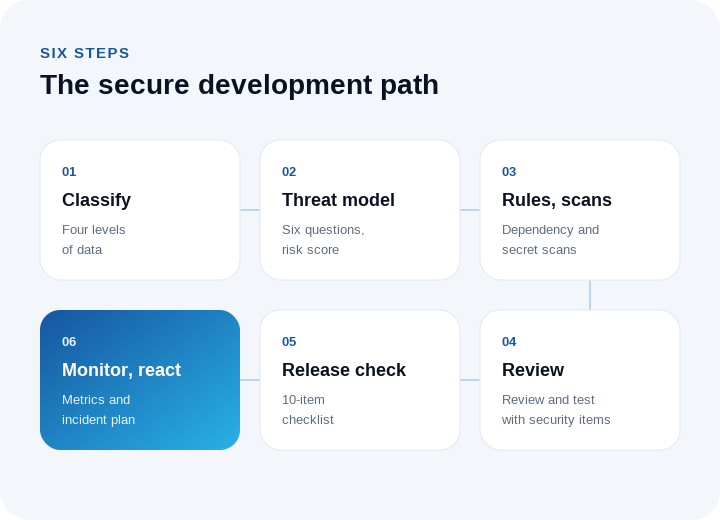
- Classify the data: Write down what is protected using the four-level table.
- Build a threat model: Apply the six questions to your assets and score the risk.
- Set up rules and scanning: Coding rules plus dependency and secret scans run on every change.
- Strengthen review and testing: Add security items to review and unauthorized-access scenarios to testing.
- Apply the release check: The 10-item list is ticked off in every release.
- Monitor and be ready to respond: Review the metrics monthly and rehearse the plan once a year.
What Common Mistakes Happen in a Secure SDLC?
- Leaving security to the end: A flaw found at the most expensive point breaks the schedule and the budget.
- Treating a findings list as done work: Without an owner and a deadline it only grows.
- Testing with real data: Test environments are often less protected.
- Writing the plan and never trying it: An unrehearsed incident plan does not work in a crisis.
We recommend reading: How to secure an API: authentication, token lifetime and monitoring
We recommend reading: What is role-based access control (RBAC)?
We recommend reading: How to Do Incident Management and Post-Mortems: SEV Levels, On-Call, MTTR and Blameless Review Guide
We recommend reading: What Is Penetration Testing? Types, Scope, Reports, Cost and How a Business Should Commission One
We recommend reading: What Is MFA and SSO? Multi-Factor Authentication, Single Sign-On and Password Policy Guide
We recommend reading: Disaster Recovery and Business Continuity Planning: BIA, RTO, Tiers and Drills Explained
We recommend reading: What Is Data Encryption and Key Management? Encryption in Transit and at Rest, Envelope Encryption and Rotation Guide
We recommend reading: How to Design an Audit Log: Event Schema, Immutability, Retention and Payback Guide
We recommend reading: What Is Data Masking and Anonymization? Test Data, Pseudonyms, k-Anonymity and Payback Guide
We recommend reading: How to Manage Software Environments (Dev, Test, Staging, Production): Drift, Data Flow and Cost Guide
We recommend reading: How to Set Up Centralized Log Management: Structured Logs, Retention and Cost Guide
We recommend reading: How to Set Up a Software Bill of Materials (SBOM) and Dependency Update Management: Vulnerability Matching, Priority and Payback Guide
We recommend reading: What Is Static Code Analysis and Quality Gates? Complexity, Thresholds and Findings Management Guide
We recommend reading: How to Design Secure File Upload and Storage: Validation, Scanning, Signed Links and Cost Guide
We recommend reading: How to Set Up Secrets Management: Inventory, Vault, Rotation, Short-Lived Credentials and Leak Response Guide
Building Security into the Process with İnovabil
At İnovabil our focus is building bespoke software from scratch for your company: custom software, ERP, CRM, e-commerce, web, mobile and integration. Role-based authorization, audit logs and secure hosting are among the core capabilities of the systems we build; we recommend writing security expectations (data classes, the role model, backup) down at the requirements stage.
We have built CRM, purchasing and mobile for Avcılar İnşaat; a purchasing system for İZBAN; logistics and shipment planning with wholesale order management for Karyak; and warehouse management plus a complaint and support management system for Sleepy. We do not claim to offer security certification or penetration testing; this article is a guide to how security can be structured in a development process. Send us a short summary of your project and we will clarify the data classes and role model together.
We recommend reading: Our software development process: step by step from analysis to release
Frequently Asked Questions
What is secure software development (Secure SDLC)?
It means adding a defined security activity to each stage of planning, design, coding, testing, release and maintenance. The aim is to catch flaws at the earliest possible stage, not in production.
What does shift left mean?
It means pulling security work toward the start of the project. The later a flaw is found, the more components change and the more people are affected. In the representative example in this article, a scan only at the end costs 1,760 units and work at every stage costs 586.
Is threat modeling needed in small projects too?
Yes, but in a light form. Applying the six threat questions to the main assets in a one-hour meeting makes the biggest risks visible during design.
How much effort should be set aside for security?
There is no fixed ratio. In the representative example, 8% of a 73 person-day project, 5.84 person-days (₺52,560), is set aside. The right share depends on how sensitive the data is and the business impact of an incident.
What are the security metrics?
Open vulnerabilities, mean time to fix, fix-target compliance and dependency currency are a sufficient start for most teams. What matters is not a single value but the trend over time.