

Any source that answers "how much does ERP cost?" with a single number is misleading you. The honest answer to how much does ERP cost is not a price list but a calculation method: the subscription or license is only one line item. Customization, integration, data migration, training, infrastructure, maintenance and the time your own team spends all belong in the total. That total is called the total cost of ownership (TCO).
In this guide we walk through the ERP cost items, the three-year and five-year total for a sample business with 50 users, the cost structure of off-the-shelf, customized and custom ERP, the hidden items, the five factors that drive cost, how to set the budget and how to calculate the benefit. All figures in this article are illustrative; they are not a product price or a market average. Put your own numbers into the same method.
How Much Does ERP Cost, and Why Is There No Single Number?
There is no single correct price, because cost depends on your number of users, module scope, how unusual your processes are, the systems to be connected and the volume of data to be migrated. The same software can end up with a total cost twice as high in one business as in another.
So instead of asking for a price, ask: "What is the three-year total for my scope, and which line depends on which assumption?" That question can only be answered by separating the items. If you want a refresher on the basics, see our guide on what ERP is; for the selection process, see how to choose an ERP. This article focuses on the question that follows selection: the total cost.
What Are the ERP Cost Items?
ERP cost consists of eight items; at the quote stage, check one by one which of them are in your budget.
| Item | What it includes | How it is calculated |
|---|---|---|
| License / subscription | The right to use the software, often with hosting included | Users × monthly fee × months |
| Customization | Screen, field, report and rule changes to fit your processes | Person-days × daily rate |
| Integration | Connections to marketplaces, carriers, e-invoice (e-Fatura), banks and other systems | Number of integrations × person-days |
| Data migration | Cleansing, mapping, trial runs and cutover from the old system | Data volume and cleansing effort |
| Training | User and administrator training, documentation | Person-days or per user |
| Infrastructure | Extra environments, backup, server or cloud resources | Annual amount × years |
| Maintenance and support | Fixes, updates, support requests | Annual percentage of the customization and integration fee |
| Internal team time | Your own staff for analysis, testing, data preparation and ongoing administration | Days × internal daily cost |
Internal team time is the most forgotten item because it never appears on an invoice. Yet the fact that an employee cannot do other work on those days is a real cost. As scope grows, the proportions of these eight items shift; in custom development the license drops to zero while development and maintenance carry the weight. We explain how the development fee is derived in our software project cost guide.
We recommend reading: Our ERP software service
What Does a Three-Year ERP Cost for a Business with 50 Users?
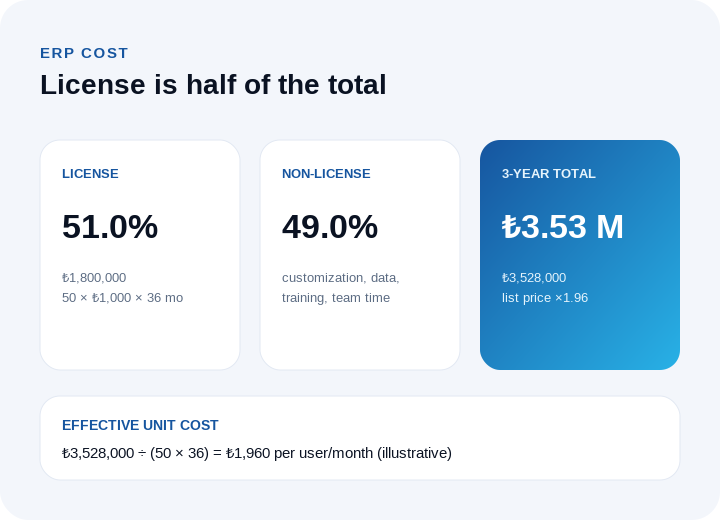
The sample business has 50 users and a customized ERP; over three years the total comes to ₺3,528,000. The assumptions are illustrative: subscription ₺1,000 per user per month; developer day ₺9,000; internal day ₺4,000; maintenance 15% of the customization and integration fee per year.
| Item | Calculation | 3-year amount |
|---|---|---|
| Subscription | ₺1,000 × 50 × 36 | ₺1,800,000 |
| Customization | 40 person-days × ₺9,000 | ₺360,000 |
| Integration | 20 person-days × ₺9,000 | ₺180,000 |
| Data migration | 15 person-days × ₺9,000 | ₺135,000 |
| Training | 10 person-days × ₺9,000 | ₺90,000 |
| Infrastructure | ₺24,000 × 3 years | ₺72,000 |
| Maintenance and support | 15% × (₺360,000 + ₺180,000) × 3 | ₺243,000 |
| Internal team time | setup 90 days × ₺4,000 + administration 2 days × 12 months × ₺4,000 × 3 years = ₺360,000 + ₺288,000 | ₺648,000 |
| Total | ₺3,528,000 |
Shares: subscription ₺1,800,000 ÷ ₺3,528,000 = 51.0%; internal team ₺648,000 ÷ ₺3,528,000 = 18.4%. Non-license items total ₺1,728,000, or 49.0%. The real unit cost per user per month is ₺3,528,000 ÷ (50 × 36) = ₺1,960, 1.96 times the list price.
In the five-year view, the one-time items (customization, integration, migration, training and internal setup) stay the same while recurring items grow: one-time ₺1,125,000 + subscription ₺1,000 × 50 × 60 = ₺3,000,000 + infrastructure ₺120,000 + maintenance ₺405,000 + internal administration ₺480,000 = ₺5,130,000. The annual average is ₺1,176,000 over three years and ₺1,026,000 over five; one-time cost is spread over a longer period, so the unit cost falls from ₺1,960 to ₺1,710.
How Does the Cost Structure of Off-the-Shelf, Customized and Custom ERP Differ?
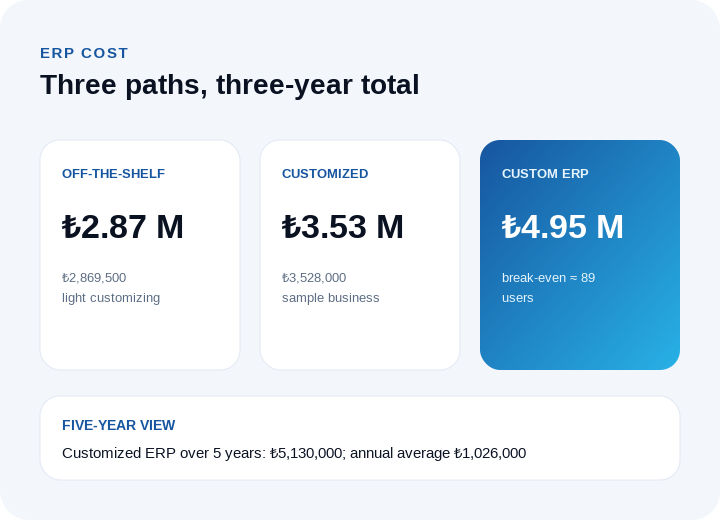
The three paths differ in structure, not only in total: in off-the-shelf ERP the cost rests on the subscription, in custom ERP on development and maintenance. For the same 50 users and three years, the illustrative comparison is below.
| Item (3 years) | Off-the-shelf ERP | Customized ERP | Custom ERP |
|---|---|---|---|
| Subscription | ₺1,800,000 | ₺1,800,000 | — |
| Customization / development | ₺180,000 | ₺360,000 | ₺2,700,000 |
| Integration | ₺90,000 | ₺180,000 | in development |
| Data migration | ₺90,000 | ₺135,000 | ₺135,000 |
| Training | ₺60,000 | ₺90,000 | ₺90,000 |
| Infrastructure | in subscription | ₺72,000 | ₺120,000 |
| Maintenance and support | ₺121,500 | ₺243,000 | ₺1,215,000 |
| Internal team time | ₺528,000 | ₺648,000 | ₺688,000 |
| Total | ₺2,869,500 | ₺3,528,000 | ₺4,948,000 |
The custom ERP calculation: 250 person-days × 1.2 margin = 300 person-days × ₺9,000 = ₺2,700,000 development; maintenance 15% × ₺2,700,000 × 3 = ₺1,215,000; internal team 100 days × ₺4,000 + ₺288,000 administration = ₺688,000. In off-the-shelf ERP, maintenance is calculated only on customization and integration: 15% × (₺180,000 + ₺90,000) × 3 = ₺121,500.
Custom ERP has no license, so its cost does not grow with users. The cost of the customized ERP for u users is ₺36,000 × u + ₺1,728,000 (other items held constant). Break-even: (₺4,948,000 − ₺1,728,000) ÷ ₺36,000 ≈ 89 users. This number holds only for the example assumptions; recalculate with your own figures. For when each path fits, see off-the-shelf vs custom software.
What Are the Hidden Costs of ERP?
Hidden costs are the items that do not appear in the quote but inflate the budget after the project. In the sample business they are sized as follows.
| Hidden item | Why it appears | Example impact (3 years) |
|---|---|---|
| Internal team time | Analysis, testing, data preparation and administration never reach the invoice | ₺648,000 (18.4% of the total) |
| Scope growth | Customization grows if the first request is not limited in writing | 20% × (₺360,000 + ₺180,000) = ₺108,000 |
| Extra module | A new need appears after go-live | ₺200 × 50 × 36 + 10 days × ₺9,000 + maintenance ₺40,500 = ₺490,500 |
| Extra user | The company grows and the subscription rises linearly | 10 users: ₺1,000 × 10 × 36 = ₺360,000 |
| Integration maintenance | An external interface changes and the connection is updated | 15% × ₺180,000 × 3 = ₺81,000 |
Two of these, internal team time and scope growth, can be calculated before the project starts. To write the scope down, our requirements analysis guide helps.
What Are the Five Factors That Drive ERP Cost, and How Do You Read Sensitivity?
The factors are the number of users, the number of modules, customization depth, the number of integrations and data volume. Change each one on its own and watch how the sample total (₺3,528,000) moves.
| Factor | Change | Added cost | New total | Increase |
|---|---|---|---|---|
| Users | 50 → 60 (20%) | ₺360,000 | ₺3,888,000 | 10.2% |
| Modules | 1 extra module | ₺490,500 | ₺4,018,500 | 13.9% |
| Customization depth | 2× | ₺360,000 + maintenance ₺162,000 = ₺522,000 | ₺4,050,000 | 14.8% |
| Number of integrations | 2× | ₺180,000 + maintenance ₺81,000 = ₺261,000 | ₺3,789,000 | 7.4% |
| Data volume | 2× | ₺135,000 | ₺3,663,000 | 3.8% |
Reading it: if users grow by 20%, cost rises about 10%, because the subscription is half of the total. If customization depth doubles, the increase is 14.8%; this factor causes the largest deviation and is the one most within your control. Even if data volume doubles, the increase is only 3.8%; the real risk of migration is quality, not cost. The table changes only the direct items; internal team time usually rises along with them. For migration preparation, see our data migration guide.
How Is an ERP Budget Set?
The budget is set as a ceiling by adding an uncertainty margin on top of the calculated total. In the example the ceiling is ₺3,528,000 × 1.20 = ₺4,233,600; if the calculation stays below it, the margin is unused, and if it exceeds it, the decision is made in advance.
Do not spend the ceiling in one go; tie it to phases. Split the one-time ₺1,125,000 across three phases at 45%, 35% and 20%: ₺506,250, ₺393,750 and ₺225,000. At the end of each phase, check the output and the spend before moving on; the budget passes through a gate at each phase rather than melting away in a single line.
- Phase 1: Core processes (inventory, purchasing, sales) and basic data migration.
- Phase 2: Production, costing, finance and reporting.
- Phase 3: Integrations, extra modules and improvements.
If you can also take the subscription in stages, buy licenses in phase 1 only for the people who will use the system. To see the order of the core processes, look at our inventory tracking guide and our production planning guide.
What Should You Watch for When Comparing ERP Quotes?
Quotes must be compared on the same scope, the same items and the same period; a low first price often signals a missing scope.
- Same scope: Ask every vendor for quotes against the same written list of modules, integrations and users.
- Three-year total: Calculate three years including subscription and maintenance, not only the first year.
- Itemization: Customization, integration, migration and training should appear on separate lines; a single package price breaks the comparison.
- What is left out: Ask explicitly about work the quote does not cover (training, migration, extra environments).
- Price rises and extra users: Get the subscription increase terms and the price for extra users in writing.
- Exit: Ask in what format and at what cost you can take your data back when the contract ends.
How Can ERP Cost Be Reduced?
The most reliable way is to narrow the scope and phase the rollout; price negotiation usually has a smaller effect.
- Narrow the scope: Take only the functions needed for the first phase; postponing the others does not remove their cost, it only delays it.
- Phase the users: Start with 30 users for the first 12 months.
- Prefer the standard process: Every customization day ties you to maintenance and update effort.
- Clean the data beforehand: If cleansing is done early by your own team, the migration rounds get shorter.
In the example, 30 users for the first 12 months: ₺1,000 × 30 × 12 + ₺1,000 × 50 × 24 = ₺360,000 + ₺1,200,000 = ₺1,560,000; saving ₺240,000. If the customization scope shrinks by 25%, ₺360,000 → ₺270,000, saving ₺90,000; maintenance 15% × (₺270,000 + ₺180,000) × 3 = ₺202,500, saving ₺40,500. Total saving ₺370,500; the new total is ₺3,157,500, a 10.5% reduction. Only these three items entered the calculation; the later cost of postponed functions is added separately. If your processes run in spreadsheets today, the phased plan in our guide to moving from Excel to software also helps clarify the scope.
How Is the Benefit of ERP Calculated, and When Does It Pay Back?
The benefit is measured by dividing the monthly net gain into the investment. In the example the gains are: 200 hours × ₺300 = ₺60,000 of time, ₺35,000 of errors and rework, and ₺6,000,000 × 10% × 20% ÷ 12 = ₺10,000 of inventory carrying cost; gross monthly ₺105,000.
Monthly running cost is subscription ₺50,000 + infrastructure ₺2,000 + maintenance ₺6,750 + internal administration ₺8,000 = ₺66,750. Monthly net benefit is ₺105,000 − ₺66,750 = ₺38,250. With a one-time investment of ₺1,125,000, payback is ₺1,125,000 ÷ ₺38,250 ≈ 29.4 months. Over three years the total benefit is ₺105,000 × 36 = ₺3,780,000 against a total cost of ₺3,528,000; net +₺252,000.
This result is highly sensitive to the benefit: if the gain falls 30% short, gross is ₺73,500, net is ₺6,750 and payback is ₺1,125,000 ÷ ₺6,750 ≈ 167 months. So tie the benefit assumptions to measurable indicators (hours, error counts, inventory value) and measure after the project.
What Is the Six-Step Process for an ERP Budget?
- Write the scope: The list of modules, users, integrations and data to be migrated.
- Calculate the items: Work out the eight items for three and five years.
- Test sensitivity: Change the five factors one at a time and see the deviation.
- Set the ceiling: Add a 20% margin to the total and split it across phases.
- Compare quotes: On the same scope, with the three-year total.
- Track benefit and spend: Measure actual cost and gain in each phase.
We recommend reading: How to estimate software development cost: effort, team and three-year total
We recommend reading: How to Run an ERP Implementation: Process Design, Training, Pilot and Go-Live Guide
We recommend reading: What Is ABC Analysis? Inventory Classification, Pareto, XYZ and Policy Guide
We recommend reading: What Is Multi-Company ERP? Intercompany Transactions, Eliminations and Consolidation Guide
We recommend reading: How to Build a Business Case for a Software Investment: NPV, Payback and Sensitivity Guide
ERP and Custom Software with İnovabil
At İnovabil our focus is building bespoke software from scratch for your company; ERP is one of our services, and on our service page we describe modules such as bill of materials, MRP, production, costing, inventory, purchasing and finance. We suggest that the cost items and scope be pinned down in writing during requirements analysis; the figures in this article are not a price or package commitment.
We built the warehouse management system (WMS) for Sleepy, logistics and shipment planning with wholesale order management for Karyak, and shipment planning software for Bofigo. Send us a short summary of your processes, user count and the systems to be connected, and let us work out the scope together.
We recommend reading: Our software development process: step by step from analysis to launch
Frequently Asked Questions
How is ERP cost calculated?
Eight items are worked out separately: subscription, customization, integration, data migration, training, infrastructure, maintenance and internal team time. The total is calculated for three and five years, and a 20% uncertainty margin is added on top to set the budget ceiling.
How much does ERP cost?
There is no single price; it depends on users, modules, customization, integrations and data volume. In the example in this article, the three-year total for 50 users is ₺3,528,000; this figure is illustrative and must be recalculated for your own scope.
What is the most forgotten ERP cost?
Internal team time. It does not show up on an invoice, but the days spent on analysis, testing, data preparation and administration make up 18.4% of the total in the example.
Is off-the-shelf ERP or custom ERP cheaper?
At low user counts, off-the-shelf or customized ERP is usually cheaper; because the subscription grows with users, custom ERP can come out ahead as the user count rises. In the example, the break-even between customized and custom ERP is about 89 users.
How can an ERP budget be reduced?
By narrowing the scope to the first phase, adding users in stages, preferring the standard process and cleaning the data beforehand. In the example, 30 users for the first 12 months and a 25% narrower customization cut the total by 10.5%.