

Orders arrive by email, stock is kept in Excel, invoices are issued in another program, and the report is prepared at month end by merging three files. The business runs and customers are happy, but every job passes through several hands and several tools. Digital transformation comes onto the agenda at exactly this point: rebuilding how work is done, how data flows and how decisions are made, with digital tools.
In this guide we explain what digital transformation is, how it differs from digitization and automation, why it matters for businesses, how to assess your digital maturity, the six-step roadmap, which technologies to start with, a 12-month example plan, cost and payback calculation, how to bring employees along and the common mistakes. Example figures are illustrative.
What Is Digital Transformation?
Digital transformation is a business redesigning its processes, data and relationship with customers with digital tools so that it becomes more efficient and measurable. It has three dimensions: process (how work is done), data (where and how information is kept) and people (how employees take up the new way of working).
Transformation is not a one-off project but ongoing work. As the business grows, the market changes and new tools arrive, systems are reviewed again. That is why success is decided not by installing a single piece of software but by the work improving in a measurable way.
We recommend reading: Our custom software development service
What Is the Difference Between Digitization, Digital Transformation and Automation?
The three concepts are often confused but describe different things. Digitization moves information into digital form, automation runs steps by software, and transformation changes how the work is done.
| Concept | What it does | Example |
|---|---|---|
| Digitization | Moves information that is on paper or scattered into digital form | Moving customer account cards from a ledger into a program |
| Automation | Has software carry out repetitive steps by rule | Opening the invoice and shipment record automatically from an order |
| Digital transformation | Rebuilds process, data and decision-making together | Joining sales, stock, finance and reporting in one flow and deciding with data |
In practice transformation includes digitization and automation but does not end with them. We covered process automation in detail in our business process automation guide.
Why Do Businesses Go Through Digital Transformation?
Five reasons stand out: speed, fewer errors, visibility, scalability and customer experience. Each is a direct result of moving a manually run job into a digital flow.
- Speed: Data is entered once and reaches where it is needed on its own; waiting and handling time fall.
- Fewer errors: Typing the same information several times by hand disappears.
- Visibility: Stock, sales and receivables are seen instantly; decisions are made with data, not guesses.
- Scalability: When order counts grow, the team does not have to grow at the same rate.
- Customer experience: Customers see their order status, tracking and history themselves.
How Do You Assess Your Business's Digital Maturity?
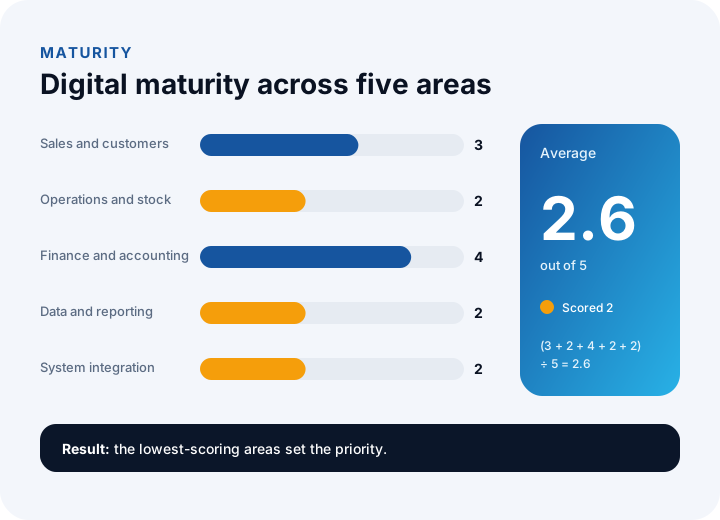
Before starting transformation, measure where you stand. Score five areas from 1 to 5: 1 means "everything is manual and scattered," 5 means "digital, integrated and measured."
Example (illustrative):
| Area | Score | Status |
|---|---|---|
| Sales and customers | 3 | Customer records exist but opportunity tracking is scattered |
| Operations and stock | 2 | Stock is in Excel, the order flow is manual |
| Finance and accounting | 4 | Pre-accounting and e-invoice are in use |
| Data and reporting | 2 | Reports are monthly, prepared by merging files |
| System integration | 2 | Systems are not connected, data is moved by hand |
| Average | 2.6 | Weakest areas: operations, reporting, integration |
In the example the average is (3 + 2 + 4 + 2 + 2) ÷ 5 = 2.6. Because finance is strong, no new investment is needed there; operations and integration are the priority. Use the score not as a grade but as a prioritization tool.
How Do You Prepare a Digital Transformation Roadmap?
It is prepared in six steps: set the goal, measure the current state, choose the priority, run a small pilot, scale up what works and measure the results. If the pilot step is skipped, risks appear at full scale.
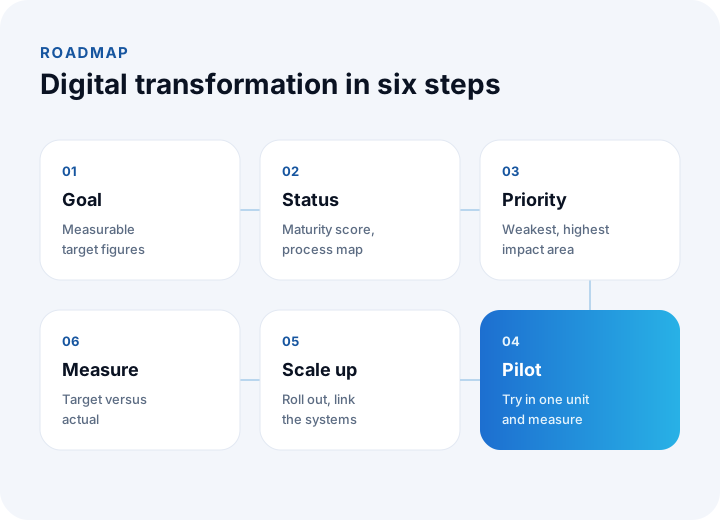
- Goal: Write down measurably what you want to improve: "order entry time should fall from 12 minutes to 4," "stock accuracy should rise to 95%."
- Current state: Work out the maturity score, map processes and tools, and record today's figures.
- Priority: Choose the weakest area with the highest impact; do not try to do everything at once.
- Pilot: Try the chosen area in a single unit or process; measure the results.
- Scale up: Carry what worked in the pilot to other units and connect the systems.
- Measure: Compare the target figures with the actual ones, then move on to the next area.
Which Technologies Do You Start With in Digital Transformation?
Technology is chosen according to the weakest area and the problem you want to solve; the same order does not suit every business. The table below matches each area with a fitting solution.
| Area | Solution | Problem it solves |
|---|---|---|
| Sales and customers | CRM | Scattered customer records, opportunities that are not tracked |
| Operations, stock, production | ERP, warehouse management | Manual stock, planning and cost uncertainty |
| Finance | Pre-accounting, e-invoice integration | Manual invoicing, customer account and collection tracking |
| Sales channels | E-commerce, marketplace integration | Separate stock and price management per channel |
| Data and decisions | Business intelligence and reporting | Preparing reports by merging files |
| Connection | Integration and API | Moving data between systems by hand |
| Process | Workflow and approval automation | Approvals that cannot be tracked and repetitive steps |
We recommend reading: How to choose an ERP: process mapping, module priority, payback and rollout
What Does a 12-Month Digital Transformation Plan Look Like?
The plan is split into four quarters and measured at the end of each. The example below is for a trading business with a low maturity score; change it to fit your own priorities.
| Period | Focus | Output |
|---|---|---|
| Quarter 1 | Foundation: process map, data cleaning, target figures | A measured current state, a priority list |
| Quarter 2 | Core system: stock, orders and accounting | A system working in the pilot unit |
| Quarter 3 | Integration and automation: marketplace, shipping, e-invoice, approval flow | Manual data-moving steps removed |
| Quarter 4 | Reporting and improvement: dashboards, measurement | Comparison with target figures, next year's plan |
How Is a Digital Transformation Budget Spread Over the Year?
Instead of spending the budget in one go at the start, split it into quarters and tie each quarter to the previous quarter's measurements. That way you can stop an investment that does not work in the pilot before scaling it.
| Quarter | Share | Amount | What for? |
|---|---|---|---|
| Quarter 1 | 25% | ₺300,000 | Process map, data cleaning, first analysis and design |
| Quarter 2 | 35% | ₺420,000 | Building the core system and the pilot |
| Quarter 3 | 25% | ₺300,000 | Integrations and automation |
| Quarter 4 | 15% | ₺180,000 | Reporting, training and improvement |
| Total | 100% | ₺1,200,000 |
The shares are illustrative; the biggest slice usually goes to the core system. At the end of each quarter the target figures are compared with the actual ones; if there is a deviation, the scope of the next quarter changes accordingly.
How Are the Cost and Payback of Digital Transformation Evaluated?
Evaluate transformation not with a single total budget but with staged investment and measured benefit. Payback time is found by dividing the investment by the monthly net benefit.
Example (illustrative): let the total investment be ₺1,200,000, the gross annual benefit ₺1,080,000 (manual work saved, fewer errors and lower stock cost) and the annual running cost ₺240,000. The monthly net benefit is (1,080,000 − 240,000) ÷ 12 = ₺70,000; payback is 1,200,000 ÷ 70,000 ≈ 17 months. Feed the benefit with the measurements from the first stage, not with guesses; to break the items down, you can use the payback calculation in our ERP selection guide.
How Are Employees Brought into the Transformation?
The place where transformation gets stuck most often is not technology but adoption. If the person who will use the new system does not take part in the process, they return to their old habit.
- Name a champion: Have one person in each unit who backs the system and helps colleagues.
- Involve people early: Design the screens and flow with the people who will use them.
- Move in stages: Start with the pilot and carry what you learn to the next unit.
- Train and listen: Watch usage closely in the first weeks and fix the flow with feedback.
- Show the gain: Share a concrete figure such as "this system made your work this much easier."
How Is Success Measured in Digital Transformation?
Measure success not by feeling but with indicators you recorded before the transformation began. For each indicator, write today's value and the target:
| Indicator | How it is measured | Example target |
|---|---|---|
| Order entry time | Minutes it takes to enter an order into the system | 12 min → 4 min |
| Stock accuracy | Items where system matches shelf ÷ items counted | 82% → 95% |
| Report preparation time | Hours spent merging the monthly report | 16 h → 2 h |
| Manual data-moving steps | Number of manual transfers between systems in a job | 5 → 1 |
| System adoption rate | Employees actively using the system ÷ targeted employees | 90% and above |
Track the indicators every quarter. Adoption rate is especially important: a system that is technically installed but not used is not transformation but expense.
How Are Data Security and Personal Data Handled in Digital Transformation?
As data becomes digital, protecting it matters more. Role-based access, audit logs, backup and restore testing should be part of the transformation plan; in processes containing personal data, KVKK (Turkey's personal data protection law) obligations should be settled with your legal advisor.
We recommend reading: How to back up business data: RPO, RTO and the 3-2-1 rule
What Mistakes Are Common in Digital Transformation?
- Starting with technology: First the problem and the goal, then the tool is chosen.
- Doing everything at once: A big-budget move without a pilot and measurement is risky.
- Digitizing without simplifying the process: A broken process stays broken in a digital setting too.
- Not connecting systems: Tools that run separately create new islands.
- Leaving employees out: A system that is not adopted produces no value.
- Not measuring: A transformation with no before and after figures leaves its benefit debatable.
We recommend reading: How to choose a CRM: criteria, scoring, cost and demo guide
We recommend reading: What is procurement software? Process, approval matrix, quote scoring and three-way matching guide
We recommend reading: What is help desk software? Ticket life cycle, priority matrix, SLA compliance and team sizing guide
We recommend reading: How to move from Excel to software: signs, cost and data migration
We recommend reading: What is shipment planning software? Routes, vehicle load and proof of delivery
We recommend reading: What is low-code? Limits, risks and cost of low-code development
Recommended reading: What is a customer portal? Self-service scope, security and payback guide
Digital Transformation with İnovabil
At İnovabil we look at a business's processes, systems and data together. Depending on your need we build CRM, ERP, accounting, e-commerce, business intelligence and integration software, and we build custom software where an off-the-shelf solution falls short. We start a project with a process map and a priority analysis, and move forward with development in parts and measurement.
We have built purchasing, shipment planning and warehouse management systems for businesses such as Avcılar İnşaat, İZBAN, Karyak and Sleepy. Describe your current situation and the processes you struggle with in a few sentences, and we will first send you the priority order and a roadmap in writing.
We recommend reading: Our software development process: step by step from analysis to release
Frequently Asked Questions
What is digital transformation, in short?
Digital transformation is a business redesigning its processes, data and relationship with customers with digital tools so that it becomes more efficient and measurable. It is not just buying software but changing how the work is done.
Are digitization and digital transformation the same thing?
No. Digitization is moving information into digital form; digital transformation is rebuilding process, data and decision-making together. Transformation includes digitization and automation but does not end with them.
Where should a small business start with digital transformation?
First measure the goal and the current state, then pick the weakest area with the highest impact and start with a small pilot. In most businesses that is the stock and order flow or customer tracking.
How is the payback of digital transformation calculated?
The total investment is divided by the monthly net benefit; monthly net benefit is found by subtracting running cost from gross annual benefit and dividing by 12. In the example calculation, an investment of ₺1,200,000 with a monthly net benefit of ₺70,000 pays back in about 17 months.
Why does digital transformation fail?
The most common causes are starting with technology, digitizing before simplifying the process, not connecting systems, leaving employees out and not measuring the result. A pilot and measurement reduce these risks.