

The machine on the shop floor, the sales team's vehicles, the computer on every desk, the furniture in the meeting room. These are assets that stay in use for years and carry real value, yet in many businesses their records are scattered across a spreadsheet, an accounting entry and a few people's memories. Fixed asset management means keeping one consistent record of these assets: where each one is and who holds it, how much value it loses each period, and when it leaves the business. Software that does this is called fixed asset or depreciation software.
In this guide we move in order from the asset card to custody, from turning a purchase into an asset (capitalization) to the depreciation calculation, from book value to the gain or loss on disposal, and from the annual physical count to a six-step setup. The sample figures and periods are illustrative; they are not legal rates, legal useful lives or tax rules.
What Is Fixed Asset Management?
A fixed asset is a machine, vehicle, computer, piece of furniture or similar item that will be used for more than a year and adds value to the business. It is different from consumable supplies or stock that will be sold. Which items count as fixed assets, and the threshold amount, are written in the accounting policy; because that limit is set by regulation, confirm it with your accountant.
Management has three layers: the record (asset card), physical control (tag, custody, count) and financial calculation (capitalization, depreciation, disposal). For where this sits in basic accounting, see our what is pre-accounting guide.
We recommend reading: Our accounting software service
What Information Should an Asset Card Contain?
The card is the asset's identity and life story. If a field is missing, matching at the count, the depreciation calculation or the gain or loss on sale goes wrong.
| Field group | Example fields | What it is for |
|---|---|---|
| Identity | Asset no, tag no, name, class, serial no, photo | Finding the right asset at the count |
| Acquisition | Purchase date, supplier, invoice no, cost | Capitalized amount and warranty tracking |
| Location and holder | Site, room, custodian, department | Who has it and where it is |
| Depreciation | Method, life, residual value, start date | Period expense and book value |
| Status and history | Active, in maintenance, lost, sold; maintenance and transfer history | Life cycle and audit trail |
How Does a Purchase Record Become an Asset?
Capitalization means booking a purchased item as an asset instead of expensing it. The value is not only the invoice price but the total of the spending needed to bring the asset into working condition. Which items are included (for example sales tax) is decided with your accountant.
The flow runs like this: the purchase request is approved, the order is placed, goods receipt flags the item as an asset candidate, the invoice is matched, and after capitalization approval the asset card is opened and a tag is printed. We described the request-to-payment chain in our procurement software guide; fixed assets are the last link attached to the end of that chain.
Illustrative example: for a production machine the invoice is ₺480,000, freight ₺12,000, and installation and commissioning ₺18,000. The capitalized cost is ₺480,000 + ₺12,000 + ₺18,000 = ₺510,000. Items outside the invoice should also appear as separate lines on the card, so you can trace where the cost came from.
How Do Depreciation Methods Work?
Depreciation spreads the cost of an asset over its useful life, expensing a part each period. The aim is to reflect the asset's value in expense in proportion to the benefit it produces, not all at once. The methods, rates and lives that may be used depend on regulation and are not given here; the following are only company-policy examples to show the concept.
- Straight-line (equal amounts): The same amount every year. Annual depreciation = (cost − residual value) ÷ life.
- Declining balance: Each year, a fixed rate of the remaining value. Expense is high in the early years and lower afterwards.
- Units of use: In proportion to working hours or output.
Assumptions for the sample machine: cost ₺510,000, residual value ₺30,000, and, as a company-policy example, a 5-year life. Straight-line: (₺510,000 − ₺30,000) ÷ 5 = ₺96,000 a year, or ₺8,000 a month. For declining balance, the illustrative rate is 40% (double the straight-line rate of 20%).
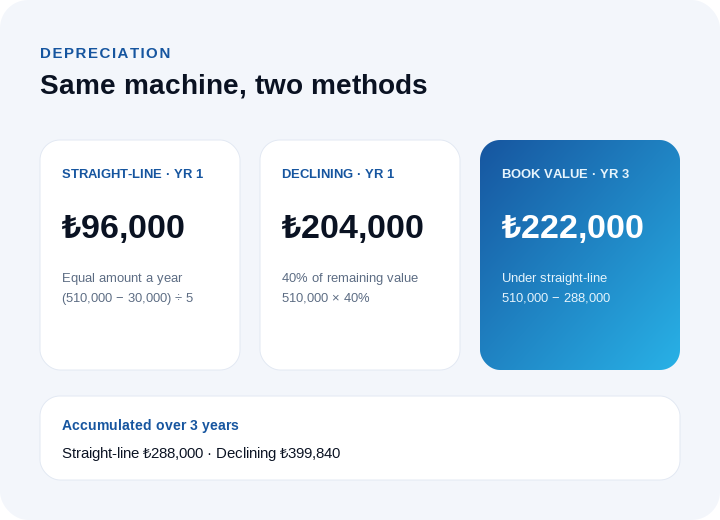
| Year | Straight-line depreciation | Straight-line book value | Declining balance depreciation (40%) | Declining balance book value |
|---|---|---|---|---|
| 1 | ₺96,000 | ₺414,000 | ₺204,000 | ₺306,000 |
| 2 | ₺96,000 | ₺318,000 | ₺122,400 | ₺183,600 |
| 3 | ₺96,000 | ₺222,000 | ₺73,440 | ₺110,160 |
| 3-year total | ₺288,000 | — | ₺399,840 | — |
Check: ₺510,000 × 40% = ₺204,000; ₺306,000 × 40% = ₺122,400; ₺183,600 × 40% = ₺73,440. The year-one gap between the methods is ₺204,000 − ₺96,000 = ₺108,000; expense is spread differently across periods, but the total cost does not change. With declining balance, book value is not taken below the residual value.
If an asset is bought mid-year, the first period is calculated partially. In the straight-line example, capitalized on 1 April, the first year is 9 months × ₺8,000 = ₺72,000 and book value ₺438,000. In units of use, for a machine expected to run 400,000 hours, depreciation per hour is (₺510,000 − ₺30,000) ÷ 400,000 = ₺1.20; if it runs 3,000 hours in the year, the expense is ₺3,600. How depreciation is spread into product cost is covered in our product cost guide; here all that matters is that the depreciation amount is produced correctly.
How Are Barcodes, Tags and Custody Managed?
Every asset gets a unique tag number, printed as a barcode or QR code. Scanning the tag opens the asset card; counts, transfers and custody are done with the same scan. For code structures and reader options, see our barcode system guide.
Custody is the record of which person an asset was handed to. A good custody record carries:
- Handover: Date, who handed over, who received, and the asset's condition at handover.
- Return or transfer: Offboarding is not complete until the leaver's custody list is closed.
- Acknowledgement: The receiver's acceptance, by paper signature or on-screen approval.
- Transfer: When the site, room or person changes, a dated new record is opened; the old one is not deleted, so the history can be traced and cost lands in the right place.
Loss and damage need a written process too: report, review, approval and booking. For the legal side of liability and compensation, consult your legal adviser.
How Is the Annual Count Done and How Are Differences Read?
An asset count is unlike a stock count: what is counted is individually identified, long-lived assets, and the asset itself is verified rather than a quantity. For stock counting methods, see our inventory counting guide; here one-by-one matching and custody checks come to the front.
Illustrative example: 200 recorded assets, total cost ₺8,300,000 and total book value ₺4,800,000. The count result:
| Result | Count | Share (of 200 records) | Action |
|---|---|---|---|
| Matches the record (location and holder correct) | 178 | 89.0% | Close |
| Found, location or custody differs | 12 | 6.0% | Correct the transfer record |
| Not found | 10 | 5.0% | Investigate, loss entry |
| Unrecorded asset found | 5 | off-record | Trace the source, create a card |
178 + 12 + 10 = 200 records; assets physically found are 178 + 12 + 5 = 195. Record accuracy is 178 ÷ 200 = 89.0%. The book value of the 10 missing assets: 6 computers × ₺8,000 + 3 pieces of furniture × ₺6,000 + 1 measuring device at ₺30,000 = ₺48,000 + ₺18,000 + ₺30,000 = ₺96,000, which is ₺96,000 ÷ ₺4,800,000 = 2.0% of total book value. How a lost asset is reflected in the books, and its tax result, should be asked of your accountant.
The source of the gap is often an unrecorded transfer. So treat the count not as an annual "penalty" but as a measure of record quality, and track it with a target such as accuracy above 95%.
How Are Book Value and Gain or Loss on Disposal Calculated?
Book value = cost − accumulated depreciation. When an asset is sold, the sale price is compared with book value: if the price is higher there is a gain, if lower a loss.
The sample machine has a book value of ₺222,000 after three years on the straight-line method. If sold on the market for ₺260,000, the gain is ₺260,000 − ₺222,000 = ₺38,000; if sold for ₺180,000, the loss is ₺180,000 − ₺222,000 = −₺42,000. A low book value does not mean the asset has no value left; market value and book value are separate concepts. In disposal, the asset card is closed, depreciation stops, the tag is cancelled and the sales invoice is matched with the record. Work through the tax and reporting side with your accountant.
How Is the Maintenance Record Linked to the Asset?
If maintenance and breakdown history is linked to the asset card, "repair or replace" is decided with numbers. For maintenance plans, fault records and spare parts, see our maintenance management software guide.
Illustrative decision: if the old machine's yearly maintenance is ₺110,000 and breakdown downtime loss is ₺40,000, its yearly cost is ₺150,000. If the new machine's yearly depreciation is ₺96,000 and maintenance ₺20,000, its cost is ₺116,000. The difference ₺150,000 − ₺116,000 = ₺34,000 favours the new machine. The old machine's book value plays no part in the decision; money already spent does not change today's choice, only the cost from here on matters.
How Is Depreciation Expense Seen at Portfolio Level?
The class-level total matters as much as a single asset. In the illustrative table below, 200 assets are grouped with the straight-line method and company-policy example lives.
| Class | Count | Cost | Life (example) | Annual depreciation |
|---|---|---|---|---|
| Computers and phones | 80 | ₺1,600,000 | 4 years | ₺400,000 |
| Furniture and office | 70 | ₺700,000 | 10 years | ₺70,000 |
| Machinery and equipment | 30 | ₺3,000,000 | 8 years | ₺375,000 |
| Vehicles | 20 | ₺3,000,000 | 5 years | ₺600,000 |
| Total | 200 | ₺8,300,000 | — | ₺1,445,000 |
₺1,445,000 a year means ₺1,445,000 ÷ 12 ≈ ₺120,417 a month. Vehicles are 10% of the count (20 ÷ 200) yet make up 41.5% of annual expense (₺600,000 ÷ ₺1,445,000); this is how a management report shows which class drives expense.
How Quickly Does Moving from a Spreadsheet to Fixed Asset Software Pay Back?
Most businesses keep the register in a spreadsheet; the trigger for change is usually count differences and manual depreciation. We covered the general frame of moving from sheets to a system in our moving from Excel to software guide. Let us compute payback under the illustrative assumptions below.
- Migration effort: 200 assets × 15 min (card, photo, tag) = 3,000 min = 50 h × ₺300 = ₺15,000.
- Investment: Software setup ₺120,000; with migration effort, the start-up cost is ₺120,000 + ₺15,000 = ₺135,000. Annual running cost ₺12,000.
- Count time: With a sheet 200 × 6 min = 20 h; with barcodes 200 × 1.5 min = 5 h. Saving 15 h × ₺300 = ₺4,500 a year.
- Depreciation calculation: Manually 3 h a month (36 h a year), with the system 0.5 h a month (6 h a year). Saving 30 h × ₺300 = ₺9,000 a year.
- Lost assets: If ₺96,000 a year is assumed, a 60% reduction with proper tracking = ₺57,600 a year.
Annual gross benefit is ₺4,500 + ₺9,000 + ₺57,600 = ₺71,100; after the running cost the net is ₺59,100, or ₺4,925 a month. Payback: ₺135,000 ÷ ₺4,925 ≈ 27.4 months.
Sensitivity: if the loss reduction is only 30% (₺28,800), net benefit is ₺28,800 + ₺4,500 + ₺9,000 − ₺12,000 = ₺30,300 a year, ₺2,525 a month, and payback is ₺135,000 ÷ ₺2,525 ≈ 53.5 months. Most of the gain comes from the lost-asset line; if your losses are small, payback gets longer. When deciding between ready-made and custom, our software license guide helps with the licensing structure.
How Is Fixed Asset Management Set Up in Six Steps?
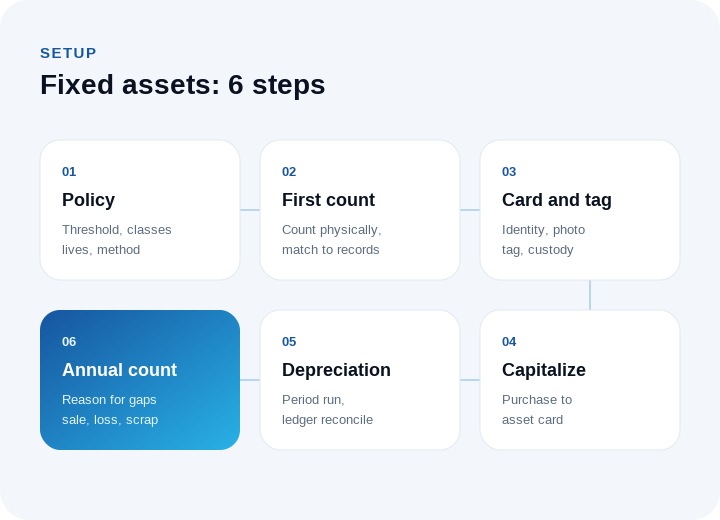
- Policy: Write down which items count as assets, the classes, the depreciation method and the lives; have it confirmed by your accountant.
- First count: Count what you have physically and match it to existing records; do not move to a system before closing the differences.
- Asset card and tag: Identity, photo, tag and custody record for every asset.
- Capitalization flow: The asset card should arise from purchase approval, goods receipt and invoice; no manual re-entry should remain.
- Depreciation and ledger: Run period-end calculation in the system and reconcile with the accounting entry.
- Annual count and disposal: Count every year; define an approved process for sale, loss and scrapping.
What Are Common Mistakes in Fixed Asset Management?
- Untagged assets: An asset with no serial number or tag does not match at the count.
- Not recording transfers: If a change of site or person is not booked, the annual gap grows.
- Depreciating a lost asset: An asset that cannot be found keeps depreciating without review.
- Expensing assets and capitalizing supplies: If the policy threshold is unclear, items are classified wrongly.
- Knowledge tied to one person: The sheet stays on one person's computer and the record decays when they leave.
- Keeping accounting and physical records apart: The ledger and the inventory never check each other.
We recommend reading: How to track customer accounts: due dates, risk limits and collection guide
We recommend reading: What Is Fleet Management Software? Vehicle Records, Fuel Deviation, Cost per Km and Replacement Guide
We recommend reading: How to Speed Up the Month-End Close: Calendar, Checklist and Automatic Reconciliation Guide
Custom Software and Accounting Processes with İnovabil
At İnovabil our focus is custom software built from scratch for the company: custom software, ERP, CRM, e-commerce, web, mobile and integration. We do not claim a ready-made fixed asset product; we suggest writing your asset, custody and depreciation expectations down in the requirements stage and comparing a ready-made solution, an ERP module and custom software in writing.
We built CRM, purchasing and mobile for Avcılar İnşaat; a purchasing system for İZBAN; logistics and shipment planning with wholesale order management for Karyak; and warehouse management plus a complaint and support management system for Sleepy. Send a short summary of your asset count, classes and current record-keeping, and we will assess it together and produce a written scope.
We recommend reading: Our software development process: from analysis to launch, step by step
Frequently Asked Questions
What is fixed asset management, in short?
It is keeping the record, location, custody and loss of value of long-lived assets such as machines, vehicles and computers in one consistent system. It reduces count differences and produces depreciation accurately and regularly.
Is a fixed asset the same as office equipment?
In everyday language they are often used interchangeably. In accounting, a fixed asset is an item that meets certain conditions and is capitalized; which item counts as which depends on policy and regulation, so confirm it with your accountant.
What is the difference between straight-line and declining balance?
In straight-line the same amount is expensed every year. In declining balance the early years are high and later years lower. In the example, year-one expense ranges from ₺96,000 to ₺204,000; over three years the totals are ₺288,000 and ₺399,840, while over the whole life total expense is capped by the depreciable amount under either method. Ask your accountant which method is allowed.
How often should an asset count be done?
Most businesses do a full count once a year; high-value or high-movement assets may also get a partial count. If there are legal count obligations, confirm them with your accountant. What matters is recording the reason for each difference.
Is a spreadsheet enough for fixed asset management?
For a small number of assets it is. As assets, sites or custody movements grow, tags, transfer history and depreciation reconciliation get harder in a sheet. In the 200-asset example payback came out between 27 and 54 months depending on the lost-asset line; recompute with your own figures.